Facts
Respondent No. 2 claimed that she married the petitioner in August 2012 and that Respondent No. 3 was born from the marriage. She sought maintenance for herself and the minor child under Section 125 of the Code of Criminal Procedure, 1973, alleging dowry demands, an attempt on her life, and the petitioner’s subsequent marriage to another woman.
Source reference: p. 2, para. 3The Family Court initially dismissed the maintenance case on 4 May 2019, holding that Respondent No. 2 had failed to prove that she was the petitioner’s legally married wife.
Source reference: p. 2, para. 3In Criminal Revision No. 1589 of 2019, the High Court set aside the dismissal order, declared Respondent No. 2 to be the petitioner’s legally married wife, and remanded the matter to the Family Court for adjudication of the quantum of maintenance on the basis of the material available on record.
Source reference: p. 2, para. 3On remand, the Family Court directed the petitioner to pay monthly maintenance of ₹10,000 to Respondent No. 2 and ₹4,000 to Respondent No. 3 from 22 July 2013, the date of filing of the maintenance petition, with arrears payable in equal instalments over two years.
Source reference: p. 2, para. 2Issues
Whether the Family Court exceeded the scope of the High Court’s remand order by reconsidering matters relating to the marital status and entitlement of Respondent No. 2 instead of limiting its consideration to the quantum of maintenance.
Source reference: p. 3, para. 4Whether the Family Court’s award of ₹10,000 per month to Respondent No. 2 and ₹4,000 per month to Respondent No. 3, from the date of filing of the maintenance petition, suffered from any impropriety, infirmity, or illegality warranting interference in revision.
Source reference: p. 5, para. 7Law Applied
The Court applied Section 125 of the Code of Criminal Procedure, 1973, which empowers a Magistrate or competent court to award maintenance to a wife and minor child unable to maintain themselves, subject to the statutory requirements.
Source reference: no citationIt further applied the procedural principle governing remand: where a matter is remanded for determination of a particular issue, the subordinate court must comply with the remand direction.
Source reference: no citationHowever, determination of the quantum of maintenance necessarily requires consideration of the evidence and circumstances relevant to the parties’ entitlement, financial capacity, and appropriate amount of maintenance; such consideration cannot take place in a factual vacuum.
Source reference: p. 5, para. 7Reasoning
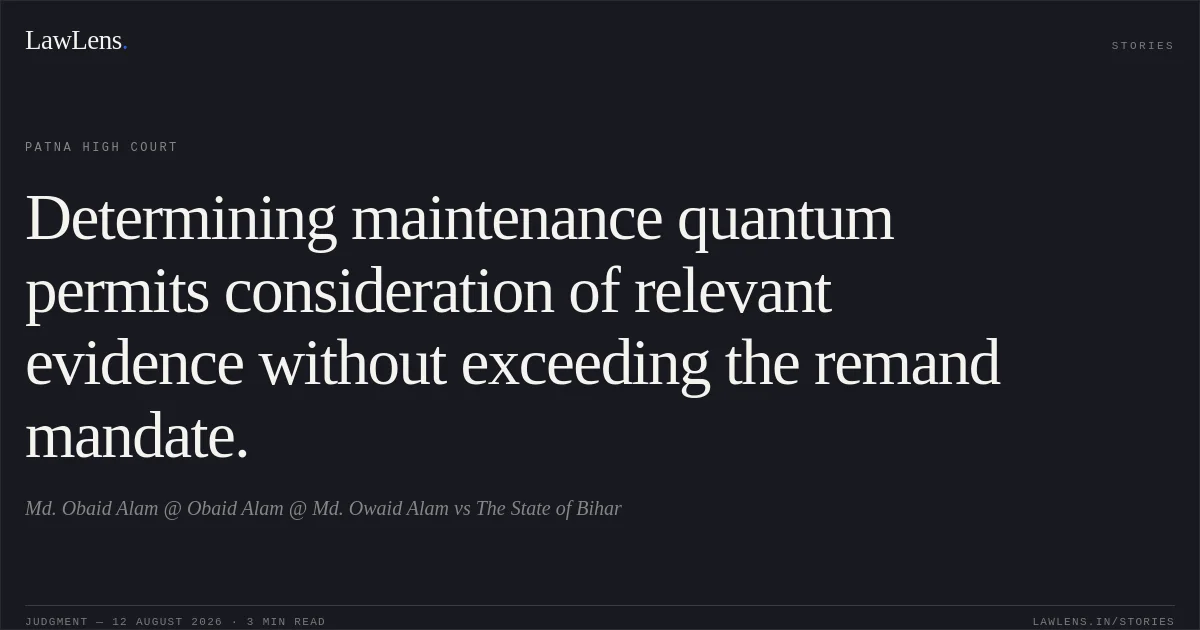
The High Court held that the Family Court did not improperly travel beyond the remand order. Although the earlier order had directed the Family Court to determine the quantum of maintenance, that determination necessarily required examination of the evidence and material bearing on the parties’ circumstances and the appropriate amount payable.
Source reference: p. 5, para. 7The Family Court had already been directed to proceed on the basis of the finding that Respondent No. 2 was the petitioner’s legally married wife, and its consideration of the evidence while fixing maintenance did not amount to an impermissible reopening of that issue.
Source reference: p. 5, para. 7The High Court found that the Family Court passed a reasoned order after considering the available evidence and that the petitioner could not dictate the manner in which the Family Court was required to reach its conclusion.
Source reference: p. 5, para. 7Holding
The Court answered the issues against the petitioner. It held that the Family Court acted within the scope of the remand order and that its order awarding ₹10,000 per month to Respondent No. 2 and ₹4,000 per month to Respondent No. 3 from 22 July 2013, with arrears payable in equal instalments over two years, disclosed no impropriety, infirmity, or illegality.
The criminal revision petition was accordingly dismissed for lack of merit.
Source reference: p. 5, para. 8Acts & Sections Cited
1 provisions across 1 statute referred to in this judgment. Each provision opens on LawLens.
Code of Criminal Procedure, 19731
Original Court PDF
Md. Obaid Alam @ Obaid Alam @ Md. Owaid AlamvsThe State of Bihar
Click to open original judgment
Original judgment, available to read, download and summarize on LawLens.in