Facts
M/s Hatkesh Builders, owned by Respondent No. 1, developed and sold approximately 72 industrial units on land at Village Ghodbunder, Thane, from 1979–80 onwards.
Source reference: paras. 2–3The purchasers subsequently formed Hatkesh Udyog Nagar Industrial Premises Co-operative Housing Society Ltd., which was registered on 11 November 2008.
Source reference: paras. 2–3Respondent No. 1 later sought de-registration under Section 21A of the Maharashtra Co-operative Societies Act, 1960 (“MCS Act”), alleging that the Society’s registration had been obtained through forged, altered and misleading documents, including documents concerning different survey numbers and allegedly unauthorised construction.
Source reference: paras. 4, 9, 18The Divisional Joint Registrar allowed the application and cancelled the Society’s registration on 15 July 2024; the Minister (Co-operation) dismissed the Society members’ appeal on 23 June 2025.
Source reference: paras. 5–6The members challenged both orders before the High Court.
Source reference: paras. 5–6The Court noted that Respondent No. 1 had himself developed and sold the units, had represented that the construction was pursuant to sanctioned plans and had promised formation of a co-operative society, while later relying upon alleged irregularities in the construction to seek de-registration.
Source reference: paras. 22–32It also found that he had knowledge of the Society’s registration by March 2010 but did not challenge the registration under Section 152 of the MCS Act.
Source reference: paras. 34–36Issues
Whether the power of de-registration under Section 21A of the MCS Act could be exercised on the basis of alleged discrepancies, incomplete information, construction irregularities and subsequent events, without establishing a root-level misrepresentation that induced registration of the Society.
Source reference: paras. 10–13, 45–46Whether alleged illegality or irregularity in the construction of the industrial units could constitute a ground for de-registration of the Society under Section 21A of the MCS Act.
Source reference: paras. 39–44Whether Respondent No. 1, having himself developed and sold the units and allegedly failed to secure the requisite permissions, could seek de-registration so as to benefit from his own wrong.
Source reference: paras. 36–38, 47–48Whether the orders dated 15 July 2024 and 23 June 2025 directing and confirming de-registration were legally sustainable.
Source reference: para. 49Law Applied
Section 21A(1) of the MCS Act permits de-registration only where the Society was registered on misrepresentation by the applicants, its work is complete or exhausted, its purposes are not served, or—subject to the statutory condition—the Society uses a prohibited banking-related name; the power is therefore narrower than the appellate remedy under Section 152 against the original registration order.
Source reference: paras. 11–13“Misrepresentation” under Section 21A must relate to information or documents submitted at the time of registration, must be false, forged or fabricated, and must be of such a nature that, without it, the Society would not have been registered; mere inaccurate, incomplete or subsequently disproved information is insufficient.
Source reference: para. 12, quoting Elite Diagnostic Center Pvt. Ltd. v. Krishna Kunj Co-operative Housing Society Ltd.The Registrar cannot exercise Section 21A as an appellate power or revisit extraneous matters relating to the legality of construction.
Source reference: paras. 12–13In Sukhsagar Co-operative Housing Society Ltd. v. State of Maharashtra , 2004 (3) Mh.L.J. 1010, and Airoli Neha Apartments Co-operative Housing Society Ltd. v. State of Maharashtra , 2023 (3) Mh.L.J. 529, the Court held that construction legality, development permission and occupation or completion certificates are matters for the planning authority and are not grounds to refuse registration or de-register a Society.
Source reference: paras. 39–43Reasoning
The Court held that the authorities had treated Section 21A as an appellate mechanism and had principally relied on absence of development or NA permission, alleged unauthorised construction, variation in the number of units, use of whitener on documents, non-compliance with MOFA and rejection of deemed conveyance—matters which either concerned construction legality, subsequent events or were otherwise extraneous to the statutory test under Section 21A.
Source reference: paras. 15–17, 44–46Although discrepancies appeared in certain documents, the Court found that the legality of construction was not essential to registration of a society formed for collective management of industrial units; hence, any deficiency in establishing construction legality could not demonstrate that registration would not have occurred without the alleged statements.
Source reference: paras. 40–41Further, the alleged construction and permission irregularities were attributable principally to Respondent No. 1, who had developed and sold the units, represented that they were constructed under sanctioned plans and delayed formation of the promised Society.
Source reference: paras. 24–32Permitting him to obtain de-registration on the basis of those very irregularities would allow him to benefit from his own wrong and would undermine the collective management of premises that had been registered as a Society for 18 years.
Source reference: paras. 36–38, 47–48The appropriate remedy against the original registration, if available, was an appeal under Section 152, not the exceptional power under Section 21A.
Source reference: paras. 10–11Holding
The High Court answered the issues in favour of the Petitioners.
It held that the alleged discrepancies and construction irregularities did not establish the statutory misrepresentation required under Section 21A and could not justify de-registration.
Source reference: paras. 38, 43, 48Respondent No. 1 could not invoke those irregularities, for which he was substantially responsible, to secure an advantage against the Society.
Source reference: paras. 38, 43, 48The Court accordingly set aside the Divisional Joint Registrar’s order dated 15 July 2024 and the Minister’s order dated 23 June 2025, dismissed Respondent No. 1’s de-registration application, allowed the writ petition and made no order as to costs.
Source reference: paras. 49–50Original Court PDF
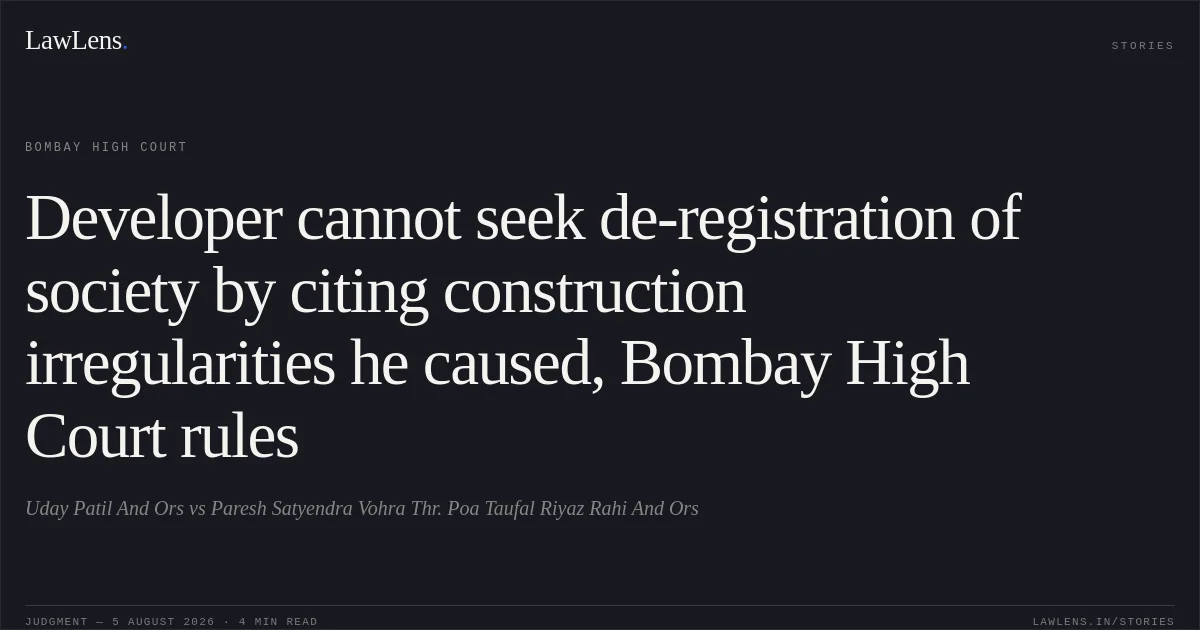
Uday Patil And OrsvsParesh Satyendra Vohra Thr. Poa Taufal Riyaz Rahi And Ors
Click to open original judgment
Original judgment, available to read, download and summarize on LawLens.in