Facts
The writ petitioner, Respondent No.7, claimed ownership over Sy. No.36, measuring 19 acres 19 guntas at Badepur Village, having purchased it from Smt. Mahadevi under a registered sale deed dated 17 March 1975. Khajasab filed Form No.7 under the Karnataka Land Reforms Act, 1961 (“KLR Act”) seeking occupancy rights over the land. Although the Land Tribunal initially granted occupancy rights to Khajasab on 29 March 1989, that order was set aside in an earlier writ petition and the matter was remanded. Upon fresh enquiry, the Tribunal rejected Khajasab’s claim on 27 May 2004; the challenge to that rejection was dismissed by the High Court, the writ appeal, and ultimately the Special Leave Petition on 30 March 2015.
Source reference: paras. 3–4The writ petitioner subsequently sought possession from the Deputy Commissioner and filed W.P. No.205975/2014 when no action was taken. The learned Single Judge treated the matter as one falling under Section 41(2) read with Section 130 of the KLR Act and directed the Deputy Commissioner, Tahsildar, Gulbarga City Corporation and Gulbarga Urban Development Authority to evict the occupants and deliver possession to the writ petitioner within six months.
Source reference: paras. 4, 7The appellants, who were among the contesting respondents, asserted that they were individual purchasers of residential sites in a converted layout, had constructed houses pursuant to approvals and building licences, and were not Khajasab or persons claiming through him. More than 500 residential buildings were stated to exist on the property.
Source reference: paras. 6, 12, 14The Division Bench also noted that the original writ petition had sought relief under Sections 39 and 104 of the Karnataka Land Revenue Act, 1964 (“KLR Act, 1964”), whereas reliance on Section 41 of the KLR Act was introduced without appropriate amendment to the pleadings.
Source reference: para. 20Issues
Whether a writ of mandamus directing eviction under Section 41(2) read with Section 130 of the KLR Act could be issued without establishing that the writ petitioner had filed an application in the prescribed form and within the statutory period of two years?
Source reference: paras. 16–19, 24Whether Section 41(2) of the KLR Act authorises the Tahsildar, through summary proceedings, to evict third-party occupants who were neither the tenant who filed Form No.7 nor persons whose relationship of landlord and tenant with the writ petitioner had been adjudicated?
Source reference: paras. 21–28Whether the writ petitioner could obtain relief under Section 41 of the KLR Act when the original prayer was founded on Sections 39 and 104 of the KLR Act, 1964, without amending the writ petition and prayer?
Source reference: para. 20Law Applied
Section 41 of the KLR Act provides a procedure for obtaining possession after a tenant or landlord has finally succeeded in proceedings under the Act; Section 41(2) specifically requires a successful landlord to apply to the Tahsildar in the prescribed form within two years from accrual of the right to possession, while Section 41(3) contemplates an inquiry and order by the Tahsildar.
Source reference: paras. 8, 26Section 130 permits summary proceedings only within the limited statutory framework and cannot be used to decide disputed title or complex possession claims involving third parties.
Source reference: paras. 7, 26–29Sections 39 and 104 of the KLR Act, 1964 concern eviction pursuant to an existing competent order and summary eviction from unauthorised occupation of public land, respectively.
Source reference: para. 20A writ of mandamus lies only to enforce an established legal or statutory duty owed to the petitioner, as explained in Hari Krishna Mandir Trust v. State of Maharashtra, (2020) 9 SCC 356.
Source reference: para. 19The Court distinguished Abbubaker Beary v. Tahsildar, ILR 1992 KAR 1779, because it concerned eviction of the tenant who had unsuccessfully claimed occupancy rights, and distinguished Ni Pra Channabasava Deshikendra Swamigalu Matadhipathigalu Kannada Mutt v. C.P. Kaveeramma, (2013) 16 SCC 565, because it did not concern eviction of independent third-party occupants.
Source reference: paras. 9–10, 22Revenue authorities cannot adjudicate disputed questions of title, consistent with Smt. Jayamma v. State of Karnataka, ILR 2020 KAR 1449.
Source reference: para. 24Any eviction involving civil consequences must comply with natural justice and provide a reasonable opportunity of hearing, as reaffirmed in D.K. Yadav v. J.M.A. Industries Ltd., (1993) 3 SCC 259.
Source reference: paras. 27–28Reasoning
The Division Bench held that the learned Single Judge could not have issued mandamus without first verifying whether the writ petitioner had filed the prescribed application under Section 41(2) within two years. The alleged requisition dated 19 May 2015 and an unacknowledged Form No.5 were produced only after the appeals had been reserved, and the writ petitioner had not placed the asserted application before the learned Single Judge.
Source reference: paras. 16–18Further, the relief granted was materially different from the original prayer under Sections 39 and 104 of the KLR Act, 1964; the respondents could not be taken by surprise by introducing Section 41 proceedings without amendment.
Source reference: para. 20More importantly, Section 41(2) presupposes a final adjudication between the landlord and the tenant who had claimed occupancy rights. Khajasab was the person who filed Form No.7, whereas the appellants were independent site purchasers who claimed possession under registered instruments and approvals. They were neither the applicant before the Land Tribunal nor parties to an adjudicated landlord–tenant dispute with the writ petitioner.
Source reference: paras. 23, 26The limited summary inquiry contemplated under Section 41 could therefore not be expanded into a proceeding for determining the rights and title of more than 500 households. Eviction in such circumstances would raise substantial disputed questions of title and possession and could not lawfully occur without a full hearing before a competent civil court.
Source reference: paras. 27–29Holding
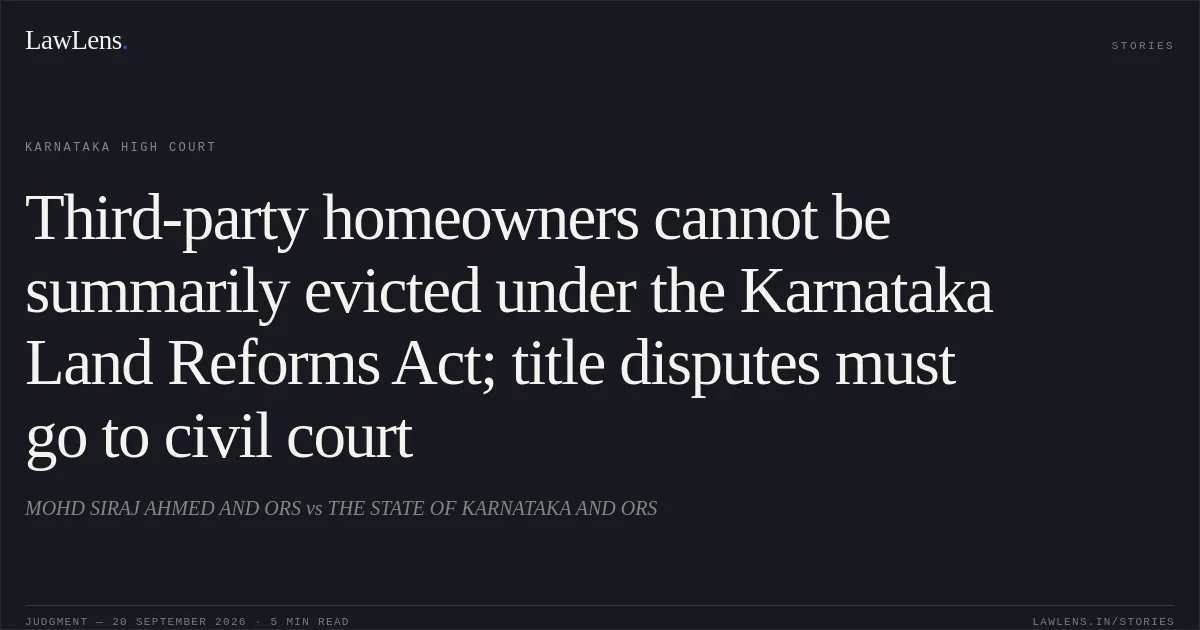
The Court answered the issues against the writ petitioner. Section 41(2) of the KLR Act could not be invoked through summary proceedings to evict the appellants, who were third-party occupants whose rights had never been adjudicated and who were not the tenant who had filed Form No.7.
The learned Single Judge’s order dated 11 December 2019 was set aside, the writ appeals were allowed, and W.P. No.205975/2014 was dismissed.
Source reference: para. 31The Court clarified that the writ petitioner’s claim for eviction, if otherwise maintainable, must be pursued before a competent civil court rather than through proceedings before the Tahsildar under the KLR Act or the KLR Act, 1964.
Source reference: paras. 28–29Acts & Sections Cited
4 provisions across 3 statutes referred to in this judgment. Each provision opens on LawLens.
KARNATAKA HIGH COURT ACT, 19611
KARNATAKA LAND REFORMS ACT, 19612
KARNATAKA CERTAIN INAMS ABOLITION ACT, 19771
Original Court PDF
MOHD SIRAJ AHMED AND ORSvsTHE STATE OF KARNATAKA AND ORS
Click to open original judgment
Original judgment, available to read, download and summarize on LawLens.in