Facts
The Enforcement Officer found that Genisys was remitting provident-fund contributions only on a small component described as “basic wages”, while treating a substantial portion of employee remuneration as “other earnings”, including special allowance, commission, bonus and conveyance allowance. Proceedings under Section 7A of the Employees’ Provident Funds and Miscellaneous Provisions Act, 1952 (“EPF Act”) were initiated for the period April 2010 to September 2014.
Source reference: pp.6–8, paras.7.1–7.2The Regional Provident Fund Commissioner (“RPFC”) held that the establishment’s wage structure was designed so that 60–70% of wages were classified as allowances, many of which were paid universally and ordinarily to employees. It assessed additional provident-fund liability of ₹2,86,16,453 on special allowance, commission, bonus and conveyance allowance, subject to the applicable statutory wage ceilings.
Source reference: pp.8–10, para.7.3Before the Central Government Industrial Tribunal-cum-Labour Court, the establishment admitted liability on special allowance but disputed liability on commission, bonus and conveyance allowance. The Tribunal held that bonus and conveyance allowance were excluded from “basic wages”, but confirmed the liability on special allowance and commission, limited to the statutory ceilings, and directed the RPFC to recalculate the dues.
Source reference: pp.10–15, paras.7.4–7.7The establishment challenged the inclusion of commission, while the RPFC challenged the Tribunal’s exclusion of bonus and conveyance allowance. The establishment also contended that, because of substantial employee attrition, the assessment could not be made in respect of unidentified employees.
Source reference: pp.17–20, para.10Issues
Whether the commission paid by the establishment constituted “basic wages” under Section 2(b) of the EPF Act and was therefore liable to provident-fund contribution.
Source reference: pp.13–16, paras.7.6–7.7; pp.23–25, paras.17–19Whether the Tribunal was justified in excluding bonus and conveyance allowance from the computation of provident-fund contributions.
Source reference: pp.10–15, paras.7.4–7.7Whether the provident-fund dues could be determined without identifying the employees to whom the assessed contributions related.
Source reference: pp.17–20, para.10; pp.25–26, paras.19–21Whether the RPFC was required to undertake a fresh calculation after identifying the employees concerned and verifying their entitlement.
Source reference: pp.25–27, paras.20–22Law Applied
The Court applied Sections 2(b) and 6 of the EPF Act, under which “basic wages” include emoluments earned by an employee while on duty, leave or holidays with wages, subject to specified exclusions, and provident-fund contributions are payable on the statutory wage components.
Source reference: no citationRelying principally on Regional Provident Fund Commissioner v. Vivekananda Vidyamandir, the Court held that an allowance which is universally, ordinarily and necessarily paid to employees, and which is not genuinely linked to extra work, enhanced production or a special opportunity, may be treated as basic wages if it is merely a camouflage to avoid provident-fund contributions.
Source reference: pp.20–22, para.13The Court also considered Bridge & Roof Co. Ltd. v. Union of India, The Daily Pratap v. Regional Provident Fund Commissioner, Food Corporation of India v. Regional Provident Fund Commissioner, Himachal Pradesh State Forest Corporation v. Regional Provident Fund Commissioner and Builder Association of India v. Union of India.
Source reference: pp.16–20, paras.9–10These authorities establish that genuinely variable incentive payments linked to additional production may fall outside basic wages, but that assessments must be based on identifiable employees whose contributions can actually be credited to their provident-fund accounts.
Source reference: pp.22–26, paras.15–20Reasoning
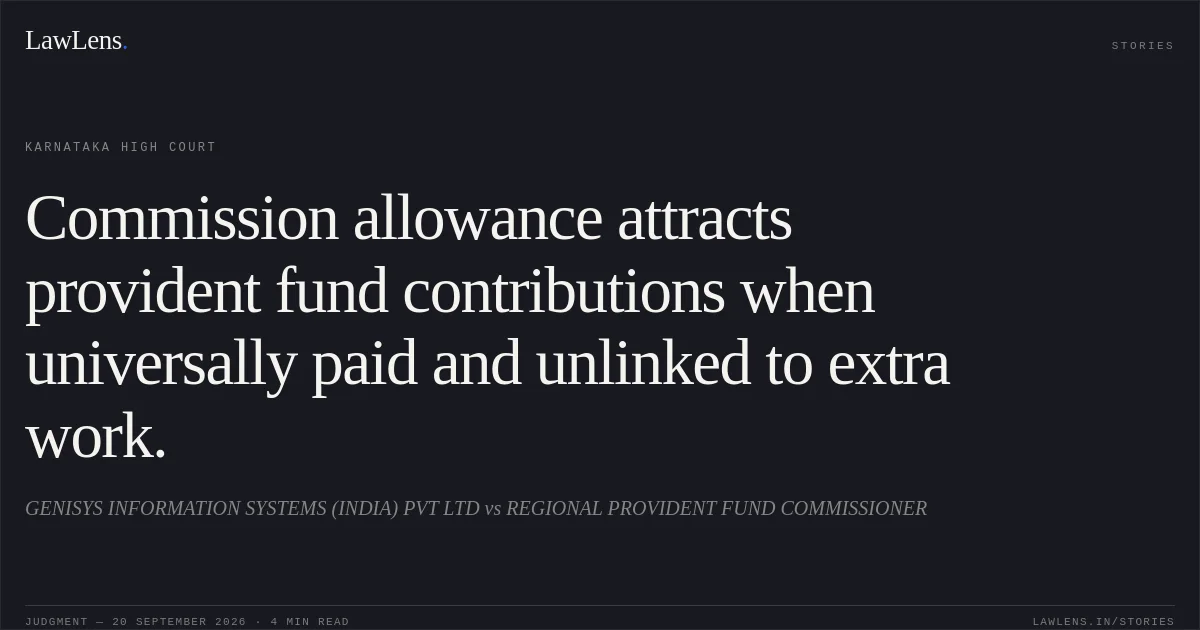
The Court found that the establishment had not produced evidence showing that the commission was genuinely linked to additional work, the number of calls attended, enhanced output or any special opportunity availed by an employee. The commission was predetermined in the appointment structure, was paid even for weekly holidays and national holidays, and was not shown to depend upon actual performance during working hours.
Source reference: pp.23–25, paras.17–18Accordingly, its nomenclature as “commission” did not exclude it from basic wages; on the facts, it was remuneration ordinarily and universally paid and therefore attracted provident-fund contribution under Section 2(b).
Source reference: pp.21–25, paras.14–18The Court did not disturb the Tribunal’s finding that bonus and conveyance allowance were excluded components. It also noted that the establishment had admitted liability in respect of special allowance.
Source reference: pp.10–15, paras.7.4–7.7However, the Court accepted the establishment’s contention that the dues relating to commission had to be determined with reference to identifiable employees. Since the establishment had shown substantial attrition—from 1,843 employees in April 2010 to 506 employees in September 2014—the RPFC was required to verify the identity and entitlement of the employees concerned before finalising the assessment. This was necessary to ensure that the recovered contribution actually benefited the relevant employees.
Source reference: pp.25–26, paras.19–20Holding
The Court upheld the Tribunal’s finding that commission, as paid by Genisys in the circumstances of the case, formed part of basic wages and was subject to provident-fund contribution.
The Tribunal’s exclusion of bonus and conveyance allowance was left undisturbed, and the establishment’s admission regarding special allowance was recognised.
Source reference: pp.25–26, paras.18–21The RPFC was directed to conduct a fresh inquiry to identify the employees on the establishment’s rolls during the relevant period and to redo the calculation of provident-fund dues on the commission allowance after notifying Genisys and considering the material on record.
Source reference: pp.26–27, paras.20–22The connected writ petitions were accordingly disposed of with these directions.
Source reference: no citationActs & Sections Cited
3 provisions across 1 statute referred to in this judgment. Linked provisions open on LawLens.
Employees’ Provident Funds And Miscellaneous Provisions Act, 19523
Original Court PDF
GENISYS INFORMATION SYSTEMS (INDIA) PVT LTDvsREGIONAL PROVIDENT FUND COMMISSIONER
Click to open original judgment
Original judgment, available to read, download and summarize on LawLens.in