Facts
Munnalal, a Patwari posted at Patwari Halka No. 31, Khurai, was accused of demanding ₹450/₹500 from Veer Singh for issuing a duplicate Bhu-Adhikar Evam Rin Pustika.
Source reference: pp.1–6, paras.1–6Veer Singh alleged that he paid ₹150 initially and agreed to pay ₹300 later; he thereafter approached the Lokayukt authorities and lodged complaints.
Source reference: pp.1–6, paras.1–6On 17 October 1996, a trap was conducted, during which ₹300 in phenolphthalein-treated currency notes were recovered from Munnalal’s shirt pocket, and phenolphthalein traces were detected on his hands and shirt.
Source reference: pp.1–6, paras.1–6Relevant documents, including an incomplete Rin Pustika, were also recovered from his residence.
Source reference: pp.1–6, paras.1–6The prosecution obtained sanction and charged him under Sections 7 and 13(1)(d) read with Section 13(2) of the Prevention of Corruption Act, 1988.
Source reference: pp.1–6, paras.1–6The Special Judge, Sagar, acquitted him on 19 December 1997, finding that the prosecution had failed to establish the demand for illegal gratification and that the defence version—that the amount related to outstanding government dues—was reasonably probable.
Source reference: pp.1–6, paras.1–6The State appealed against the acquittal.
Source reference: pp.1–6, paras.1–6Issues
Whether Munnalal demanded ₹300 as illegal gratification, other than legal remuneration, from Veer Singh in connection with the issuance of a duplicate Bhu-Adhikar Evam Rin Pustika?
Source reference: p.7, para.8(i)Whether Munnalal obtained ₹300 as illegal gratification and thereby committed criminal misconduct under Section 13(1)(d) read with Section 13(2) of the Prevention of Corruption Act, 1988?
Source reference: p.7, para.8(ii)Whether the trial court’s judgment of acquittal was perverse, manifestly erroneous, or otherwise liable to appellate interference?
Source reference: p.7, para.8(iii)Law Applied
The Court applied Sections 7 and 13(1)(d) read with Section 13(2) of the Prevention of Corruption Act, 1988, in their applicable pre-amendment form.
Source reference: pp.11–12, para.13For Section 7, the prosecution had to prove that the accused was a public servant who accepted or obtained gratification other than legal remuneration as a motive or reward for an official act; Section 13(1)(d) required proof that he obtained a valuable thing or pecuniary advantage by corrupt or illegal means, abuse of office, or without public interest.
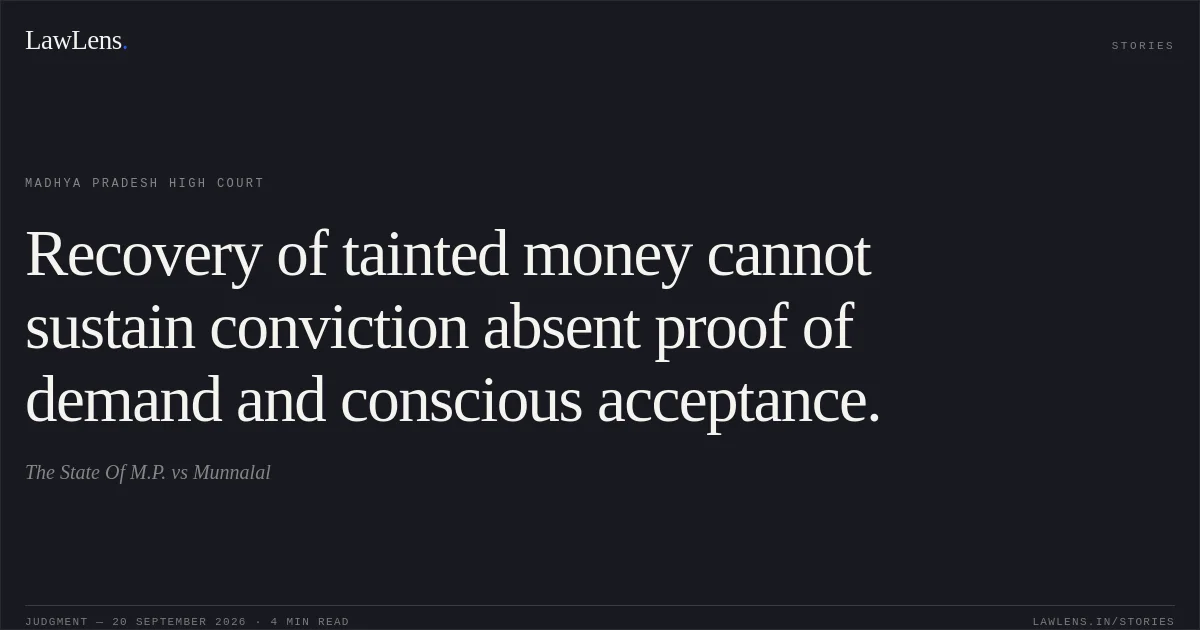
Source reference: pp.11–12, para.13Demand and acceptance or obtainment of illegal gratification are foundational requirements; mere recovery of tainted money is insufficient: C.K. Damodaran Nair v. Union of India, State of Kerala v. C.P. Rao, B. Jayaraj v. State of Andhra Pradesh, and P. Satyanarayana Murthy v. State of Andhra Pradesh.
Source reference: pp.12–14, paras.14–18Under Neeraj Dutta v. State (NCT of Delhi), demand and acceptance may be proved by direct, documentary, or circumstantial evidence, but the foundational facts must first be established; the presumption under Section 20 is mandatory only after proof of acceptance of illegal gratification and does not apply to Section 13(1)(d)(i) and (ii).
Source reference: pp.15–17, para.23Although the appellate court may reappreciate the evidence, interference is justified only for substantial and compelling reasons, and where two reasonable views are possible, the acquittal should ordinarily be upheld.
Source reference: pp.7–10, paras.9–11For circumstantial evidence, the circumstances must be fully established, conclusive, consistent only with guilt, and form a complete chain excluding reasonable hypotheses of innocence, as stated in Sharad Birdhichand Sarda v. State of Maharashtra.
Source reference: pp.17–18, para.24Reasoning
The Court found that recovery of the phenolphthalein-treated ₹300 and the positive chemical test were proved, but these circumstances did not independently establish a demand for or conscious acceptance of illegal gratification.
Source reference: pp.30–31, para.49Veer Singh’s testimony contained material inconsistencies regarding the amount allegedly demanded, the occasions of demand, and the persons present; the complaint referred to a demand of ₹450, whereas his deposition referred to ₹500.
Source reference: pp.19–20, paras.26–28The supporting witnesses either did not corroborate the prosecution case or indicated that the amount could have related to lawful government dues connected with boundary proceedings and issuance of the Rin Pustika.
Source reference: pp.22–26, paras.32–38The alleged tape-recorded conversation could not reliably corroborate demand because the original cassette was not produced or played, the accused’s voice was not identified, and the accuracy and absence of tampering were not proved.
Source reference: pp.26–27, paras.39–42Official revenue records and defence evidence established outstanding government dues of ₹325 plus interest, and the applicable procedure required their clearance before issuance of the duplicate document, thereby making the defence explanation reasonably probable.
Source reference: pp.28–30, paras.43–47Since the foundational facts necessary for invoking Section 20 were not proved beyond reasonable doubt, the statutory presumption could not be used to fill the evidentiary gap.
Source reference: p.30, para.48The trial court’s assessment was therefore a reasonable view of the evidence and was not perverse or unsustainable.
Source reference: pp.31–32, paras.51–53Holding
The Court answered Issues 1 and 2 in the negative, holding that the prosecution failed to prove beyond reasonable doubt that Munnalal demanded or accepted ₹300 as illegal gratification for issuing the duplicate Bhu-Adhikar Evam Rin Pustika.
It further held that the trial court’s acquittal was based on a proper appreciation of the evidence and did not disclose any compelling or substantial ground for appellate interference.
Source reference: pp.31–32, paras.51–53Accordingly, the State’s appeal was dismissed, the judgment of acquittal dated 19 December 1997 was affirmed, and the trial court record was directed to be remitted after necessary formalities.
Source reference: p.32, paras.53–55Acts & Sections Cited
6 provisions across 3 statutes referred to in this judgment. Each provision opens on LawLens.
Code of Criminal Procedure, 19732
Prevention of Corruption Act, 19883
Indian Penal Code, 18601
Original Court PDF
The State Of M.P.vsMunnalal
Click to open original judgment
Original judgment, available to read, download and summarize on LawLens.in