Facts
On 24 October 2024, the complainant, Satendra Pachouri, alleged that respondents Ashok, Shivam and Devesh Pachouri, accompanied by a juvenile co-accused, assaulted him and other intervening persons due to prior enmity.
Source reference: paras. 2–2.1The complainant alleged that Ashok struck him on the head with an axe, while the other accused used iron rods and other weapons; threats to kill were also allegedly extended.
Source reference: paras. 2–2.1An FIR was initially registered under Sections 109, 115(2), 351(2), 296 and 3(5) of the BNS, 2023.
Source reference: para. 2.1During investigation, CCTV footage, statements of independent witnesses, seizure material and medical evidence were collected.
Source reference: para. 2.1–2.3The medical query report described the complainant’s head injury as simple and caused by a hard and blunt object, while later medical documents allegedly indicated fractures.
Source reference: para. 2.1–2.3Section 109 was subsequently dropped, and Section 117(2) was added.
Source reference: para. 2.3The charge-sheet was filed for offences under Sections 115(2), 351(2), 296, 3(5) and 117(2) of the BNS.
Source reference: para. 2.3The Judicial Magistrate First Class framed charges under Sections 296, 115(2)/3(5), 117(2)/3(5) and 351(2) of the BNS, but not under Sections 109 or 118(2).
Source reference: para. 2.4The complainant challenged the non-framing of the graver charges in revision under Sections 397/401 read with Section 482 CrPC.
Source reference: para. 1Issues
Whether the material collected during investigation disclosed a prima facie case or grave suspicion sufficient to require framing of a charge under Section 109 of the BNS for attempt to murder?
Source reference: paras. 3–3.8, 9–12Whether the allegations concerning the use of an axe, iron rods and other weapons, together with the injuries sustained, warranted framing of a charge under Section 118(2) of the BNS for causing grievous hurt by dangerous means?
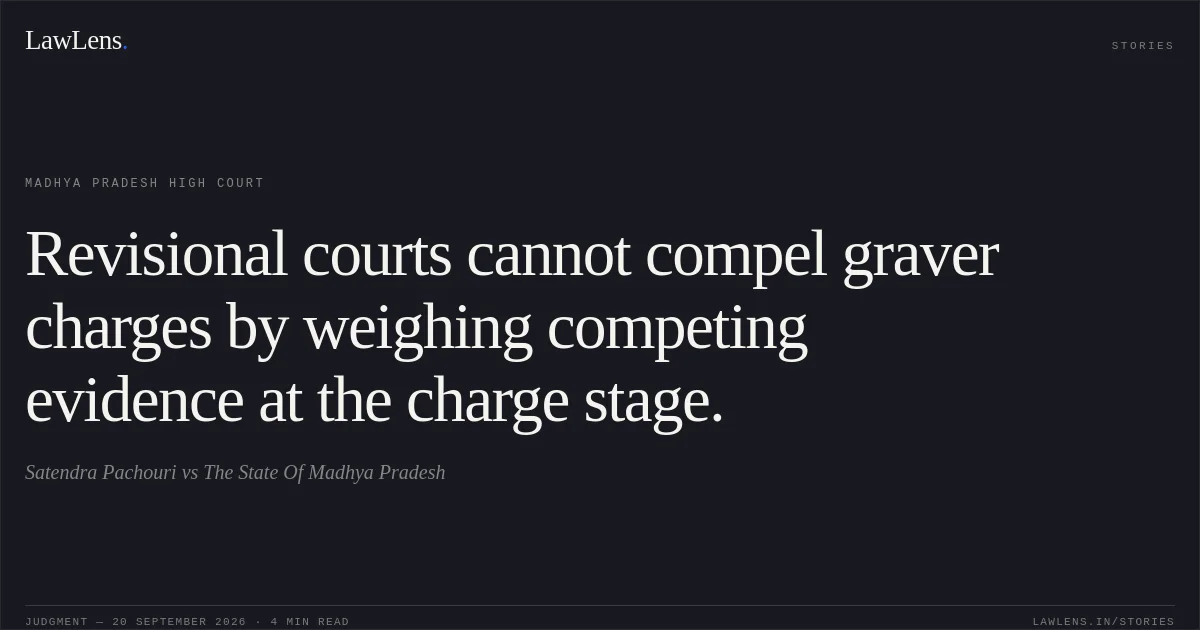
Source reference: paras. 3.1–3.3, 9–13Whether the revisional court should interfere with the Magistrate’s order where the material presented two competing factual versions and the Magistrate had adopted a plausible view?
Source reference: paras. 7–11, 14–16Law Applied
At the stage of framing of charge, the court must examine the police report and accompanying material to determine whether, taken at face value, they disclose the ingredients of the alleged offence or raise a grave and reasonable suspicion; the court must not conduct a mini-trial, assess witness credibility or weigh the probative value of competing evidence.
Source reference: para. 7Revisional jurisdiction under Sections 397 and 401 CrPC is narrow and supervisory, and interference is justified only where the order is illegal, perverse, without jurisdiction or based on a manifest misreading of the record.
Source reference: para. 8Section 109 of the BNS concerns attempt to commit culpable homicide amounting to murder, for which intention or knowledge and an overt act are material; the seriousness of the injury is not by itself conclusive, as recognised in State of Madhya Pradesh v. Harjeet Singh, (2019) 20 SCC 524.
Source reference: para. 12Section 118(2) concerns grievous hurt caused by dangerous means.
Source reference: para. 13The court also considered Khaleel v. State of Madhya Pradesh, CRR No. 5162 of 2025, and Ram Singh v. State of Madhya Pradesh, CRR No. 5920 of 2018, while assessing the relevance of the nature of the weapon and the injury.
Source reference: paras. 13, 4.2A charge may subsequently be altered or added during trial under Section 216 CrPC, corresponding to Section 239 of the BNSS, if the evidence warrants it.
Source reference: para. 17Reasoning
The record contained materially competing versions: the complainant and injured witnesses alleged an axe blow and assaults with iron rods, whereas the CCTV footage, independent witness statements, seizure records and medical opinion suggested that Ashok was empty-handed and that sticks, rather than an axe or iron rods, were used.
Source reference: paras. 9–11Determining which version was reliable would require appreciation of evidence and comparison of credibility, which was impermissible at the charge stage and particularly inappropriate in revision.
Source reference: paras. 7–10Although the court accepted that a simple injury does not by itself rule out Section 109, the principle in Harjeet Singh presupposes prima facie material indicating the requisite intention or knowledge.
Source reference: para. 12Here, the factual foundation of the alleged axe attack was contradicted by independent material, making the Magistrate’s refusal to frame the graver charge a plausible view.
Source reference: para. 12The same evidentiary conflict prevented the court from compelling a charge under Section 118(2).
Source reference: paras. 9–13Allegations concerning the alleged parallel investigation and observations made in bail proceedings did not justify interference because the Magistrate had considered the complete charge-sheet material rather than relying exclusively on those matters.
Source reference: para. 14The possibility that stronger evidence might emerge at trial could be addressed through alteration or addition of charges under Section 216 CrPC.
Source reference: paras. 15, 17Holding
The High Court answered the issues against the complainant.
It held that the Magistrate’s decision not to frame charges under Sections 109 and 118(2) of the BNS was a legally permissible and plausible view based on the competing evidentiary material, and did not suffer from illegality, perversity, impropriety or jurisdictional error.
Source reference: paras. 16–18The criminal revision was dismissed, and the order dated 9 October 2025 framing charges under Sections 296, 115(2)/3(5), 117(2)/3(5) and 351(2) of the BNS was upheld.
Source reference: para. 18The trial court was left free to add or alter charges, including under Sections 109 and 118(2) of the BNS, if warranted by evidence emerging during trial, without being influenced by the High Court’s observations.
Source reference: para. 17The interim stay of proceedings was vacated and the trial court was directed to proceed in accordance with law.
Source reference: para. 20Acts & Sections Cited
17 provisions across 5 statutes referred to in this judgment. Each provision opens on LawLens.
Code of Criminal Procedure, 19736
Bharatiya Nyaya Sanhita, 20237
Bharatiya Sakshya Adhiniyam, 20231
Bharatiya Nagarik Suraksha Sanhita, 20232
Indian Penal Code, 18601
Original Court PDF
Satendra PachourivsThe State Of Madhya Pradesh
Click to open original judgment
Original judgment, available to read, download and summarize on LawLens.in