01Facts
The appellants and respondents entered into a development agreement on December 3, 2003, for the commercial exploitation of an immovable property
¶ 10, 14Following disputes regarding the execution of the project, the respondents filed an application under Section 9 of the Arbitration and Conciliation Act, 1996, seeking interim relief to prevent the creation of third-party interests
¶ 12The application was filed in 2022 before the Additional District & Sessions Judge, Fast Track Court-5, Barasat
¶ 13The learned Trial Judge passed an interim order (Order No. 19 dated May 4, 2024), and subsequently dismissed a review application (Order No. 09 dated December 15, 2025)
¶ 7, 8, 15The appellants challenged these orders on the ground that the dispute was "commercial" and the trial court lacked jurisdiction
¶ 1002Issues
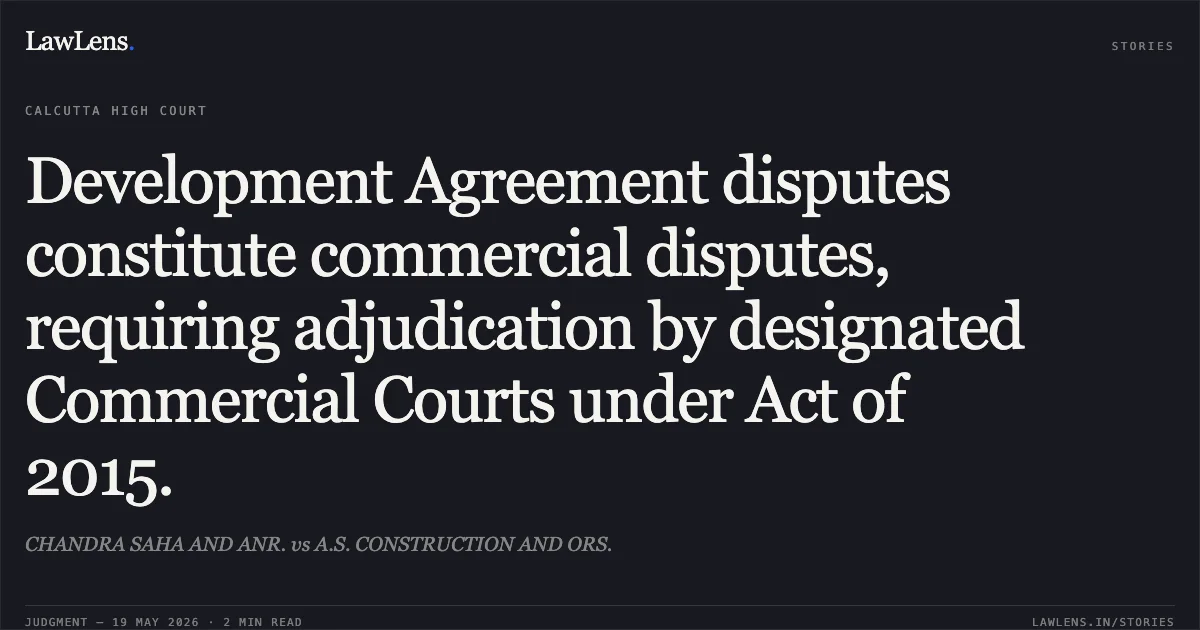
i.1. Whether a dispute arising out of a development agreement for the commercial exploitation of land constitutes a "commercial dispute" under the Commercial Courts Act, 2015
¶ 14ii.2. Whether the orders passed by a non-designated Commercial Court are sustainable when a Commercial Court has already been notified for that jurisdiction
¶ 15, 1603Law Applied
The Court applied Section 2(1)(c) of the Commercial Courts Act, 2015, which defines "commercial disputes," specifically in the context of agreements relating to immovable property used exclusively in trade or commerce
¶ 14It relied on the precedents Ratan Kumar Agarwal vs. M/s Asmi Construction & Ors. (2026:CHC-JP:17-DB) and Ashok Saraf and Others vs. Asansol Durgapur Development Authority (2025:CHC-AS:2038-D) to establish that development agreements constitute commercial exploitation of property
¶ 10, 14Furthermore, the court adhered to the jurisdictional mandate that commercial disputes must be heard by designated Commercial Courts established under the Act of 2015
¶ 15, 16Provisions in the judgment · 2 · Linked ones open on LawLens
Arbitration and Conciliation Act, 1996 Section 9Section 21
04Reasoning
The Court observed that the development agreement aged 2003 was intended for the commercial exploitation of land, thereby squarely falling within the definition of a "commercial dispute" under the Act of 2015
¶ 14The Court noted that a specialized Commercial Court for the Barasat jurisdiction had been notified and established on February 11, 2021
¶ 15Since the proceedings (Misc. Case No. 17 of 2022) were instituted in 2022—after the establishment of the Commercial Court—the Additional District & Sessions Judge (Fast Track Court) lacked the inherent jurisdiction to entertain the Section 9 application
¶ 15, 16The Court reasoned that any order passed by a forum coram non judice (without jurisdiction) is legally unsustainable
¶ 1605Holding
The High Court held that the subject matter was a commercial dispute and the Trial Court lacked jurisdiction to pass the impugned orders
¶ 16The Court condoned the 535-day delay in filing the first appeal in the interest of justice
¶ 3, 4Consequently, the Court set aside Order No. 19 dated May 4, 2024, and Order No. 09 dated December 15, 2025. Both appeals were disposed of, effectively requiring the parties to approach the appropriate designated Commercial Court
¶ 16, 17Original Court PDF
CHANDRA SAHA AND ANR.vsA.S. CONSTRUCTION AND ORS.
Click to open original judgment
Original judgment, available to read, download and summarize on LawLens.in