Facts
The State of Tamil Nadu acquired land parcels measuring 5,450 sq.m, 6,500 sq.m, and 5,700 sq.m in Okkiyam-Thorapakkam Village under the Tamil Nadu Highways Act, 2001.
Source reference: p.3The acquisition was for a specific public project: forming a link road and constructing a bridge across the Buckingham Canal.
Source reference: para. 2In Award No. 1 of 2020, the appellants determined the market value but applied a blanket 33.33% deduction towards "development charges".
Source reference: para. 1The respondents challenged this deduction through writ petitions. A learned Single Judge quashed the award to the limited extent of this deduction on 30.07.2025.
Source reference: para. 1The State appealed, contending that the lands were unapproved and that administrative circulars mandated such deductions.
Source reference: para. 3Issues
1. Whether the State is legally justified in enforcing a 33.33% deduction toward development charges for land acquired specifically for a linear road and bridge project.
Source reference: para. 62. Whether the respondents were required to exhaust the alternative remedy of a reference to a Civil Court before invoking writ jurisdiction.
Source reference: para. 14Law Applied
The court applied the "Theory of Deduction" principle, historically rooted in Section 23 of the Land Acquisition Act, 1894, which allows for value adjustments (20% to 50%) when large agricultural tracts are converted into spatial developments like housing colonies.
Source reference: para. 7It relied on the "Linear Acquisition Exception" established in Nelson Fernandes v. Special Land Acquisition Officer (2007) 9 SCC 447, which holds that deductions for development charges are impermissible when land is acquired for specific linear purposes like railways.
Source reference: para. 8This was reinforced by C.R. Nagaraja Shetty (2) v. Land Acquisition Officer (2009) 11 SCC 75 regarding national highways.
Source reference: para. 9Madhya Pradesh Road Development Corporation v. Vincent Daniel (2025) 7 SCC 798, which prohibits arbitrary deductions from market values determined by the State's own guideline rates.
Source reference: para. 12Reasoning
The court reasoned that the "theory of deduction" applies only when land must be sacrificed for internal amenities (roads, parks) within a spatial layout.
Source reference: para. 10In contrast, for "linear acquisitions"—such as the subject road and bridge project—the entire strip of land is consumed by the infrastructure itself; hence, the road is the development.
Source reference: para. 10-11The court rejected the State's distinction between "widening" an old road and "forming" a new link road, noting both are structurally linear.
Source reference: para. 11It further observed that since the State fixes guideline rates for stamp duty, it cannot claim those same rates are "too high" and require deduction when paying compensation.
Source reference: para. 12The court held that an internal directive dated 06.01.2021 by the Commissioner of Land Administration explicitly prohibited such deductions for linear acquisitions abutting existing roads.
Source reference: para. 13Holding
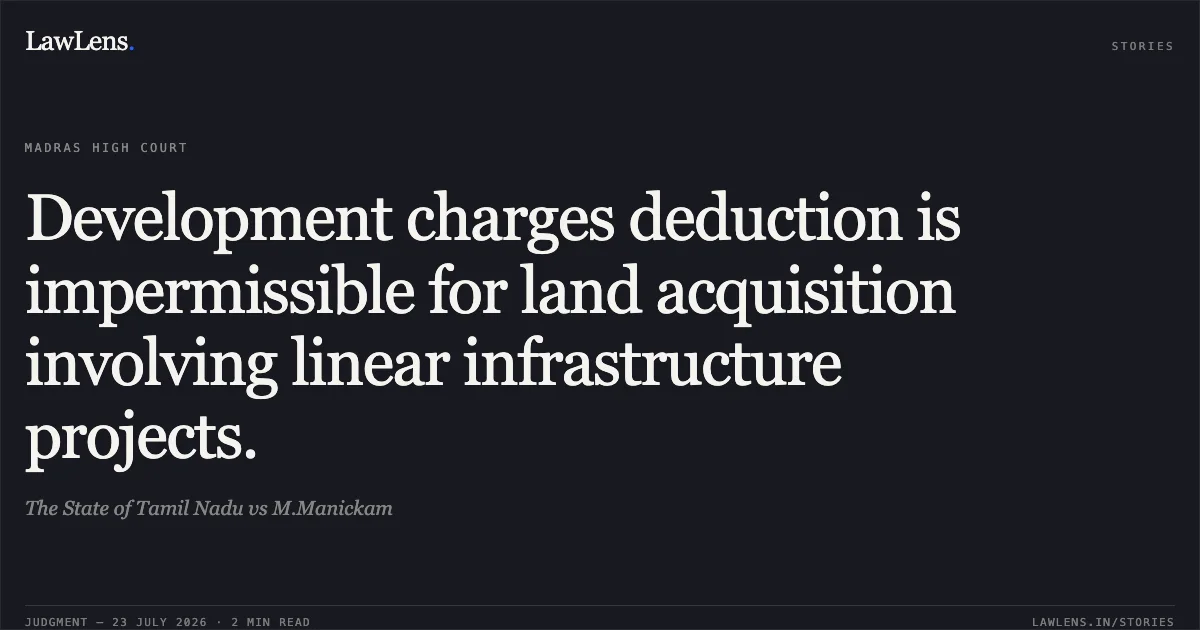
The High Court dismissed the writ appeals and affirmed the Single Judge's order, holding that a 33.33% deduction for development charges in a linear project is "wholly unsustainable in law".
Regarding the procedural challenge, the court held that the availability of an alternative remedy does not bar writ jurisdiction under Article 226 when the State commits a patent error of law regarding an unauthorized statutory deduction.
Source reference: para. 14The appellants were directed to pay the withheld 33.33% compensation to the respondents within four weeks.
Source reference: p. 16Acts & Sections Cited
1 provisions across 1 statute referred to in this judgment. Each provision opens on LawLens.
Right to Fair Compensation and Transparency in Land Acquisition, Rehabilitation and Resettlement Act, 20131
Original Court PDF
The State of Tamil NaduvsM.Manickam
Click to open original judgment
Original judgment, available to read, download and summarize on LawLens.in