01Facts
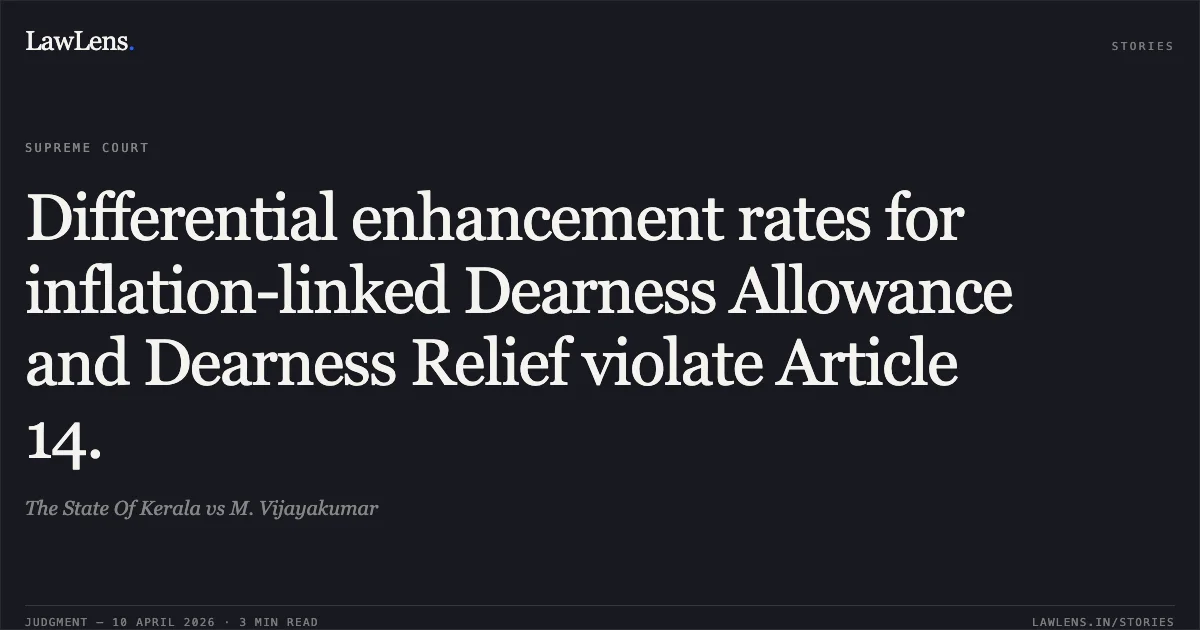
Retired employees of the Kerala State Road Transport Corporation (KSRTC) filed a writ petition challenging the differential rates fixed for the enhancement of Dearness Relief (DR) on pension compared to Dearness Allowance (DA) on salary
¶ 4While serving employees received a 14% enhancement in DA, pensioners were restricted to an 11% enhancement in DR
¶ 4The Single Judge of the Kerala High Court dismissed the petitions, holding that serving and retired employees constitute different classes
¶ 5However, the Division Bench reversed this, declaring the differentiation discriminatory and violative of Article 14
¶ 8The State of Kerala and KSRTC appealed to the Supreme Court, arguing that financial constraints justified the lower rate for pensioners and that the two groups were not a homogenous class
¶ 11-1202Issues
i.Whether, after deciding to extend the benefit of inflation-linked enhancements (DA/DR), the State/KSRTC could validly effect a classification between serving employees and pensioners to grant such benefits at differential rates?
¶ 3 / para. 703Law Applied
The Court applied the twin tests of reasonable classification under Article 14 of the Constitution, requiring that any classification be founded on an intelligible differentia with a rational nexus to the object sought to be achieved
¶ 22It relied on D.S. Nakara v. Union of India, which established that the State must establish the rational principle behind a classification
¶ 22E.P. Royappa v. State of Tamil Nadu, which defined equality as the antithesis of arbitrariness
¶ 22Furthermore, the court referred to Kallakkurichi Taluk Retired Officials Association v. State of Tamil Nadu, noting that since inflation affects all employees and pensioners similarly, different levels of dearness relief to remedy inflation are generally unsustainable
¶ 16the court cited State of Punjab v. Davinder Singh to emphasize that the basis of classification must be deducible and pertinent to the legislative object
¶ 2404Reasoning
The Court observed that the singular objective of both DA and DR is to mitigate the hardship caused by inflation
¶ 21, 25Since inflation exerts equal pressure on both serving and retired employees, the court reasoned that the two groups are similarly situated regarding the measure of the relief required
¶ 21While the State cited precedents like T.N. Electricity Board v. R. Veerasamy and State of Punjab v. Amar Nath Goyal to justify classification based on financial constraints, the Court distinguished these cases, noting they pertained to the entitlement to a new scheme or cut-off dates for eligibility
¶ 26-27In the present case, the entitlement to DR was undisputed; the issue was the rate of enhancement
¶ 26The Court held that while financial crunches may justify deferring the disbursement of benefits, they cannot justify providing a lower rate of inflation adjustment to one group over another when the underlying cause (inflation) remains common to both
¶ 28Consequently, the differentia (status of service) had no rational nexus to the object (mitigating inflation)
¶ 25, 2705Holding
The Supreme Court dismissed the appeals and upheld the Division Bench’s judgment, holding that fixing different rates of enhancement for DA and DR is discriminatory and violative of Article 14 of the Constitution
¶ 26, 29The Court answered the central question by stating that once a decision is taken to provide inflation-linked allowances, a higher rate of increase for serving employees over retired employees is arbitrary
¶ 28All pending applications were disposed of without an order as to costs
¶ 29Original Court PDF
The State Of KeralavsM. Vijayakumar
Click to open original judgment
Original judgment, available to read, download and summarize on LawLens.in