Facts
The appellant manufactured iron ore pellets classifiable under Chapter 2601 and cleared them to its own units at Raigad and Angul, where they were used as inputs in the manufacture of dutiable finished goods.
Source reference: p.1The receiving units availed CENVAT credit of the excise duty paid on the pellets and cleared their finished products on payment of duty.
Source reference: p.1For the inter-unit clearances, the appellant determined the assessable value under Rule 8 of the Central Excise Valuation Rules, 2000, based on CAS-4 costing.
Source reference: p.1The Department alleged that the values adopted from time to time were lower than the values subsequently certified by the Cost Accountant and issued a show cause notice dated 24 December 2014 covering the period April 2010 to July 2011.
Source reference: p.1The adjudicating authority confirmed the differential duty demand.
Source reference: p.1The appellant challenged the order before the Tribunal, contending that the transactions were revenue neutral and that the demand for the relevant period was time-barred because the valuation details had been disclosed in ER-1 returns.
Source reference: pp.1–2Issues
1. Whether differential excise duty was payable merely because the CAS-4 certificates subsequently obtained from the Cost Accountant reflected values higher than those adopted by the appellant for clearances to its own units.
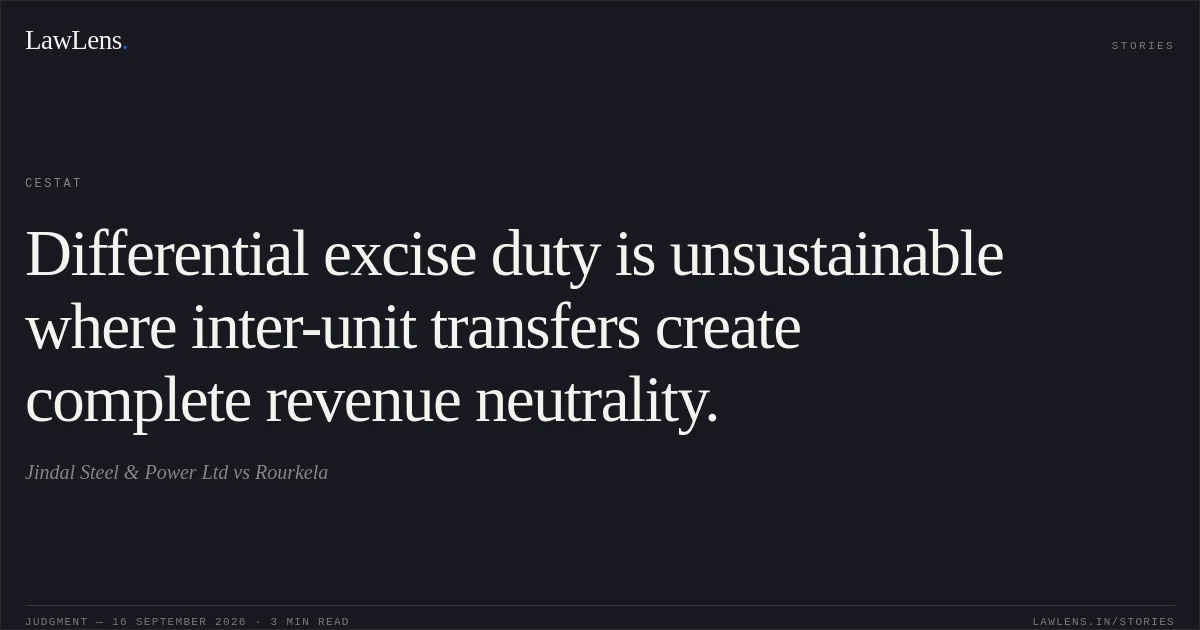
Source reference: pp.1–2, 4–62. Whether the demand was unsustainable on the ground of revenue neutrality, since the recipient units were entitled to avail CENVAT credit of the duty paid by the appellant.
Source reference: pp.2–63. Whether the extended limitation period could be invoked when the relevant valuation particulars had been disclosed in the ER-1 returns and the transactions were revenue neutral.
Source reference: pp.2, 6–7Law Applied
The Tribunal applied Rule 8 of the Central Excise Valuation Rules, 2000, governing valuation of goods transferred for captive consumption, together with the CAS-4 cost-accounting methodology.
Source reference: pp.3–6It applied the revenue-neutrality principle, under which a demand is not sustainable where the differential duty payable by the supplying unit would be fully available as CENVAT credit to the recipient unit of the same assessee and would not result in any net loss of revenue.
Source reference: pp.3–6The Tribunal relied on Britco Foods Company Ltd. v. Commissioner of Central Excise, 2001 (127) E.L.T. 73 (Tri.-Mumbai), affirmed by the Supreme Court at 2007 (213) E.L.T. 490 (S.C.), as well as Jay Yuhshin Ltd. v. Commissioner of Central Excise, 2000 (119) E.L.T. 718 (Tri.-LB), and subsequent decisions in Steel Authority of India Ltd. and Shyam Sel & Power Ltd., which recognised revenue neutrality in inter-unit clearances where the receiving unit could avail credit of the duty paid.
Source reference: pp.2–6The Tribunal also applied the principle that extended limitation cannot be invoked in the absence of suppression or wilful misstatement, particularly where the relevant particulars were disclosed in statutory returns and no additional revenue benefit accrued to the assessee.
Source reference: p.7Reasoning
The Tribunal found that the pellets were used as inputs by the appellant’s own receiving units, which availed CENVAT credit of the excise duty paid on the inter-unit clearances.
Source reference: pp.3–6Since the units belonged to the same assessee and maintained a common balance sheet, any additional duty payable by the supplying unit would correspondingly become available as credit to the receiving units; the transaction was therefore revenue neutral.
Source reference: pp.3–6On that basis, the Tribunal held that the alleged undervaluation, even if established by reference to the later CAS-4 certificates, could not sustain a net duty demand.
Source reference: pp.3–6The Tribunal further noted that the appellant had disclosed the values adopted for the clearances in its ER-1 returns.
Source reference: p.7In the absence of concealment and given the revenue-neutral character of the transactions, the Department could not establish suppression or invoke the extended limitation period.
Source reference: p.7Holding
The Tribunal answered the valuation and revenue-neutrality issues in favour of the appellant and held that the differential duty demand was unsustainable.
It also held that the demand was barred by limitation because the relevant valuation details had been disclosed in the ER-1 returns and no suppression was established.
Source reference: p.7The impugned order was set aside, the appeal was allowed both on merits and on limitation, and consequential relief was granted in accordance with law.
Source reference: pp.8–9Original Court PDF
Jindal Steel & Power LtdvsRourkela
Click to open original judgment
Original judgment, available to read, download and summarize on LawLens.in