Facts
The petitioner, a civil contractor, sought declarations concerning the validity of Section 7(3) read with Clause 6 of Schedule II of the GST Act, reimbursement from government employers of additional GST allegedly paid on works contracts, and a State policy addressing the transition from VAT to GST.
Source reference: pp. 2–6He also challenged a GST assessment order under Section 73(9) for FY 2018–19 and a garnishee notice issued in February 2026.
Source reference: pp. 2–6The Court considered the reliefs in light of earlier decisions of the Karnataka High Court, including the Division Bench’s modification of the order in Chandrashekharaiah.
Source reference: pp. 7–15Issues
1. Whether the petitioner’s claims concerning the GST burden on works contracts and reimbursement were governed by the prior decisions of the Karnataka High Court.
Source reference: paras. 3–6; pp. 7–162. Whether the Court should grant the requested relief against the assessment order and garnishee notice in this petition.
Source reference: pp. 5–6, 15–16Law Applied
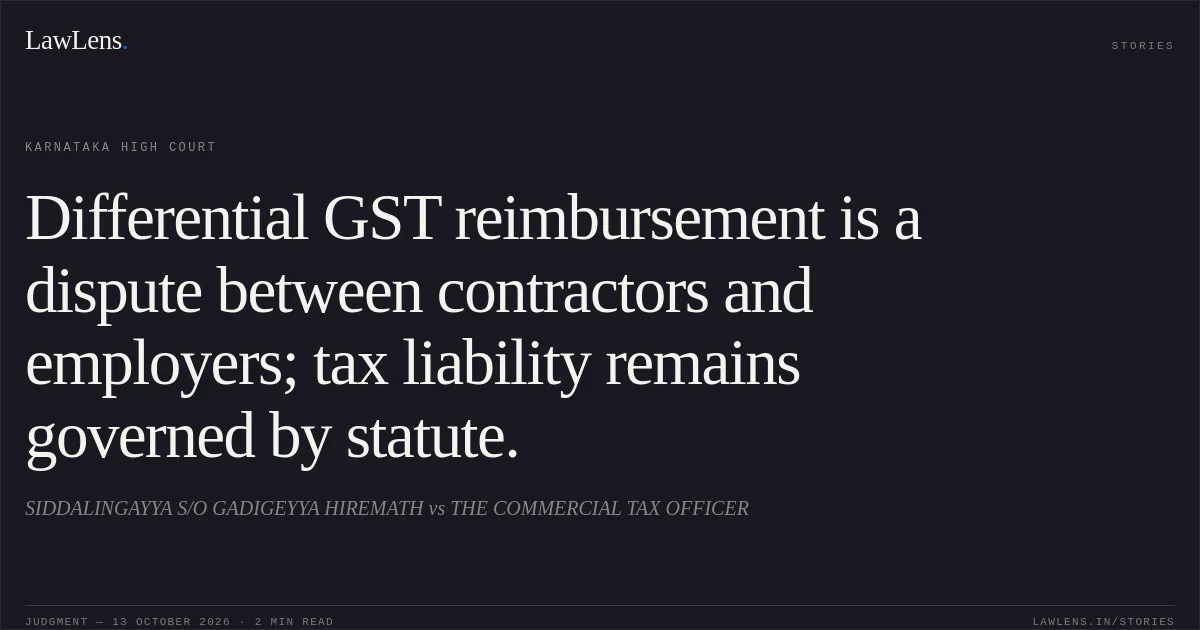
The Court applied the statutory principle that GST liability, assessment, recovery and enforcement are governed by the applicable GST legislation and cannot be altered by the terms of a contract between a contractor and an employer.
Source reference: paras. 3–5; pp. 8–9, 13–15The Division Bench in Office of the Principal Commissioner, GST and Central Excise v. R. Chandrashekhar S/o. Ramaiah, W.A. No. 1587/2023 and connected matters, held that disputes over reimbursement of incremental tax are between contractors and their employers; directions concerning tax administration cannot override the statutory scheme, and directions to reimburse differential tax operate only against the concerned employers.
Source reference: paras. 3–5; pp. 8–9, 13–15The Court also followed the coordinate-bench order in W.P. No. 100867/2026, which adopted specified directions from Chandrashekharaiah v. State of Karnataka, W.P. No. 9721/2019, including directions for representations to employers and their consideration, while preserving the petitioner’s liberty to challenge assessment orders in appropriate proceedings.
Source reference: para. 5; pp. 9–15Reasoning
The Court treated the petitioner’s dispute as covered by the prior decisions.
Source reference: paras. 3–5; pp. 7–15Under the Division Bench ruling, the petitioner’s claim for differential-tax reimbursement could be pursued against the relevant government employers, but it could not support directions altering GST assessment, collection or enforcement by tax authorities.
Source reference: paras. 3–5; pp. 7–15The Court therefore disposed of the petition in accordance with the Division Bench and coordinate-bench orders, rather than deciding the constitutional challenge or the merits of the impugned assessment and garnishee notice.
Source reference: para. 4; pp. 15–16Holding
The writ petition was disposed of in terms of the Division Bench decision in W.A. No. 1587/2023 and the coordinate-bench order in W.P. No. 100867/2026.
The petitioner’s reimbursement claim was thus confined to the employer–contractor relationship, subject to the applicable directions concerning representations; the petition did not result in relief against the tax authorities on the GST liability.
Source reference: para. 5; pp. 13–15The incorporated order preserved liberty to challenge assessment orders in appropriate proceedings.
Source reference: para. 5; pp. 13–15Acts & Sections Cited
2 provisions across 1 statute referred to in this judgment. Each provision opens on LawLens.
Central Goods and Services Tax Act, 20172
Original Court PDF
SIDDALINGAYYA S/O GADIGEYYA HIREMATHvsTHE COMMERCIAL TAX OFFICER
Click to open original judgment
Original judgment, available to read, download and summarize on LawLens.in