Facts
Police found a car that had reportedly met with an accident and, on searching it, seized 180 bulk litres of foreign liquor.
Source reference: para. 1-4, 6The vehicle was registered to Deepak Choudhary, who had sold it to co-accused Mohd. Ashik Sheikh; the applicant was not found at the scene and was not the vehicle’s registered owner.
Source reference: para. 1-4, 6The case was registered under Section 34(2) of the Chhattisgarh Excise Act and Section 279 of the IPC. The applicant sought anticipatory bail under Section 482 of the BNSS, contending that he was implicated on the basis of co-accused statements.
Source reference: para. 1-4, 6The State opposed the application, including on the ground that Section 59-A(i) of the Excise Act barred anticipatory bail.
Source reference: para. 1-4, 6Issues
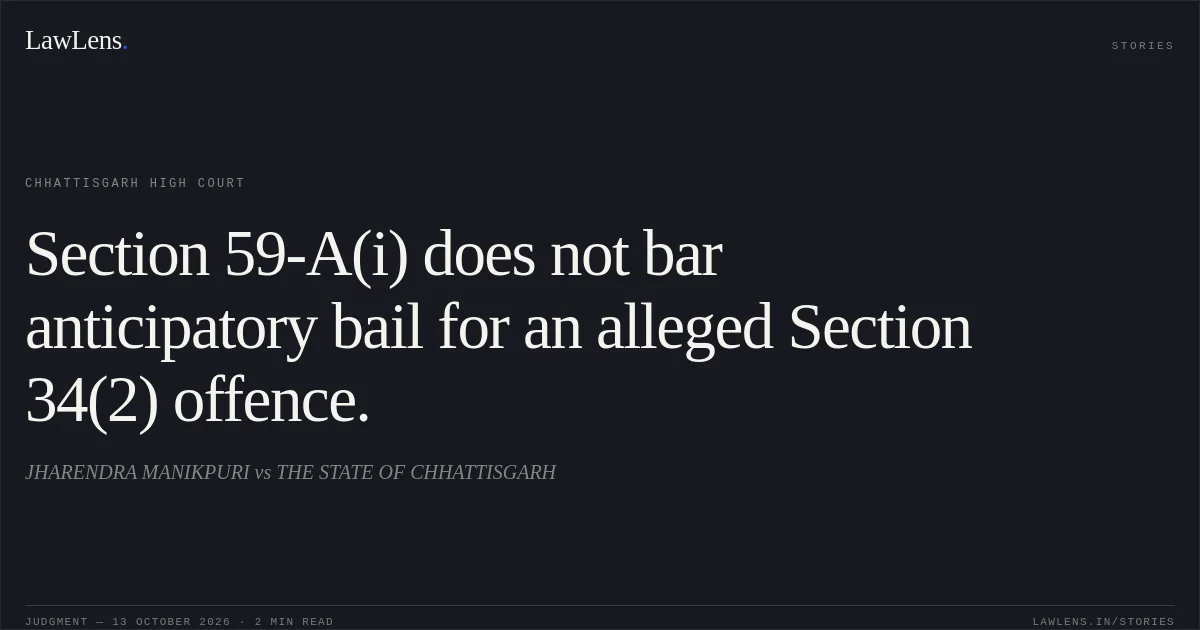
Whether the bar under Section 59-A(i) of the Chhattisgarh Excise Act precluded the Court from entertaining the applicant’s anticipatory-bail application.
Source reference: para. 4, 6-8Whether, on the facts presented, the applicant was entitled to anticipatory bail in connection with the alleged offence under Section 34(2) of the Excise Act.
Source reference: para. 3, 7-9Law Applied
Section 482 of the BNSS provides for the grant of anticipatory bail.
Source reference: no citationSection 59-A(i) of the Chhattisgarh Excise Act restricts anticipatory bail for the specified offences, including offences under Sections 49-A and 34(1)(a) or (b); the restriction does not apply merely because a provision attracting the bar is mentioned, where the offence’s essential ingredients are absent on the facts.
Source reference: para. 7The Court relied on Dilip Kumar Suryavanshi v. State of Chhattisgarh (MCRCA No. 1391 of 2020, order dated 15 December 2020), which drew on Pankaj Samundre and Naresh Kumar Lahria v. State of M.P. and Others for the principle that the court may examine whether the case factually falls within the statutory bar.
Source reference: para. 7Reasoning
The Court noted that the applicant was neither the vehicle’s registered owner nor present at the scene, and that the liquor had not been recovered from him.
Source reference: para. 6-8It further observed that the alleged offence was under Section 34(2), whereas Section 59-A(i), as considered by the Court, applied to specified offences including Sections 34(1)(a) and (b).
Source reference: para. 6-8On those facts, the Court held that the statutory bar did not prevent it from entertaining the application and, relying on Dilip Kumar Suryavanshi, found it appropriate to grant relief.
Source reference: para. 6-8Holding
The Court held that Section 59-A(i) did not bar the application in the circumstances of this case and allowed the application for anticipatory bail.
If arrested in connection with Crime No. 01/2024, the applicant was directed to be released on a personal bond of ₹25,000 with one surety for the like amount, subject to conditions concerning cooperation with investigation, non-interference with witnesses or the proceedings, and appearance before the trial court.
Source reference: para. 8-10Acts & Sections Cited
3 provisions across 3 statutes referred to in this judgment. Each provision opens on LawLens.
Bharatiya Nagarik Suraksha Sanhita, 20231
Indian Penal Code, 18601
Code of Criminal Procedure, 19731
Original Court PDF
JHARENDRA MANIKPURIvsTHE STATE OF CHHATTISGARH
Click to open original judgment
Original judgment, available to read, download and summarize on LawLens.in