Facts
The Appellant, a car cleaner, was convicted by the Fast Track Special Court, POCSO, Panaji, for house trespass, outraging modesty, and rape (Sections 448, 354, 376 IPC) regarding an incident on May 14, 2023
Source reference: p. 1-2The victim (PW1) alleged that while sleeping, the Appellant entered her bedroom through the balcony, pinned her down, and committed digital penetration
Source reference: p. 4-5Hearing her screams, the landlord (PW7) and neighbors apprehended the Appellant on the balcony
Source reference: p. 10The victim underwent medical examination at Goa Medical College (PW3), which confirmed vaginal penetration
Source reference: p. 7The Appellant challenged the conviction, arguing that the acts amounted only to an "attempt," questioning the entry into the room, and alleging procedural lapses in DNA collection and mental health inquiries
Source reference: p. 13-16Issues
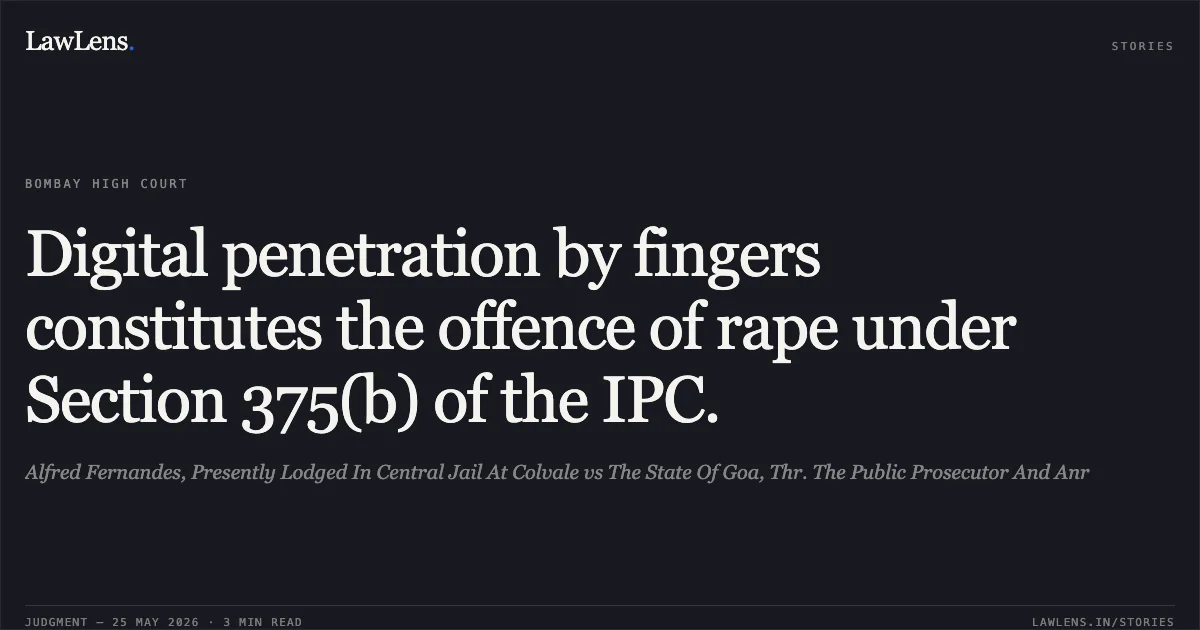
1. Whether the act of digital penetration (insertion of fingers) falls within the definition of "rape" under Section 375 of the IPC as amended in 2013
Source reference: p. 212. Whether the conviction can be sustained based on the victim’s testimony corroborated by medical evidence, despite the absence of DNA profiling and certain investigative lapses
Source reference: p. 18, 303. Whether the Appellant was entitled to a plea of insanity or mental incapacity under Section 84 of the IPC
Source reference: p. 19, 31Law Applied
The court primarily applied Section 375(b) of the IPC, which defines rape to include the insertion of any part of the body (other than the penis) into the vagina to any extent
Source reference: p. 21It relied on the post-2013 legislative expansion of the definition of rape to include digital penetration
Source reference: p. 23Furthermore, it applied Section 53A of the CrPC, holding that while DNA profiling is a facilitated scientific tool, its absence is not fatal if other cogent evidence exists
Source reference: p. 18, 30Regarding mental health, the court applied Section 84 of the IPC, noting the burden of proof for the "plea of insanity" rests on the accused
Source reference: p. 19, 31Reasoning
The High Court found the victim’s (PW1) testimony to be cogent and consistently corroborated by the landlord (PW7), who found the Appellant on the scene
Source reference: p. 24The court rejected the "attempt" argument, noting that PW3’s medical report explicitly recorded "vaginal penetration" and "digital penetration," which satisfies the threshold of Section 375(b) IPC regardless of the degree of penetration
Source reference: p. 27-28The court dismissed the challenge to house trespass, observing that the Appellant’s presence in the room was established through his apprehension on the balcony
Source reference: p. 33Regarding the defense's claim of investigative failure (non-collection of DNA and finger-prints), the court held that procedural defects do not vitiate a trial when ocular and medical evidence are overwhelming
Source reference: p. 30Finally, the court noted that the Appellant failed to provide any medical evidence of low IQ or insanity during the trial or in his Section 313 statement to satisfy Section 84 IPC
Source reference: p. 31Holding
It held that digital penetration constitutes "rape" under the amended Section 375(b) IPC and that the minimum substantive sentence of 10 years for rape, alongside concurrent sentences for trespass and outraging modesty, was proportional
The court affirmed that scientific evidence like DNA is not mandatory if the victim’s testimony is found reliable and corroborated by medical findings. Case dismissed
Source reference: p. 30, 34The High Court dismissed the appeal and upheld the conviction and sentences
Source reference: p. 34Acts & Sections Cited
8 provisions across 2 statutes referred to in this judgment. Linked provisions open on LawLens.
Indian Penal Code, 18605
Code of Criminal Procedure3
Original Court PDF
Alfred Fernandes, Presently Lodged In Central Jail At ColvalevsThe State Of Goa, Thr. The Public Prosecutor And Anr
Click to open original judgment
Original judgment, available to read, download and summarize on LawLens.in


