Facts
The Appellant, acting as a debenture trustee, entered into a Debenture Trust Deed (DTD) dated 03.08.2018 with Aaditri Constructions Pvt. Ltd. (ACPL/Borrower) for the issuance of debentures worth Rs. 395 crores.
Source reference: p. 3-4While the Corporate Debtor (CD), Radius Estate Projects Pvt. Ltd., was not an original signatory to the DTD, it later executed a First Supplemental Indenture of Mortgage (IOM) on 29.03.2019 and a Second Supplemental IOM on 16.04.2019.
Source reference: p. 4, 42, 50These IOMs contained a "Covenant to Pay," wherein the CD agreed to discharge the "Secured Obligations" (defined by the DTD).
Source reference: p. 49, 56Following the CD’s admission into CIRP, the Appellant filed a claim for Rs. 874 Crores as a "Secured Financial Creditor."
Source reference: p. 5The Resolution Professional (RP) classified the Appellant only as an "Other Secured Creditor" on the grounds that no money was disbursed directly to the CD and the CD was not a guarantor.
Source reference: p. 6, 12The NCLT upheld the RP's classification via an order dated 07.05.2024, prompting this appeal.
Source reference: p. 2, 10Issues
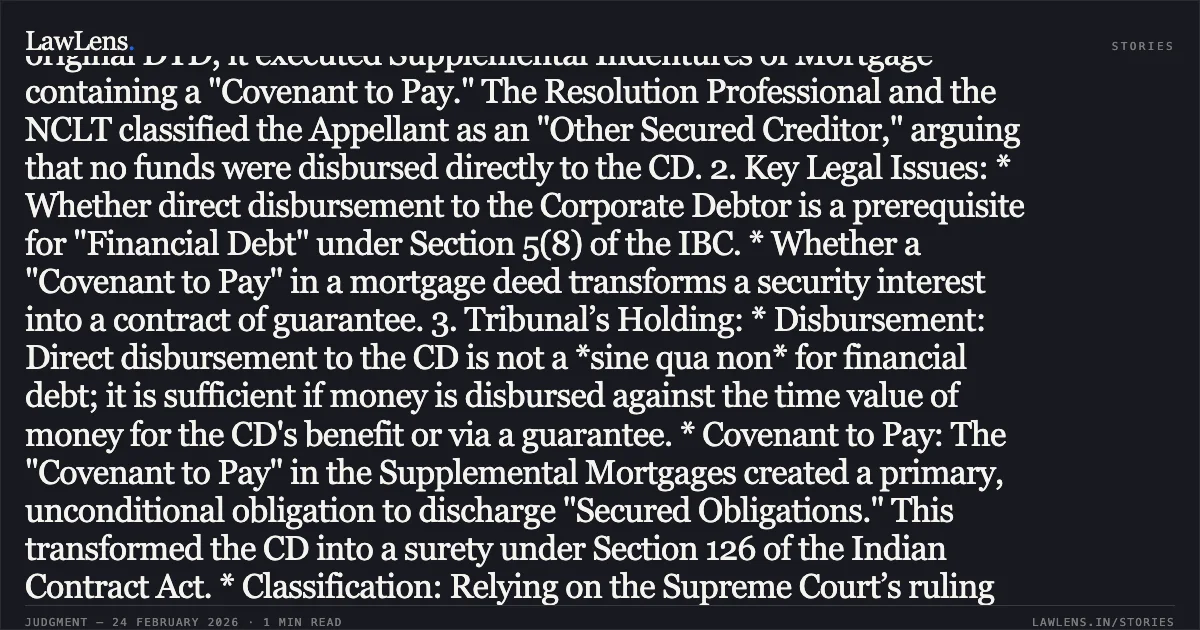
1. Whether disbursement of debt directly to the Corporate Debtor is a prerequisite for classification as "financial debt" under Section 5(8) of the IBC.
Source reference: p. 17 / para. 43(I)2. Whether the "covenant to pay" in the Mortgage Deeds constitutes a contract of guarantee under Section 126 of the Indian Contract Act, 1872, thereby making the debt "financial debt" under Section 5(8)(i).
Source reference: p. 18 / para. 43(III-IV)3. Whether the liability of the Corporate Debtor is limited only to the value of the mortgaged property.
Source reference: p. 18 / para. 43(V)Law Applied
The Court applied Section 5(8) of the Insolvency and Bankruptcy Code (IBC), which defines "financial debt" as a debt disbursed against the consideration for the time value of money, including guarantees.
Source reference: p. 19It relied on Section 126 of the Indian Contract Act, 1872, regarding contracts of guarantee.
Source reference: p. 23The Tribunal distinguished Anuj Jain v. Axis Bank (2020), which held that a mere mortgage without a personal covenant to pay does not create a financial debt.
Source reference: p. 29, 62It further relied on China Development Bank v. Doha Bank Q.P.S.C. (2025), which established that an explicit covenant to pay for a third party’s default in a security document constitutes a guarantee.
Source reference: p. 59, 68Additionally, Rajeev Kumar Jain v. Uno Minda Ltd. was cited to affirm that direct disbursement to the CD is not a sine qua non for financial debt.
Source reference: p. 30, 63Reasoning
The Tribunal analyzed the definition of "financial debt" under Section 5(8) and observed that the statute does not explicitly require funds to flow directly into the CD's account, provided there is a disbursement against the time value of money for the CD’s benefit or on its behalf.
Source reference: p. 28-30The court then examined the "Covenant to Pay" in Clause 2 of the Supplemental IOMs, reading it in conjunction with the DTD.
Source reference: p. 56, 66It found that by signing the Supplemental IOMs, the CD became a "Security Provider" and "Obligor" who undertook an unconditional liability to discharge "Secured Obligations."
Source reference: p. 39, 49, 57The Tribunal rejected the RP's argument that Clause 2.2 limited liability to default interest, noting that the later part of the clause mandated that the CD "not allow any Secured Obligations to fall in arrears," which created a secondary liability triggered by the principal borrower's default.
Source reference: p. 65, 67This specific undertaking transformed a simple mortgage into a contract of guarantee under Section 126 of the Contract Act.
Source reference: p. 69-70Holding
The NCLAT allowed the appeal and set aside the Impugned Order.
The Tribunal held that: (i) Direct disbursement to the CD is not a sine qua non for financial debt.
Source reference: p. 30-31(ii) The "Covenant to Pay" in the IOMs created an enforceable guarantee.
Source reference: p. 66, 69and (iii) The Appellant qualifies as a "Secured Financial Creditor" under Section 5(7) of the IBC.
Source reference: p. 64, 70The matter was remanded to the Adjudicating Authority for further proceedings in accordance with law.
Source reference: p. 71Original Court PDF
Vistra ITCL (India) Limited v. Vithal Madhukar Dahake & Ors., Comp. App. (AT) (Ins) No. 1110 of 2024
Click to open original judgment
Original judgment, available to read, download and summarize on LawLens.in


