Facts
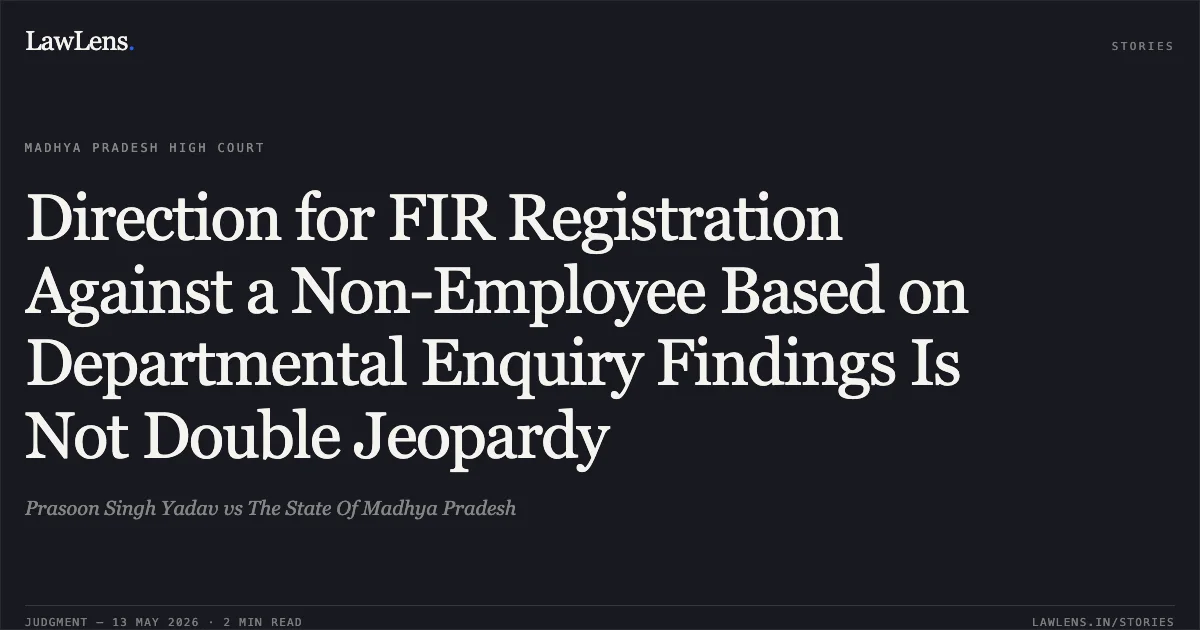
The petitioner, an Engineering Graduate in private business, challenged an order dated 30.08.2014 passed by respondent No. 3 (Managing Director, M.P. Rajya Beej Evam Farm Vikas Nigam).
Source reference: para. 1Following an audit of seed transactions at the Satna Regional Office, financial irregularities were discovered, leading to departmental enquiries against several employees.
Source reference: para. 8The enquiry revealed that payments intended for farmers were diverted via cheques to the petitioner.
Source reference: para. 8Consequently, the impugned order directed the lodging of an FIR against the petitioner.
Source reference: para. 1The petitioner contended he was not a departmental employee, was never heard during the enquiry, and that a previous investigation on similar allegations had not resulted in a charge-sheet against him.
Source reference: paras. 2-3Issues
1. Whether a departmental authority has the jurisdiction to direct the registration of an FIR against a non-employee based on findings in a departmental enquiry.
Source reference: para. 13 / para. 182. Whether the direction to lodge an FIR violates the principles of natural justice if no prior notice or hearing is afforded to the proposed accused.
Source reference: para. 133. Whether the initiation of fresh criminal investigation, following an earlier investigation where the petitioner was not charge-sheeted, constitutes double jeopardy under Article 20(2) of the Constitution.
Source reference: para. 14Law Applied
The court applied the principles of writ jurisdiction under Articles 226 and 227 of the Constitution of India, noting that extraordinary powers should be used sparingly and not to stifle legitimate investigations.
Source reference: para. 15It relied on the doctrine that criminal law is set in motion upon the disclosure of a cognizable offence or suspicion of misuse of public funds.
Source reference: para. 11Regarding double jeopardy, the court applied Article 20(2) of the Constitution and Section 300 of the Cr.P.C., which require a prior prosecution and punishment/acquittal by a competent court to trigger the bar.
Source reference: para. 14Reasoning
The Court reasoned that at the stage of initiating criminal proceedings, it cannot conduct a "mini-trial" or meticulously appreciate evidence.
Source reference: para. 10It found that the audit and enquiry reports provided sufficient prima facie material regarding suspicious financial transactions involving public money to justify an investigation.
Source reference: para. 12, 16The Court rejected the natural justice argument, holding that the law does not contemplate a prior hearing for a proposed accused before an FIR is lodged.
Source reference: para. 13Regarding jurisdiction, the Court held that a disciplinary authority is competent to recommend criminal action if criminality emerges during an enquiry, regardless of the individual’s employment status.
Source reference: para. 13, 18Finally, it dismissed the double jeopardy plea because the petitioner had never been tried or acquitted in a court of law regarding the earlier investigation; thus, fresh material could legally trigger a new FIR.
Source reference: para. 14Holding
The Court answered all issues in the negative and dismissed the writ petition.
It held that the impugned direction was not a determination of guilt but a step to unearth the truth through independent investigation.
Source reference: para. 11, 13The Court ordered that the investigating agency must proceed independently and evaluate the material without being influenced by observations made in the departmental enquiry.
Source reference: para. 21Acts & Sections Cited
1 provisions across 1 statute referred to in this judgment. Each provision opens on LawLens.
Code of Criminal Procedure, 19731
Original Court PDF
Prasoon Singh YadavvsThe State Of Madhya Pradesh
Click to open original judgment
Original judgment, available to read, download and summarize on LawLens.in