Facts
The appellant, the Director of the Integrated Rural Technology Centre (IRTC), challenged a judgment of the learned Single Judge that dismissed his writ petition.
Source reference: no citationThe litigation arose after a female employee lodged a sexual harassment complaint against the appellant on 27.11.2024
Source reference: p. 3The Internal Complaints Committee (ICC) issued a notice for the appellant to appear
Source reference: p. 3The appellant contended that as "Director," he is the "employer" under Section 2(g) of the PoSH Act, and therefore, under Section 6(1), the complaint should be heard by the Local Committee (LC) rather than the ICC
Source reference: p. 3-4He further alleged a conflict of interest with the ICC Presiding Officer
Source reference: p. 4Issues
1. Whether the Director of IRTC falls under the definition of "employer" or "employee" as per the PoSH Act, and consequently, whether the ICC or the LC has the jurisdiction to enquire into the complaint
Source reference: p. 8, para. 9Law Applied
Section 2(f) defines "employee" broadly to include those in regular or ad hoc positions
Source reference: p. 9, para 11Section 2(g)(ii) defines "employer" as the person responsible for the management, supervision, and control of the workplace, noting that "management" includes boards/committees responsible for policy formulation
Source reference: p. 9-10, para 12Section 4 mandates the constitution of an ICC
Source reference: p. 10Section 6(1) provides that the Local Committee shall receive complaints only if the ICC is not constituted or "if the complaint is against the employer himself"
Source reference: p. 12, para 14Reasoning
Although the appellant argued that his role as Chief Executive Officer and his "overall management" duties under Clause 23.2.2 of the MoA made him the "employer", the court observed that Clause 7.1 and 18.1 vest the ultimate control, administration, and management of the Society in the General Body and Executive Committee
Source reference: p. 14-16Clause 23.2.1 explicitly states the Director is appointed by the Executive Committee and works subject to their control and supervision
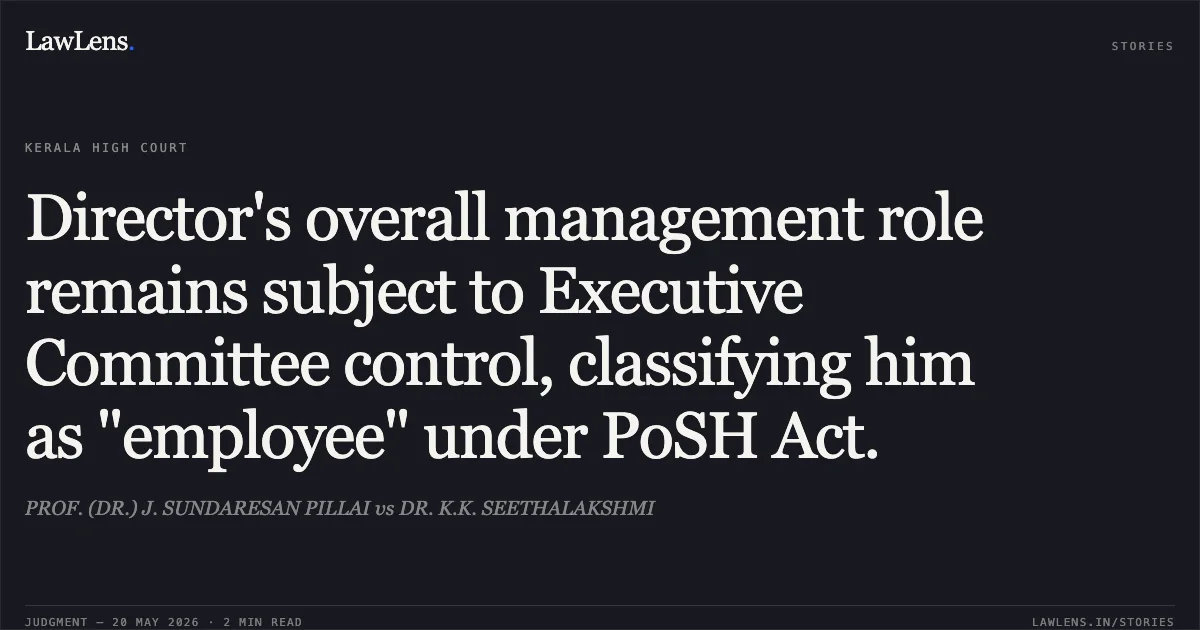
Source reference: p. 17The court reasoned that since the appellant is an appointee accountable to a higher governing body (the Executive Committee), he holds the status of an "employee" rather than the ultimate "employer"
Source reference: p. 19-20, para 18Consequently, the exception under Section 6(1) of the PoSH Act does not apply, and the ICC retains jurisdiction.
Source reference: no citationHolding
The court answered the issue by holding that the appellant is an "employee" for the purposes of the PoSH Act and the ICC is the competent authority to investigate the allegations
The court found no perversity or illegality in the Single Judge’s judgment and dismissed the writ appeal
Source reference: p. 20The ICC proceedings were allowed to continue, with the clarification that the complainant (even if a member of the ICC) shall not participate in the decision-making process regarding her own complaint
Source reference: p. 20, para 18Acts & Sections Cited
6 provisions across 1 statute referred to in this judgment. Each provision opens on LawLens.
Original Court PDF
PROF. (DR.) J. SUNDARESAN PILLAIvsDR. K.K. SEETHALAKSHMI
Click to open original judgment
Original judgment, available to read, download and summarize on LawLens.in


