Facts
The appellant, a retired Senior Principal Scientist and Director of the Integrated Rural Technology Centre (IRTC), was accused of sexual harassment by a female employee on 27.11.2024
Source reference: para. 2The Internal Complaints Committee (ICC) issued a notice on 03.02.2025 (Ext.P1) directing his appearance
Source reference: para. 2The appellant challenged the ICC’s jurisdiction, contending that as the "Director/Head of Institution," he qualifies as the "employer" under Section 2(g) of the PoSH Act, meaning any complaint against him must be heard by the Local Committee (LC) under Section 6(1)
Source reference: para. 2/6He approached the High Court after the District Collector forwarded his representation back to the Presiding Officer of the ICC
Source reference: para. 2/7The learned Single Judge dismissed his writ petition on 06.01.2026, leading to this appeal
Source reference: para. 4Issues
Whether the Director of IRTC falls under the definition of "employee" [Section 2(f)] or "employer" [Section 2(g)] under the PoSH Act for the purpose of determining the jurisdiction of the ICC vs. the LC?
Source reference: para. 9/10Whether the ICC was without jurisdiction to enquire into the allegations of sexual harassment raised against the appellant?
Source reference: para. 9Law Applied
Section 2(f) and 2(g) of the Sexual Harassment of Women at Workplace (Prevention, Prohibition and Redressal) Act, 2013 (PoSH Act), which define "employee" and "employer," respectively
Source reference: para. 11/12Section 4 regarding the constitution of the ICC and Section 6(1), which mandates that complaints against the "employer himself" be referred to the Local Committee (LC)
Source reference: para. 13/14The court examined the "Management" criteria under the Explanation to Section 2(g)(ii) and the internal governance structure as defined in the Memorandum of Association and Rules and Regulations of the Society for IRTC (specifically Clauses 7, 18, and 23.2)
Source reference: para. 16Reasoning
The court analyzed the organizational structure of IRTC as per its Memorandum of Association to determine the appellant’s status. It observed that under Clause 7.1, "control, administration and management" are vested in the General Body, and under Clause 18.3, the Executive Committee possesses the power to appoint employees and exercise disciplinary control
Source reference: para. 16/18While Clause 23.2.2 designates the Director as the "Chief Executive Officer" in "overall management," this role is explicitly "subject to the control and supervision of the Executive Committee and the General Body"
Source reference: para. 16/18Since the appellant's appointment is made by the Executive Committee (Clause 23.2.1), the court reasoned he does not possess ultimate autonomy or the status of a "Principal Employer" as defined in Section 2(g)
Source reference: para. 18Consequently, the court held that the appellant is an "employee" under Section 2(f), and therefore, the ICC retains valid jurisdiction to adjudicate the complaint
Source reference: para. 18Holding
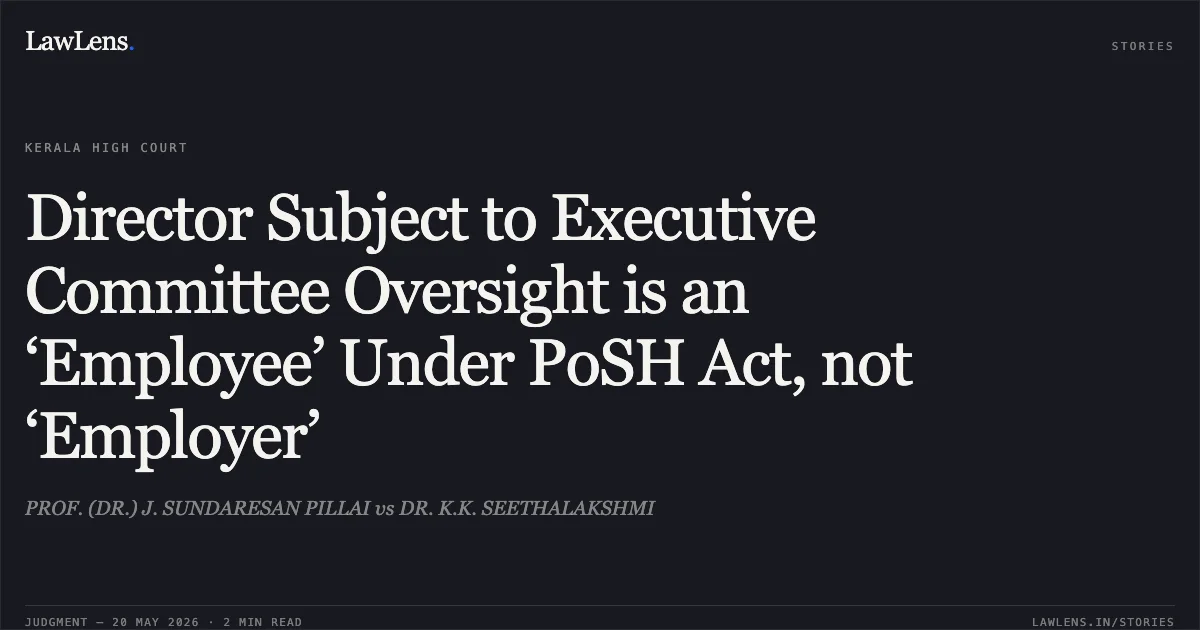
The court answered the issues by holding that the Director of IRTC is an "employee" and not the "employer" within the meaning of the PoSH Act. Therefore, the ICC has the legal authority and jurisdiction to receive and inquire into the complaint
The Court found no illegality or perversity in the Single Judge’s judgment and dismissed the writ appeal. No interference with the ICC proceedings was granted.
Source reference: para. 18Original Court PDF
PROF. (DR.) J. SUNDARESAN PILLAIvsDR. K.K. SEETHALAKSHMI
Click to open original judgment
Original judgment, available to read, download and summarize on LawLens.in