Facts
The petitioner, an Ex-Corporal of the Indian Air Force, was discharged in 1979 after being diagnosed with "Bronchial Asthma," assessed at 30% disability for life.
Source reference: para 2He received disability pension until 18.08.1980, after which it was discontinued on the grounds that he failed to appear for a Re-survey Medical Board (RSMB).
Source reference: para 2Pursuant to a court order, an RSMB was finally conducted on 19.11.2019, which confirmed that the petitioner’s 30% disability had remained "constant from 19.08.1980 onwards".
Source reference: para 2The AFT allowed the claim but restricted arrears to the date of the 2019 medical board.
Source reference: para 2The petitioner approached the High Court seeking arrears from the original date of stoppage in 1980.
Source reference: para 1Issues
1. Whether the disability pension arrears can be restricted to the date of a subsequent Medical Board (19.11.2019) when the board itself certifies the disability was constant since the original date of stoppage (19.08.1980).
Source reference: para 2, 72. Whether the respondents were justified in withholding pension based on alleged non-appearance at a medical board without proof of service of notice.
Source reference: para 11Law Applied
The Court relied on the Constitution of India, Articles 226 and 227.
Source reference: no citationThe principle established by the Hon’ble Supreme Court in Union of India v. Sgt Girish Kumar (2026), which held that the right to receive disability pension is a valuable right that must be granted from the date it became due and cannot be arbitrarily restricted to three years prior to the filing of the application.
Source reference: para 8The landmark ruling in D.S. Nakara v. Union of India (1983), establishing that pension is not a bounty or a matter of discretion but a right earned by service, governed by statutory rules.
Source reference: para 9Reasoning
The Court reasoned that once the RSMB (conducted in 2019) recorded a retrospective finding that the petitioner’s disability remained constant at 30% desde 19.08.1980, there was no legal basis to deny arrears for that intervening period.
Source reference: para 7The Court observed that the AFT’s decision to limit arrears was a "non-reasoned" order that ignored the retrospective nature of the medical evidence.
Source reference: para 11The Court noted that the respondents failed to produce any evidence proving the petitioner was served notice for the RSMB in 1980 and attributed the decades-long delay to the respondents, who had weeded out the petitioner's medical records and failed to act on his 1990 representation.
Source reference: para 10, 11The Court held that the petitioner could not be penalized for the administrative lapses of the State.
Source reference: para 9, 11Holding
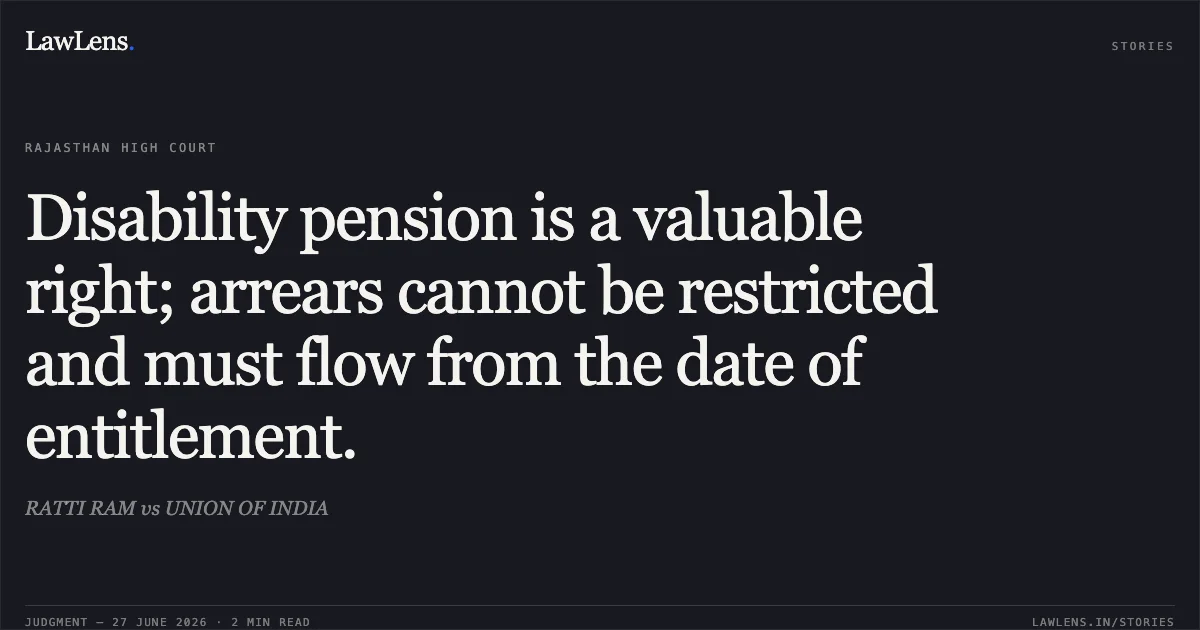
The High Court held that the petitioner is entitled to disability pension arrears starting from 19.08.1980 (the date of unlawful stoppage) until the date of actual payment.
The High Court allowed the writ petition in part, modifying the AFT judgment and directing the respondents to compute and pay the arrears—calculated at 30% disability element, rounded up to 50%—within four months, failing which a 6% per annum interest rate would apply.
Source reference: para 13, 13(ii-iii)Acts & Sections Cited
1 provisions across 1 statute referred to in this judgment. Each provision opens on LawLens.
Armed Forces Tribunal Act, 20071
Original Court PDF
RATTI RAMvsUNION OF INDIA
Click to open original judgment
Original judgment, available to read, download and summarize on LawLens.in