Facts
Respondent 1, a Deputy Central Intelligence Officer, was subjected to disciplinary proceedings for allegedly using abusive language and physically assaulting a colleague
Source reference: para 1The Inquiry Officer (IO) cleared him of charges on January 7, 2015
Source reference: para 1Disagreeing with the IO, the Disciplinary Authority (DA) issued a "Disagreement Note" on June 6, 2016, concluded the charges were "amply proved," and subsequently imposed a penalty of pay reduction until his superannuation in 2020
Source reference: para 2The Central Administrative Tribunal (CAT) quashed the proceedings entirely, holding that the Disagreement Note was not "tentative" but represented a final opinion, and ruled that further proceedings after retirement were unwarranted
Source reference: para 4The Union of India challenged this wholesale quashing before the High Court
Source reference: para 5Issues
1. Whether the Disagreement Note issued by the Disciplinary Authority was tentative in nature or expressed a final opinion on the guilt of the employee
Source reference: para 102. Whether the Tribunal was legally justified in quashing the disciplinary proceedings in their entirety instead of remanding the matter to the stage of the procedural defect
Source reference: para 16Law Applied
The court applied the principle that a Disagreement Note must be tentative to afford the delinquent employee a meaningful opportunity to respond; a foregone conclusion violates principles of natural justice
Source reference: para 11It relied on Managing Director, ECIL v. B. Karunakar (1993), which mandates that if proceedings are vitiated by procedural impropriety, the court must remand the matter to the stage where the error occurred rather than quashing the case wholesale
Source reference: para 17It further referenced Rule 9 of the Central Civil Services (Pension) Rules, 1972 (and corresponding 2021 Rules), which permits the President to continue departmental proceedings against a retired employee for the purpose of withholding or withdrawing pension due to grave misconduct
Source reference: para 19Reasoning
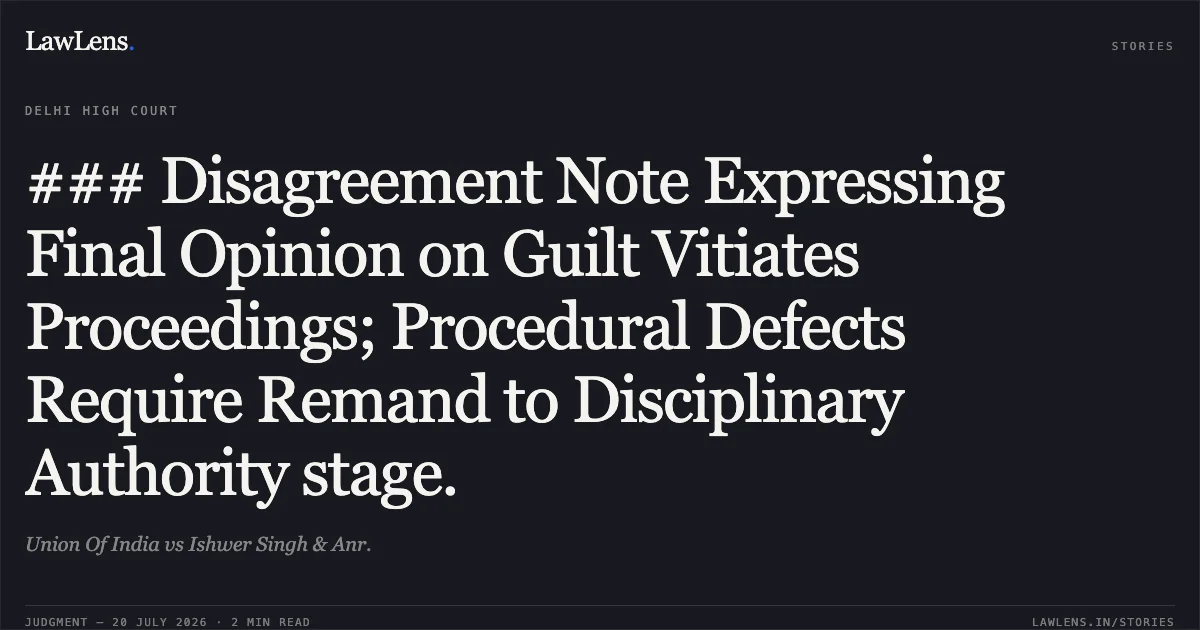
The Court observed that the DA’s note concluding that charges "stand amply proved" left no room for the respondent to defend himself, rendering the reply an "empty formality"
Source reference: para 11-12the Tribunal's finding on the defect in the Disagreement Note was upheld
Source reference: para 14However, the Court found the Tribunal’s decision to quash the entire proceedings legally unsustainable
Source reference: para 18Applying the B. Karunakar doctrine, the Court reasoned that procedural errors require a "reset" to the point of the error, not a total exoneration
Source reference: para 17The Court rejected the Tribunal's view that the Respondent's length of service or retirement served as an embargo, noting that statutory provisions under the CCS (Pension) Rules specifically allow for the continuation of such proceedings post-retirement if initiated while in service
Source reference: para 18-19Holding
The High Court partly allowed the writ petition
It upheld the quashing of the penalty and the specific Disagreement Note for being non-tentative
Source reference: para 22it set aside the wholesale quashing of the disciplinary proceedings and remanded the matter back to the Disciplinary Authority
Source reference: para 22The DA is directed to re-examine the IO report within four weeks; if it chooses to disagree, it must issue a fresh, legally valid tentative Disagreement Note
Source reference: para 23The Court restrained the Petitioner from taking adverse action until the de novo decision is reached
Source reference: para 24Original Court PDF
Union Of IndiavsIshwer Singh & Anr.
Click to open original judgment
Original judgment, available to read, download and summarize on LawLens.in


