Facts
The Petitioner, a Director of an industrial firm, alleged that officials of the Directorate General of Central Excise Intelligence (DGCEI) illegally detained and tortured him in June 2009 at Kanpur
Source reference: p. 2He further alleged that on 10.11.2009, Respondent officers abducted him from a hotel in Paharganj, Delhi, detained him overnight, and assaulted him to extort a confession
Source reference: p. 3The Petitioner filed a complaint under Section 200 CrPC. The Trial Court initially framed charges under Sections 323/348/365/368/506/34 and 120B IPC
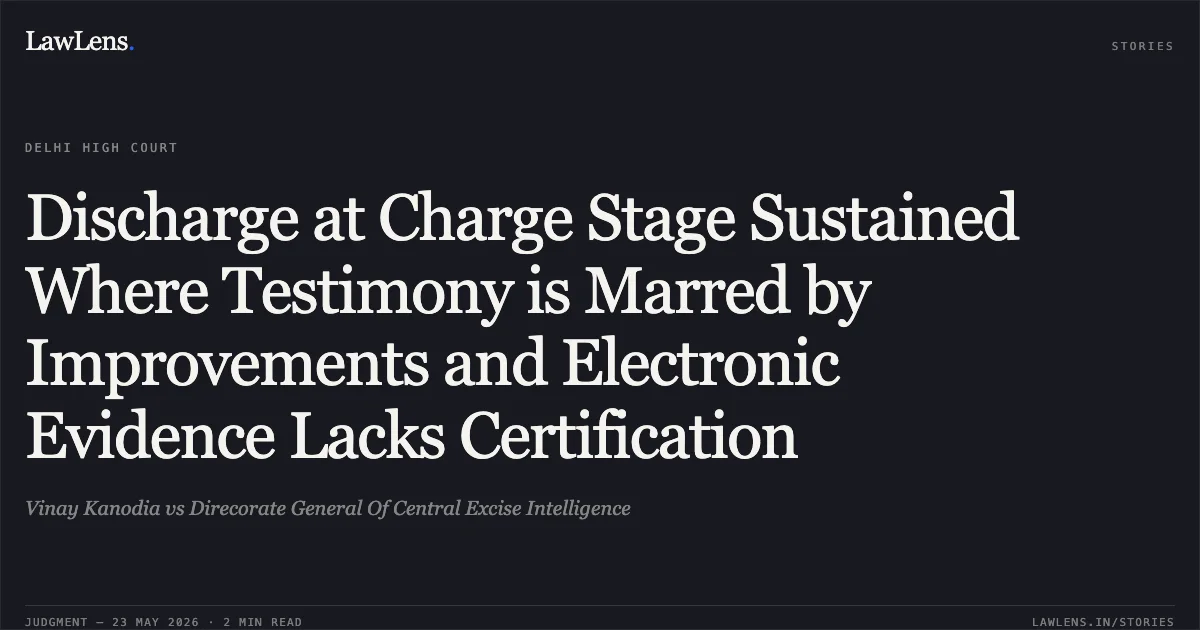
Source reference: p. 5However, the Sessions Court, in its revisional jurisdiction, set aside the charges and discharged the Respondents, noting material contradictions, lack of medical corroboration, and inadmissible electronic evidence
Source reference: p. 6, 7Issues
1. Whether the material on record disclosed "grave suspicion" against the accused sufficient to sustain charges at the stage of Sections 227/228 CrPC.
Source reference: para. 15-182. Whether the electronic evidence (CCTV footage) was admissible in the absence of a certificate under Section 65B of the Indian Evidence Act.
Source reference: para. 22-233. Whether the Sessions Court exceeded its revisional jurisdiction by discharging the accused.
Source reference: para. 14, 33Law Applied
The Court relied on Section 227 and 228 of the CrPC regarding discharge and framing of charge
Source reference: para. 15It applied the principles from Sajjan Kumar v. CBI, which held that while a "mini-trial" is prohibited, the judge must sift evidence to determine if "grave suspicion" exists rather than mere suspicion
Source reference: para. 15Regarding electronic records, the Court applied Section 65B of the Indian Evidence Act, 1872, as interpreted in Anvar P.V. v. P.K. Basheer, which mandates a certificate for the admissibility of secondary electronic evidence
Source reference: para. 22It further noted the limitations of Revisional Jurisdiction, emphasizing that the High Court should not interfere unless the lower court's order is perverse or untenable
Source reference: para. 14Reasoning
The Court found that the Petitioner’s testimony was marred by significant "improvements" and "embellishments," as he failed to mention specific roles of the nine accused in his initial complaints or pre-summoning evidence
Source reference: para. 20The Court observed that the MLCs lacked details on the "age of injuries," and no adverse physical reports were made by the Duty Magistrate or Tihar Jail authorities upon the Petitioner's remand
Source reference: para. 21Crucially, the CCTV footage from the hotel was deemed legally inadmissible because the Petitioner failed to provide a Section 65B certificate; furthermore, the witness (PW3) admitted he did not prepare the CD himself
Source reference: para. 23The Court reasoned that the Respondents, acting as public servants, maintained they followed official summons, and the inconsistencies in the Petitioner’s version failed to meet the threshold of "grave suspicion" required to proceed to trial
Source reference: para. 25-27, 31Holding
The Court held that the Petitioner failed to establish a prima facie case due to the unreliability of the medical and electronic evidence and the material contradictions in his statements
The High Court dismissed the revision petitions and upheld the Sessions Court's order of discharge; It concluded that there was no palpable perversity in the Sessions Court's decision to discharge the Respondents
Source reference: para. 33, 34Acts & Sections Cited
1 provisions across 1 statute referred to in this judgment. Each provision opens on LawLens.
Central Excise Act, 19441
Original Court PDF
Vinay KanodiavsDirecorate General Of Central Excise Intelligence
Click to open original judgment
Original judgment, available to read, download and summarize on LawLens.in