01Facts
The petitioners, A1 (husband of the deceased, Praba) and A2 (his mother), are facing trial in S.C. No. 11 of 2020 before the Sessions Judge, Mahila Neethimandram, Salem, on a final report in Crime No. 102 of 2019
p. 2The original FIR offences were under Sections 294(b), 323 and 506(ii) IPC read with Section 4 of the Prohibition of Harassment of Women Act. After the deceased's death, the charges were altered to Sections 294(b), 302 and 34 IPC
pp. 2–3The prosecution alleges that on 15.03.2019 the petitioners abused and threatened the deceased, A2 held her down, and A1 poured poison into her mouth. She died on 16.03.2019 of paraquat poisoning
pp. 5–6 · ¶ 13The deceased first stated that she had consumed poison herself, but later told the Judicial Magistrate that the petitioners administered it
p. 6 · ¶ 13The petitioners sought discharge under Section 250 BNSS (Section 227 CrPC). The Trial Court dismissed the petition by order dated 16.06.2026 in Crl.MP No. 630 of 2021, holding that materials existed to frame charges and that the defence grounds required a full trial
p. 6 · ¶ 14The petitioners then filed this revision
p. 2 · ¶ 2(b)02Issues
i.1. Whether the Trial Court erred in refusing to discharge the petitioners under Section 250 BNSS/227 CrPC for offences under Sections 294(b), 302 and 34 IPC, where the petitioners contend that the charge sheet discloses no prima facie offence
pp. 3–4 · ¶ 4 · p. 5 · ¶ 10–11ii.2. Whether contradictions in the dying declarations, the witness statements, and the medical evidence (including the claim of voluntary consumption of poison) can be resolved at the discharge stage or must await trial
pp. 3–4 · ¶ 5–6 · pp. 5–6 · ¶ 12–1403Law Applied
Section 250 BNSS (Section 227 CrPC), under which discharge is considered on the final report, the documents filed with it, the Section 180 BNSS (Section 161 CrPC) statements, and the confessions
p. 5 · ¶ 11The settled principle that the court may not conduct a roving enquiry or mini-trial at this stage and must determine only whether prima facie materials exist for framing charges
p. 5 · ¶ 12In State of Tamil Nadu v. N. Suresh Rajan (2014) 11 SCC 709, the court cannot act as a post office or mouthpiece of the prosecution, must assume the prosecution materials are true, and must ask whether the facts, taken at face value, disclose the ingredients of the offence; probative value is not weighed
pp. 6–7 · ¶ 15In State (by Inspector of Police, Chennai) v. S. Selvi (2018) 13 SCC 455, the trial judge may sift evidence only to determine whether a prima facie case exists, grave suspicion warrants framing charges, and mere suspicion warrants discharge
pp. 8–10 · ¶ 17Under State v. A. Arun Kumar (2015) 2 SCC 417, the presumption of guilt drawn at this stage is for deciding prima facie sufficiency only
p. 7 · ¶ 16In Amit Kapoor v. Ramesh Chander (2012) 9 SCC 460, framing of charge is a tentative view, and a High Court may not re-appreciate evidence in revision
pp. 10–11 · ¶ 18The State's contention that the Revision Petitioners' conduct, including risk of tampering or absconding, was relevant
p. 4 · ¶ 8Provisions in the judgment · 14 · Linked ones open on LawLens
Indian Penal Code, 1860 Section 294Section 302Section 34Section 323Section 506
Code of Criminal Procedure, 1973 Section 227Section 161Section 173Section 239Section 228
Bharatiya Nagarik Suraksha Sanhita, 2023 Section 250Section 180Section 193
Sexual Harassment of Women at Workplace (Prevention, Prohibition and Redressal) Act, 2013 Section 4
04Reasoning
The Court accepted the Trial Court's finding that the final report and statements disclosed prima facie material for the alleged offences
p. 6 · ¶ 14 · p. 11 · ¶ 19It treated the petitioners' challenges (contradictory dying declarations, inconsistent witness statements, and the claim that the deceased consumed poison voluntarily) as factual disputes that require appreciation of evidence, which is impermissible at the framing-of-charge stage
pp. 5–6 · ¶ 10, 12–13 · p. 7 · ¶ 15Applying the Suresh Rajan and Selvi standards, the Court held that the question was not whether conviction was warranted but whether the materials raised a prima facie inference of the ingredients of Sections 294(b), 302 and 34 IPC
p. 7 · ¶ 15 · p. 10 · ¶ 17Relying on Amit Kapoor, the Court held that the High Court in revision cannot re-evaluate evidence to quash charges where the correctness of allegations can be tested only at trial
pp. 10–11 · ¶ 18The Court did not rest its reasoning on the State's apprehension about absconding or tampering, and it confined its observations to the revision
p. 4 · ¶ 8 · p. 12 · ¶ 2105Holding
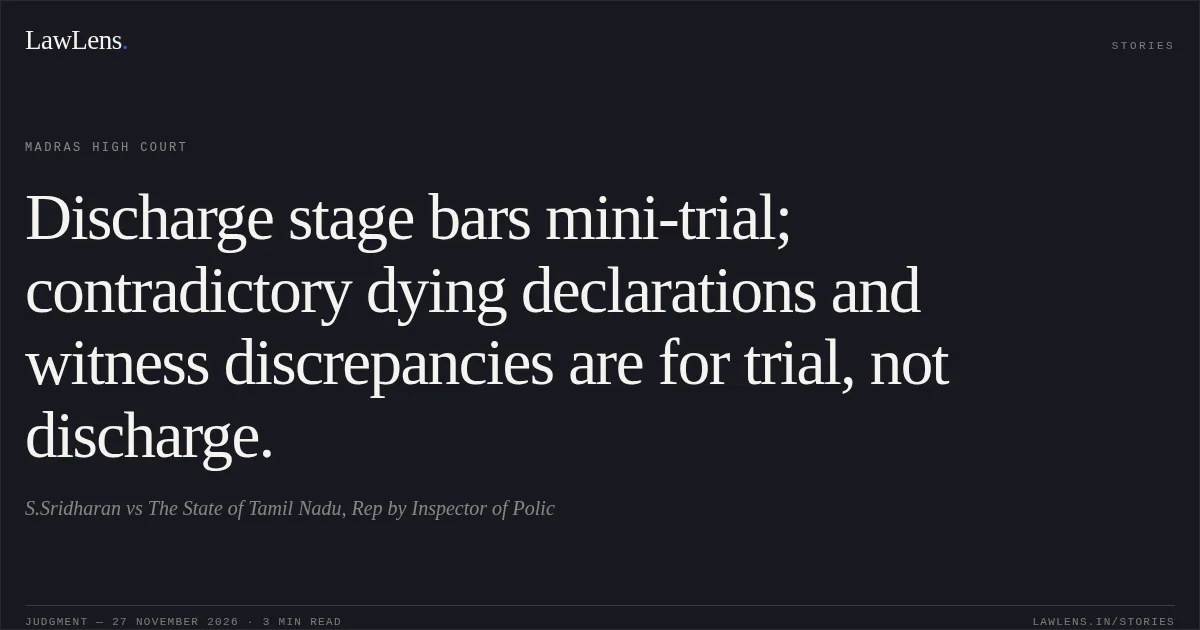
The discharge issues raised by the petitioners could be decided only after a full trial and no mini-trial is permissible at the stage of framing charges
p. 11 · ¶ 19The Criminal Revision Case is dismissed without costs, and the connected Crl.MP is closed
p. 12 · ¶ 20The Court clarified that its observations are limited to disposing of the revision and do not affect the petitioners' defence at trial. It directed the Trial Court to proceed with the trial in accordance with law
p. 12 · ¶ 21–22Original Court PDF
S.SridharanvsThe State of Tamil Nadu, Rep by Inspector of Polic
Click to open original judgment
Original judgment, available to read, download and summarize on LawLens.in