01Facts
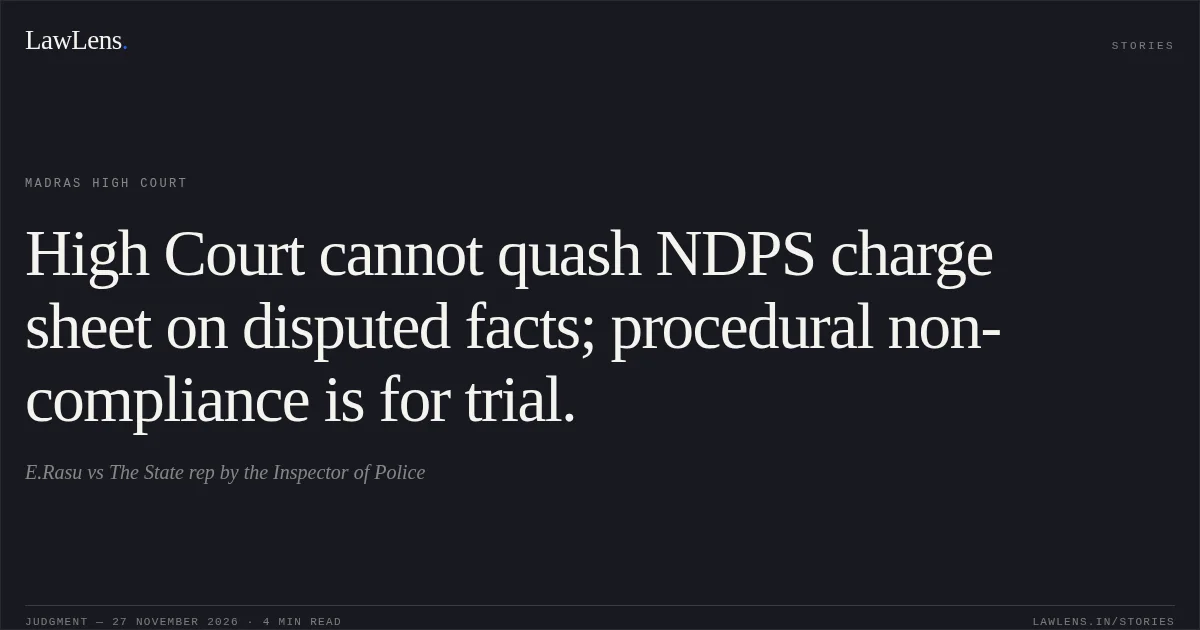
The petitioner sought to quash the charge sheet and cognisance in Special C.C. No. 66 of 2022 (Special Court under the EC and NDPS Act, Salem) for offences under Sections 8(c) and 20(b)(ii)(B) of the NDPS Act, 1985.
¶ 1 · p. 2On a complaint by the Sub-Inspector (2nd respondent), Crime No. 96 of 2021 was registered at Arcot Town Police Station, alleging that the petitioner was found in possession of 1.100 kg of ganja. After investigation, the final report was filed and cognisance was taken.
¶ 2 · p. 2The petitioner contended that the contraband, seized on arrest, was produced before the Court only after one year.
¶ 3 · pp. 2–3The petitioner contended that consent for the search by the police officer was not established and that the petitioner disputed the signature on the search memo.
¶ 3 · pp. 2–3The petitioner contended that at remand he stated he was not served with the grounds of arrest and his father was not duly intimated, and that the father's signature on the intimation was disputed.
¶ 3 · pp. 2–3The petitioner contended that the complainant-SI recorded all witness statements and had no authority to draw samples, which ought to have been drawn under magisterial supervision; that the consent letter was not signed by him; and that the FSL report lacked a verifiable chain of custody and compliance with Section 52A of the NDPS Act.
¶ 4 · pp. 3–4The respondent-State maintained that the prosecution was conducted in accordance with the NDPS Act.
¶ 5–6 · pp. 4–502Issues
i.1. Whether the High Court, exercising its powers under Section 528 of the BNSS, can quash the charge sheet and cognisance where the petitioner's defences (non-compliance with NDPS procedure, delayed production, consent to search, signatures, arrest-ground and intimation defects, and sampling/chain of custody) involve disputed questions of fact.
¶ 5–8 · pp. 4–6ii.2. Whether the question of malice in initiating the criminal proceedings can be decided at the quashing stage.
¶ 9 · pp. 6–703Law Applied
The Court relied on Section 528 of the BNSS as the source of its inherent jurisdiction to quash proceedings.
¶ 7 · p. 5The Court applied the principle from Devendra Prasad Singh v. State of Bihar (2019) 4 SCC 351 that High Courts cannot appreciate witness statements to find inconsistencies or absence of a prima facie case; such assessment belongs to the trial court, or to the appellate court, including under Section 180 of the BNSS.
¶ 6 · pp. 4–5The Court followed CBI v. Arvind Khanna (2019) 10 SCC 686, holding that the High Court cannot record findings on disputed facts and that the accused's defence must be tested by the trial court on appreciation of evidence.
¶ 7 · p. 5The Court adopted M. Jayanthi v. K.R. Meenakshi (Crl.A. No. 1817 of 2019, dated 02.12.2019), under which the quashing court examines only whether the allegations, taken at face value, disclose the ingredients of the offence and whether preconditions for cognisance are met, without enquiring into the evidence's validity.
¶ 8 · pp. 5–6The Court treated the question of malicious prosecution as requiring evaluation of facts that can be examined only at the conclusion of trial.
¶ 9 · pp. 6–7Section 52A of the NDPS Act (sampling procedure) and Sections 8(c) and 20(b)(ii)(B) were noted as the relevant statutory framework.
¶ 2 · p. 2 · ¶ 4 · p. 4Provisions in the judgment · 4 · Linked ones open on LawLens
Bharatiya Nagarik Suraksha Sanhita, 2023 Section 528Section 180
Narcotic Drugs and Psychotropic Substances Act, 1985 Section 8Section 20
04Reasoning
The prosecution alleges specific possession of a commercial quantity of 1.100 kg of ganja, and the final report was filed after investigation and taken cognisance of by the trial court.
¶ 5 · p. 4The petitioner's objections, namely the remand statements, the disputed signatures on the search memo and intimation, the consent to search, the authority to draw samples, and the sampling and chain of custody under Section 52A, all turn on factual disputes and the evidence led at trial. Those disputes cannot be resolved in a Section 528 BNSS petition without appreciating evidence, which the Supreme Court precedents bar.
¶ 5–7 · pp. 4–5The remand statements could be considered only through evidence during trial, and the alleged procedural non-compliance could be tested by cross-examining prosecution witnesses.
¶ 5 · p. 4Applying Jayanthi, the allegations in the charge sheet, if accepted, disclose the offences charged, and the petitioner's ability to prove non-compliance is a matter for trial.
¶ 8 · pp. 5–6The malice allegation was likewise held to require full factual consideration and was left for trial.
¶ 9 · pp. 6–705Holding
The Court answered the first issue in the negative: the High Court cannot quash the charge sheet on defences involving disputed facts and evidentiary appreciation under Section 528 BNSS.
¶ 5–8 · pp. 4–6On the second issue, malice is not to be determined at the quashing stage and is reserved for the conclusion of trial.
¶ 9 · pp. 6–7The Criminal Original Petition is dismissed. The Special Court, Salem, is directed to complete the trial in Special C.C. No. 66 of 2022 within six months from receipt of the order, and the connected Criminal Miscellaneous Petition (Crl.M.P. No. 22295 of 2026) is closed.
¶ 10 · pp. 6–7Original Court PDF
E.RasuvsThe State rep by the Inspector of Police
Click to open original judgment
Original judgment, available to read, download and summarize on LawLens.in