Facts
The informant alleged that he had purchased and possessed a 39-decimal plot, which was later advertised for auction after a loan default. He claimed that Arjun Yadav and Bhagwan Yadav had obtained a bank loan by forging documents and mortgaging his land.
Source reference: p. 2–4, para. 3Although the FIR did not name opposite parties 2 and 3, the investigating agency charge-sheeted them: opposite party 2 was a bank senior manager and opposite party 3 was the bank’s retained legal adviser.
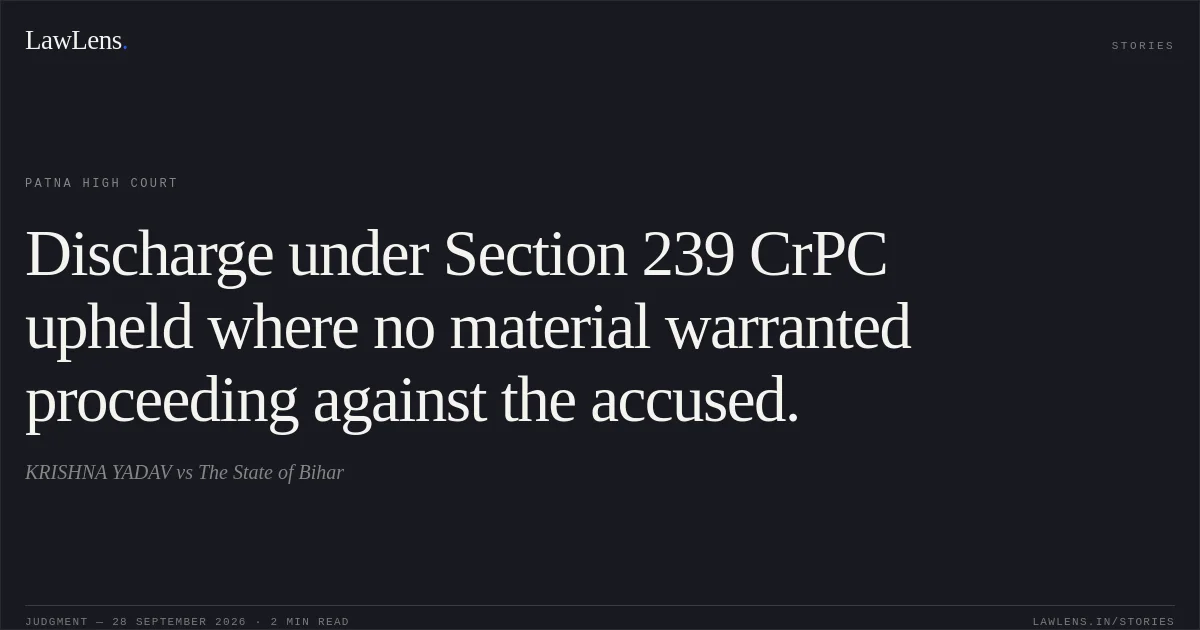
Source reference: p. 4, para. 5The Magistrate took cognizance but subsequently discharged them under Section 239 CrPC by order dated 19 December 2018. The informant sought to have that discharge order quashed.
Source reference: p. 1, p. 4–5, paras. 2, 5Issues
1. Whether the Magistrate’s order discharging opposite parties 2 and 3 under Section 239 CrPC warranted interference.
Source reference: p. 1, p. 7, paras. 2, 102. Whether the discharge order was unsustainable for want of proper application of judicial mind to the investigation materials.
Source reference: p. 1, para. 2Law Applied
Section 239 CrPC permits a Magistrate, in a case instituted on a police report, to discharge an accused where the Magistrate considers the charge to be groundless.
Source reference: p. 6–7, para. 9As explained in State of Tamil Nadu v. R. Soundirarasu, Sections 227 and 239 provide for discharge before evidence is recorded, on consideration of the case record and documents, together with an opportunity for the parties to be heard; Section 245 applies at a later stage after evidence under Section 244 has been taken.
Source reference: p. 6–7, para. 9, quoting R. Soundirarasu, paras. 53–54Reasoning
The High Court considered the challenge to the Magistrate’s discharge order and the State’s submission that opposite party 3 had provided only legal advice, no material sufficient to support a conviction had been found against either opposite party, and the informant had not initially named them.
Source reference: p. 6, para. 7Applying the discharge principles under Section 239 CrPC, as described in R. Soundirarasu, the Court found no sufficient basis to question the reasons given by the Magistrate and declined to interfere.
Source reference: p. 7, paras. 9–10Holding
The High Court held that the petition lacked merit and that the order discharging opposite parties 2 and 3 did not require interference.
The petition was dismissed, and a copy of the judgment was directed to be sent to the trial court with the trial-court record, if any.
Source reference: p. 7–8, paras. 10–12Acts & Sections Cited
10 provisions across 2 statutes referred to in this judgment. Each provision opens on LawLens.
Indian Penal Code, 18606
Code of Criminal Procedure, 19734
Original Court PDF
KRISHNA YADAVvsThe State of Bihar
Click to open original judgment
Original judgment, available to read, download and summarize on LawLens.in