Facts
The petitioner, an employee of M.P. Madhya Kshetra Vidyut Vitran Co. Ltd., was issued a show-cause notice concerning certain alleged irregularities. After receiving his reply dated 22 May 2024, the Disciplinary Authority passed an order dated 11 June 2024 imposing the punishment of withholding one annual increment for one year without cumulative effect.
Source reference: para. 2; para. 4The petitioner appealed against the punishment order on 1 August 2024. The Appellate Authority rejected the appeal by order dated 22 May 2025. The petitioner challenged both orders under Article 226 of the Constitution, contending that neither authority had properly considered his explanation and that both orders were non-speaking and unreasoned.
Source reference: para. 1–2; para. 6Issues
Whether the Disciplinary Authority’s order imposing punishment was invalid for failure to consider the petitioner’s reply and for not providing adequate reasons.
Source reference: para. 5Whether the Appellate Authority’s order rejecting the appeal was invalid for failure to independently consider the grounds of appeal and for being non-speaking.
Source reference: para. 7Whether the impugned orders were required to be quashed and the matter remanded for fresh consideration by a reasoned and speaking order.
Source reference: para. 12–13Law Applied
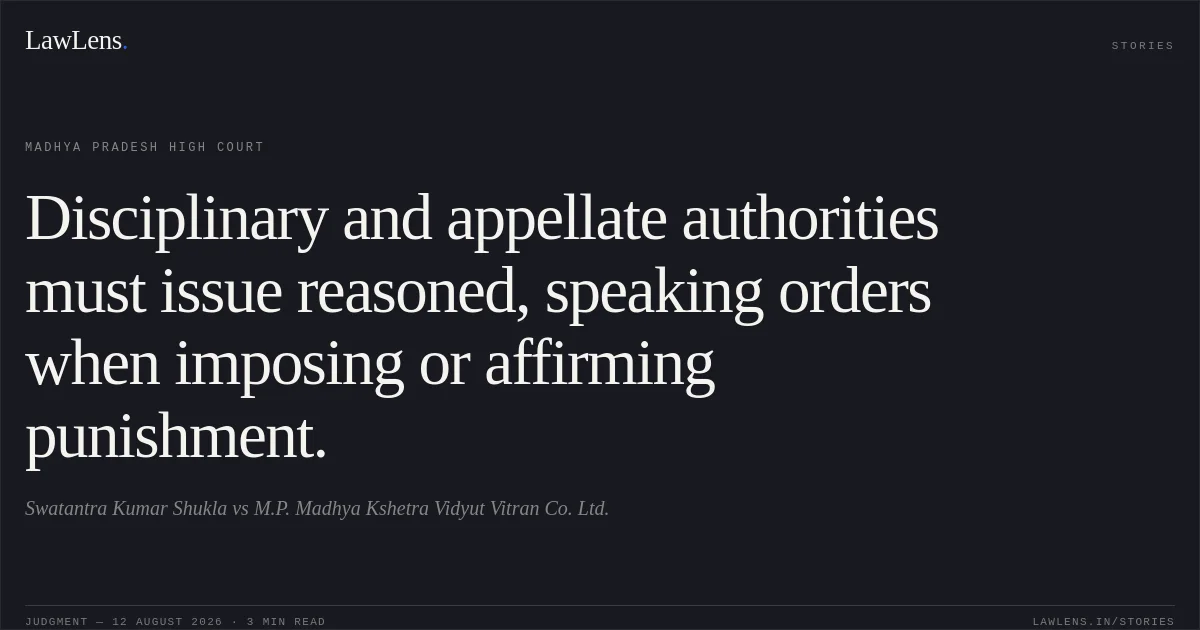
A disciplinary authority exercising quasi-judicial powers must apply its mind to the relevant facts, consider the employee’s defence, and record cogent, clear, and justifiable reasons. The same obligation applies to an appellate authority deciding a statutory or departmental appeal.
Source reference: para. 5, 7–8In State of Punjab v. Bandip Singh, (2016) 1 SCC 724, the Supreme Court held that every administrative or executive decision affecting rights must be composite and self-sustaining and must contain the reasons that prevailed with the decision-maker.
Source reference: para. 9–10The Court also relied on Kranti Associates (P) Ltd. v. Masood Ahmed Khan, (2010) 9 SCC 496, which establishes that recording reasons is an essential component of fair administrative and quasi-judicial decision-making, restrains arbitrariness, demonstrates consideration of relevant factors, and facilitates judicial review.
Source reference: para. 11Reasoning
The High Court examined the punishment order and found that it merely stated that the petitioner’s reply and supporting documents were not acceptable, without explaining why the defence was rejected or how the alleged misconduct was established.
Source reference: para. 4–5Since the Disciplinary Authority was exercising quasi-judicial powers, it was required to provide a reasoned determination rather than a conclusion unsupported by analysis. The appellate order also failed to demonstrate proper consideration of the petitioner’s specific grounds and effectively affirmed the punishment without supplying an adequate independent reasoning process. Applying the principles in Bandip Singh and Kranti Associates, the Court held that the orders did not satisfy the requirement of reasoned decision-making and were therefore vulnerable to judicial review.
Source reference: para. 5, 8; para. 6–7; para. 8–11Holding
The Court held that both the punishment order dated 11 June 2024 and the appellate rejection order dated 22 May 2025 were non-speaking and unsustainable. Both orders were quashed.
The matter was remanded to the Disciplinary Authority, which was directed to pass a fresh, reasoned, and speaking order in accordance with law within three months from receipt of the certified copy of the judgment. The authority was required to consider every fact stated in the petitioner’s reply dated 22 May 2024, any fresh reply submitted within three weeks, and to provide the petitioner a personal hearing. The writ petition was accordingly disposed of.
Source reference: para. 13–14Original Court PDF
Swatantra Kumar ShuklavsM.P. Madhya Kshetra Vidyut Vitran Co. Ltd.
Click to open original judgment
Original judgment, available to read, download and summarize on LawLens.in