Facts
The petitioner, an Assistant Grade III, was subjected to departmental proceedings after a charge-sheet was issued against him. He denied the charges. An Enquiry Officer and Presenting Officer were appointed, and the Enquiry Officer submitted a report finding the charges proved.
Source reference: p.2, para. 2The Disciplinary Authority supplied the enquiry report to the petitioner, who submitted his explanation dated 27 May 2015 and was granted a personal hearing on 12 June 2015.
Source reference: p.2, para. 2By order dated 26 September 2015, the Disciplinary Authority imposed the major penalty of reversion under Rule 10(5) of the Madhya Pradesh Civil Services (Classification, Control and Appeal) Rules, 1966.
Source reference: p.3–4, para. 5The petitioner’s appeal, filed on 29 October 2015, was rejected by the Appellate Authority on 18 December 2018, despite a personal hearing having been granted on 8 June 2017.
Source reference: p.2, para. 2; p.4–5, para. 7The petitioner challenged both orders under Article 226 of the Constitution, principally contending that his explanation, defence, and appellate grounds had not been properly considered and that both orders were non-speaking and unreasoned.
Source reference: p.1–2, paras. 1–2Issues
1. Whether the Disciplinary Authority’s punishment order was invalid for failure to consider the petitioner’s explanation and for being a non-speaking and unreasoned quasi-judicial order.
Source reference: p.3–4, paras. 5–62. Whether the Appellate Authority’s order rejecting the appeal was invalid for failure to independently consider the petitioner’s grounds and for not providing adequate reasons.
Source reference: p.4–5, paras. 7–83. Whether the petitioner was entitled to consequential monetary and other service benefits after quashing of the disciplinary and appellate orders, particularly when he had already retired.
Source reference: p.10, paras. 13–14Law Applied
The Court applied Rule 10(5) of the Madhya Pradesh Civil Services (Classification, Control and Appeal) Rules, 1966, under which the Disciplinary Authority imposed the penalty of reversion.
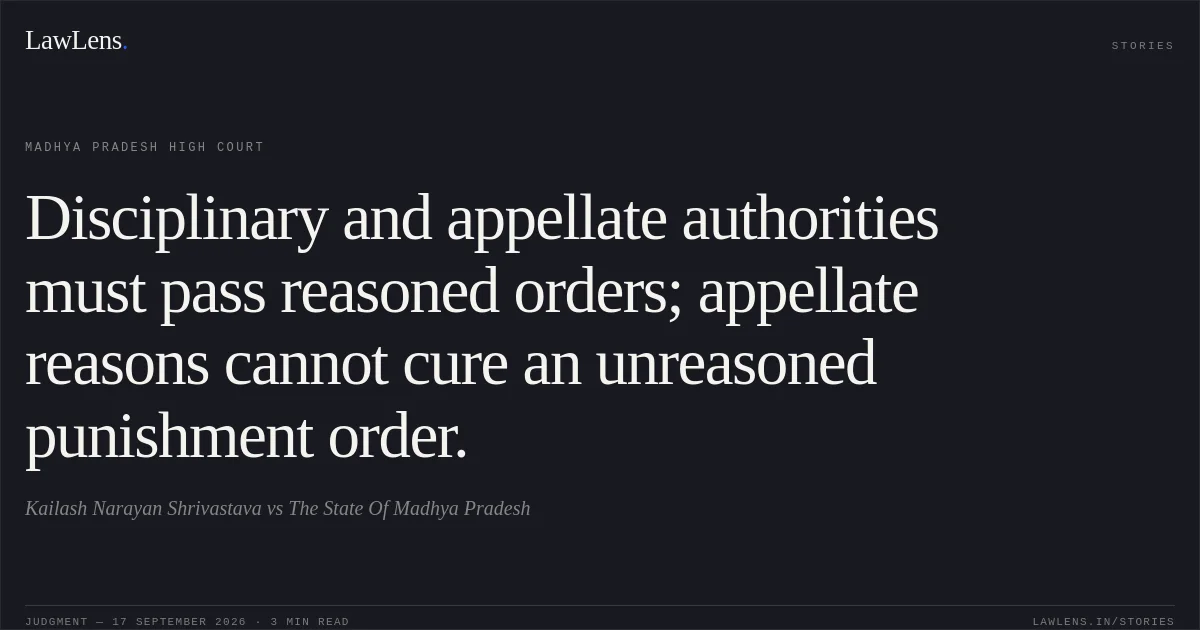
Source reference: p.3–4, para. 5It held that a Disciplinary Authority and an Appellate Authority exercising quasi-judicial powers must pass reasoned and speaking orders after applying their minds to the relevant facts, evidence, defence, and grounds of appeal.
Source reference: p.3–4, paras. 6, 8–9Relying on State of Punjab v. Bandip Singh, (2016) 1 SCC 724, the Court reiterated that administrative decisions affecting rights must be self-contained, reasoned, and free from arbitrariness.
Source reference: p.6–7, paras. 10–11It further relied on Kranti Associates Pvt. Ltd. v. Masood Ahmed Khan, (2010) 9 SCC 496, which establishes that reasons are indispensable for fairness, transparency, accountability, and effective judicial review, and that the absence of reasons in the original order cannot be cured merely by reasons supplied in appeal.
Source reference: p.7–10, para. 12The Court also referred to Institute of Chartered Accountants of India v. L.K. Ratna, (1986) 4 SCC 537, for the principle that an appeal cannot serve as a complete substitute for a procedurally defective original decision.
Source reference: p.9–10, para. 12Reasoning
The Court found that the punishment order acknowledged receipt of the petitioner’s explanation and the grant of personal hearing but did not meaningfully address the defence raised therein.
Source reference: p.3–4, paras. 5–6Although the Disciplinary Authority recorded conclusions regarding the alleged unauthorised absence and continuation of binding work without formal approval, the order did not disclose adequate, reasoned consideration of the petitioner’s explanation or establish why the findings of misconduct warranted the particular penalty imposed.
Source reference: p.3–4, paras. 5–6The Appellate Authority similarly reproduced the petitioner’s contentions but rejected the appeal in general terms, without dealing point-by-point with the factual and legal grounds raised or independently evaluating the disciplinary order.
Source reference: p.4–5, paras. 7–8Applying the requirement that quasi-judicial orders must contain cogent and intelligible reasons, the Court held that both orders were non-speaking and therefore legally unsustainable.
Source reference: p.7–10, para. 12The appellate order could not cure the fundamental defect in the original punishment order.
Source reference: p.7–10, para. 12Holding
The High Court allowed the petition and quashed the Disciplinary Authority’s punishment order dated 26 September 2015 and the Appellate Authority’s rejection order dated 18 December 2018.
The respondents were directed to grant the petitioner all consequential and monetary benefits within three months from receipt of the certified order.
Source reference: p.10, para. 14Any unpaid amount would carry interest at 6% per annum from the date of entitlement until payment.
Source reference: p.10, para. 14Since the petitioner had already retired, the Court granted no liberty to the respondents to initiate fresh disciplinary action against him.
Source reference: p.10, para. 14Original Court PDF
Kailash Narayan ShrivastavavsThe State Of Madhya Pradesh
Click to open original judgment
Original judgment, available to read, download and summarize on LawLens.in