Facts
The petitioner, Inspector Rakesh Sharma, was subjected to departmental proceedings and, by order dated 23.04.2025, was punished with withholding of one annual increment with cumulative effect.
Source reference: para. 2He preferred a statutory appeal before the Director General of Police, Bhopal.
Source reference: para. 2The appellate authority rejected the appeal by order dated 08.01.2026, without addressing the facts and grounds raised in the nine-page appeal memorandum or providing substantive reasons.
Source reference: paras. 2, 5–6The petitioner challenged both the punishment order and the appellate order under Article 226 of the Constitution, principally contending that the appellate order was non-speaking and violated Regulation 273 of the Police Regulations and the principles laid down in Kranti Associates (P) Ltd. v. Masood Ahmed Khan, (2010) 9 SCC 496.
Source reference: paras. 1–2Issues
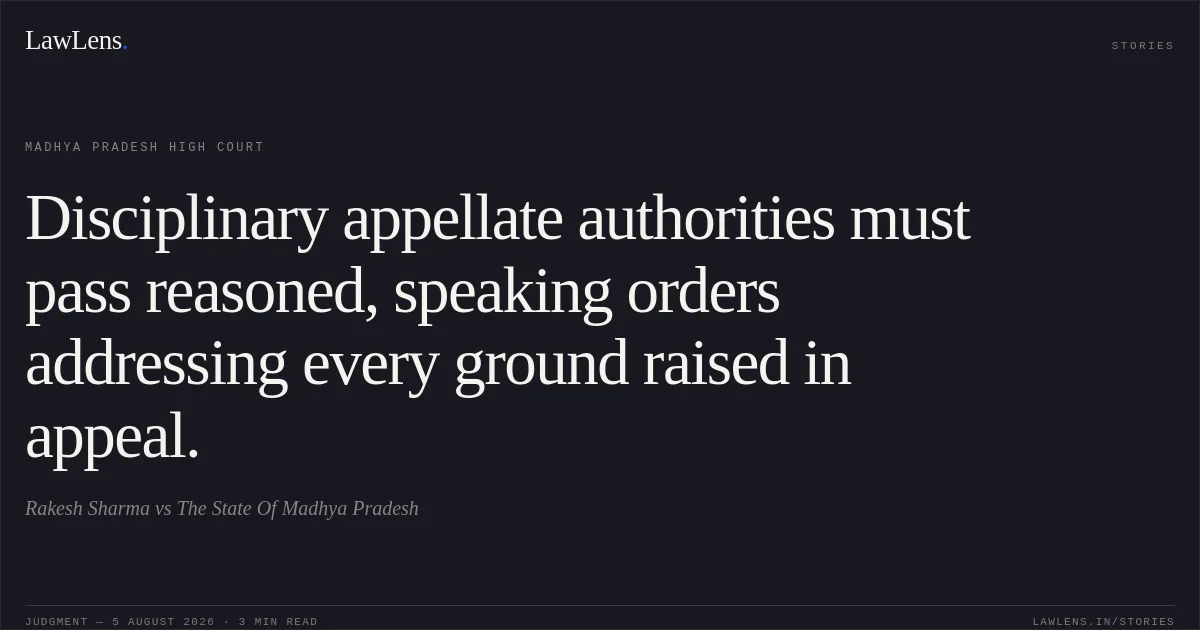
Whether the appellate authority’s order rejecting the petitioner’s departmental appeal, without considering the grounds raised or recording adequate reasons, violated Regulation 273 of the Police Regulations and the requirement of a speaking order.
Source reference: paras. 2, 5–7Whether the non-speaking appellate order was liable to be quashed and the appeal remitted for fresh consideration after granting the petitioner a personal hearing.
Source reference: paras. 6–7, 12–13Law Applied
Regulation 273 of the Police Regulations mandates that every appellate order must contain the reasons on which it is based and that a copy of the reasoned order be supplied to the appellant.
Source reference: para. 6A quasi-judicial authority exercising disciplinary appellate jurisdiction must apply its mind to the relevant facts and grounds and pass a reasoned and speaking order.
Source reference: para. 7Relying on Kranti Associates (P) Ltd. v. Masood Ahmed Khan, (2010) 9 SCC 496, the Court held that reasons are an essential component of fair decision-making, restrain arbitrary exercise of power, demonstrate consideration of relevant factors, and facilitate judicial review.
Source reference: para. 11It also relied on State of Punjab v. Bandip Singh, (2016) 1 SCC 724, for the principle that an administrative or executive decision must be composite and self-sustaining and contain the reasons that prevailed with the decision-maker.
Source reference: paras. 9–10Reasoning
The appellate authority merely stated that the punishment was legally valid and that the petitioner had raised no facts affecting the proved charges, concluding that the appeal was baseless.
Source reference: para. 5This conclusion did not disclose consideration of any of the specific facts or grounds contained in the nine-page appeal memorandum.
Source reference: para. 6Since the authority was exercising quasi-judicial appellate jurisdiction, Regulation 273 required it to record reasons, and the general principles in Kranti Associates and Bandip Singh required a genuine, intelligible application of mind rather than formulaic or “rubber-stamp” reasoning.
Source reference: paras. 6–11The Court therefore found that the appellate order was not a speaking order and could not sustain judicial scrutiny.
Source reference: para. 7Holding
The Court held that the appellate order dated 08.01.2026/22.12.2025 was contrary to Regulation 273 of the Police Regulations and the settled requirement that quasi-judicial orders contain adequate reasons.
The appellate order was quashed.
Source reference: para. 13The Director General of Police, Bhopal, was directed to reconsider the petitioner’s appeal afresh, consider every fact and ground raised in the appeal memorandum, provide the petitioner an opportunity of personal hearing, and pass a reasoned and speaking order within one month of receiving the certified copy of the judgment.
Source reference: para. 13The writ petition was accordingly disposed of.
Source reference: para. 14Original Court PDF
Rakesh SharmavsThe State Of Madhya Pradesh
Click to open original judgment
Original judgment, available to read, download and summarize on LawLens.in