Facts
The petitioner was posted as Estate Officer, Morena, in the M.P. Housing Board. On 4 March 1999, he issued an order distributing work between the Estate Manager, Mr. V.K. Sharma, and UDC/Assistant Estate Manager-II, Mr. B.S. Morya.
Source reference: para. 2A complaint was subsequently made by Prabhu Dayal Goyal regarding non-execution of a sale deed despite payment of the entire allotment amount. The Estate Manager reported the matter to the petitioner on 25 August 1999, and the petitioner endorsed directions on 28 August 1999 to trace the relevant file and proceed in accordance with law.
Source reference: paras. 2–3The petitioner’s charge was transferred on 31 January 2000. The sale deed in favour of Goyal was ultimately executed on 22 September 2000, while Mr. D.W. Joshi was holding the post.
Source reference: paras. 3–4Following proceedings before the Consumer Forum, the Housing Board was directed to pay Goyal interest of Rs.74,718/-. The disciplinary authority thereafter imposed recovery of Rs.74,718/- in the ratio of two-thirds from the petitioner and one-third from Mr. B.S. Morya.
Source reference: paras. 4, 6, 8The petitioner had received a show-cause notice and submitted a detailed reply denying responsibility. However, the disciplinary authority passed the order dated 11 March 2005 without adequately considering his defence. The appellate authority rejected his appeal by order dated 7 March 2007, also without recording reasons.
Source reference: paras. 4, 8–10During the pendency of the appeal, the petitioner deposited Rs.49,812/-—representing two-thirds of the recovery—under protest. He consequently sought quashing of both orders and refund of the deposited amount with interest.
Source reference: paras. 1, 5Issues
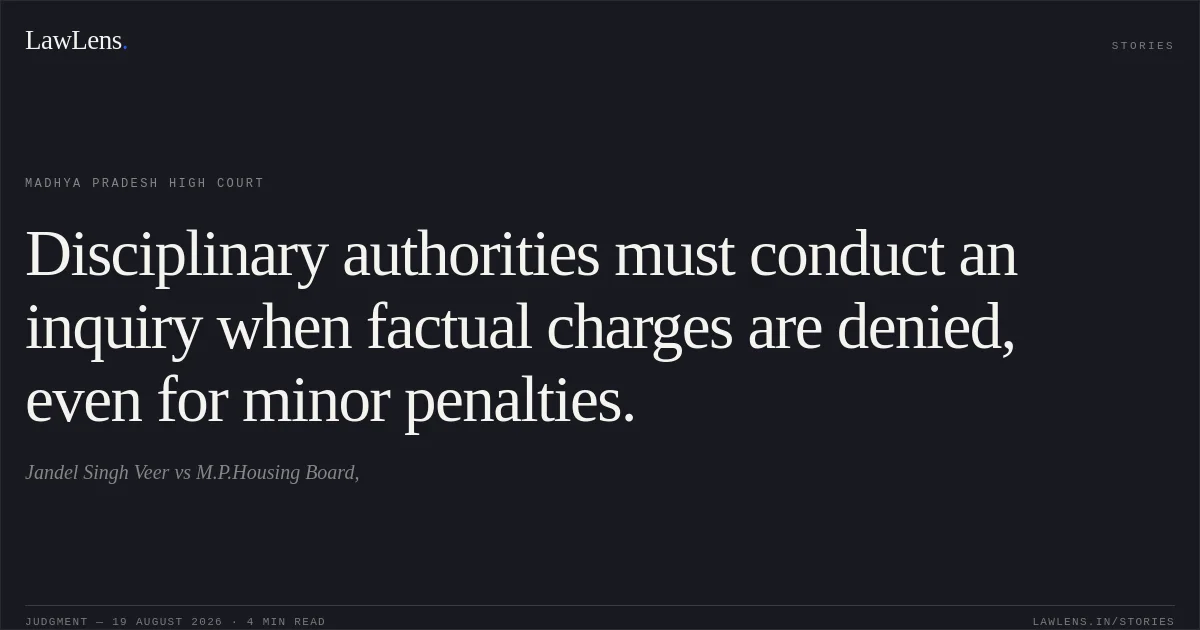
1. Whether the disciplinary authority could impose a minor financial penalty based on disputed factual allegations without conducting a regular departmental inquiry after the petitioner denied the charges?
Source reference: paras. 15–172. Whether the disciplinary authority’s punishment order and the appellate authority’s order were invalid for being non-speaking and unreasoned?
Source reference: paras. 9–153. Whether the petitioner was entitled to refund of Rs.49,812/- and consequential benefits after quashing of the impugned orders?
Source reference: paras. 18, 16–17Law Applied
The Court applied Rule 10 of the M.P. Civil Services (Classification, Control and Appeal) Rules, 1966, under which recovery of loss caused to the Government or public body may be imposed as a penalty, subject to compliance with natural justice.
Source reference: para. 8Relying on O.K. Bhardwaj v. Union of India, (2001) 9 SCC 180, the Court held that even for a minor penalty, the employee must be given an opportunity to explain the charges and, where factual charges are denied, an inquiry must ordinarily be conducted as the minimum requirement of natural justice.
Source reference: paras. 5, 16–17The Court further relied on State of Punjab v. Bandeep Singh, (2016) 1 SCC 724, Kranti Associates (P) Ltd. v. Masood Ahmed Khan, (2010) 9 SCC 496, and Oryx Fisheries Pvt. Ltd. v. Union of India, (2010) 13 SCC 427, for the rule that administrative and quasi-judicial orders affecting rights must record cogent, clear, and relevant reasons; an appellate order cannot cure the absence of reasons in the original order.
Source reference: paras. 11–15The Court also applied the settled principle that reasons are essential for fairness, transparency, accountability, and effective judicial review.
Source reference: paras. 11–15Reasoning
The Court found that the petitioner had specifically denied responsibility and had placed material facts before the disciplinary authority, including that the relevant events largely pre-dated or post-dated his tenure and that he had acted promptly upon receiving information about the missing file.
Source reference: paras. 2–4, 17The disciplinary authority’s order merely attributed the loss to the petitioner and another employee without analysing the petitioner’s detailed reply, determining the precise dereliction attributable to him, or explaining the basis for allocating recovery in the ratio of two-thirds and one-third.
Source reference: paras. 8–10Since the allegations were factual and disputed, the principle in O.K. Bhardwaj required a departmental inquiry before imposing even a minor penalty.
Source reference: paras. 16–17Further, the appellate order only recorded that the appeal had been considered and rejected by the Board, without independently addressing the petitioner’s grounds or providing reasons.
Source reference: para. 9The absence of a reasoned original order was not cured by the appellate proceedings, making both orders legally unsustainable.
Source reference: paras. 10, 15Holding
The High Court allowed the petition and quashed the disciplinary authority’s order dated 11 March 2005 and the appellate order dated 7 March 2007.
The respondents were directed to grant the petitioner all consequential benefits and refund Rs.49,812/- deposited by him under protest within three months of receiving the certified copy of the judgment.
Source reference: paras. 18, 16If the refund was not made within that period, it would carry interest at 6% per annum.
Source reference: para. 16As the petitioner had retired, the Court granted no liberty to the respondents to initiate fresh proceedings.
Source reference: para. 16The petition and pending interlocutory applications were accordingly disposed of.
Source reference: paras. 17–18Original Court PDF
Jandel Singh VeervsM.P.Housing Board,
Click to open original judgment
Original judgment, available to read, download and summarize on LawLens.in