Facts
The petitioner, a police constable appointed in 2018 and posted at the Women Police Station, Jehanabad, was deputed to the CCTNS section, where she uploaded the online progress of investigations.
Source reference: p.3–5An informant in Mahila P.S. Case No. 22 of 2021 alleged that the petitioner had demanded and received ₹3,000 for registration and progress of the case, supported by an audio recording.
Source reference: p.3–5The petitioner was suspended, and thereafter a departmental proceeding was initiated against her under the Bihar Government Servants (Classification, Control and Appeal) Rules, 2005.
Source reference: p.4–6The conducting officer found the charges proved, relying upon documentary materials, formal witnesses and the audio recording.
Source reference: p.6The disciplinary authority dismissed the petitioner from service by Memo No. 2525 dated 6 May 2022. Her departmental appeal and memorial were subsequently rejected by the competent authorities.
Source reference: p.6–8Issues
Whether the departmental proceeding and the orders imposing and affirming the petitioner’s dismissal violated the principles of natural justice or suffered from procedural irregularity?
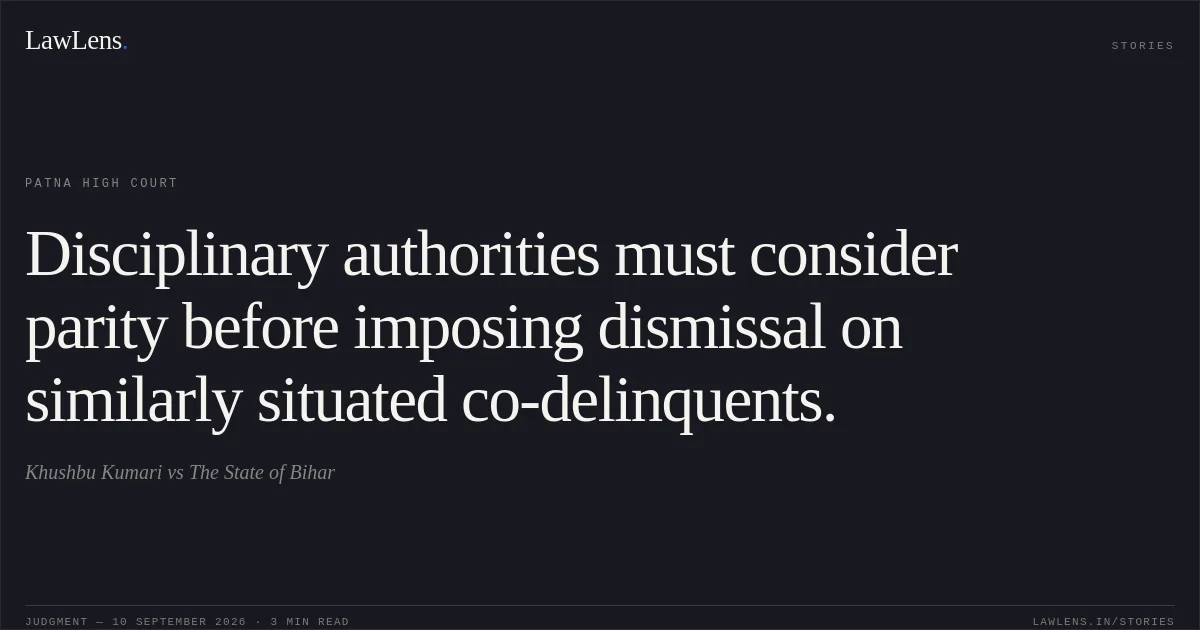
Source reference: paras. 9–11Whether the punishment of dismissal was liable to be interfered with on the ground that similarly situated delinquent employees involved in the same occurrence had received lesser punishments?
Source reference: paras. 12–14Whether the impugned orders were liable to be quashed and the matter remitted for fresh consideration of the petitioner’s plea of parity in punishment?
Source reference: paras. 14–16Law Applied
The Court applied the principles of natural justice governing departmental proceedings, including the right to notice, reasonable opportunity of defence and opportunity to cross-examine witnesses, in the context of the Bihar Government Servants (Classification, Control and Appeal) Rules, 2005.
Source reference: paras. 10–11It recognised that judicial review in disciplinary matters does not ordinarily permit the High Court to reappreciate evidence where the delinquent employee was afforded a fair opportunity and the inquiry was procedurally valid.
Source reference: paras. 10–11The Court further applied the principle of parity and non-arbitrariness in punishment: where several employees are proceeded against for the same occurrence or substantially similar charges, the disciplinary authority must give a reasoned explanation for imposing materially different penalties.
Source reference: paras. 12–14The Court also required the competent authority to pass a fresh, reasoned and speaking order after considering the relevant circumstances.
Source reference: para. 16Reasoning
The Court rejected the petitioner’s challenge based on denial of natural justice and procedural irregularity.
Source reference: paras. 10–11It found that she had been given adequate opportunity during the inquiry, had access to the audio recording, and had not sought to cross-examine witnesses or produce oral or documentary evidence in support of her defence.
Source reference: paras. 10–11However, the Court found substance in the petitioner’s plea of discriminatory treatment in punishment.
Source reference: paras. 12–14Although the petitioner asserted that the Officer-in-Charge and the Investigating Officer had been proceeded against for the same occurrence and had received lesser penalties, the respondents had not addressed this specific plea in their counter-affidavit or placed material explaining the different treatment.
Source reference: paras. 12–14Since the record did not disclose why the petitioner alone was subjected to the extreme penalty of dismissal, the Court held that the issue of proportionality and parity required fresh consideration by the competent disciplinary authority.
Source reference: paras. 13–14Holding
The High Court did not hold that the departmental charges were unproved or that the petitioner was entitled to immediate reinstatement. It held only that the petitioner’s plea of parity in punishment had not been properly considered.
Accordingly, it quashed the dismissal order, the appellate order, the memorial rejection order and the consequential order.
Source reference: para. 15The competent authority was directed to pass a fresh, reasoned and speaking order within sixty days, specifically examining the nature of the allegations and the punishments imposed upon the other two delinquent employees involved in the same occurrence.
Source reference: para. 16The writ petition was disposed of on this limited ground.
Source reference: para. 17Original Court PDF
Khushbu KumarivsThe State of Bihar
Click to open original judgment
Original judgment, available to read, download and summarize on LawLens.in