Facts
The applicant, a Resource Person at Doordarshan Kendra (DDK) Bhopal, filed a complaint on 06.04.2015 alleging sexual harassment by Respondent Nos. 6 and 7.
Source reference: p. 3-4An Internal Complaints Committee (First ICC) conducted an inquiry and submitted a report on 26.06.2015, finding the charges proved and recommending disciplinary action against the respondents and the applicant's appointment as a Transmission Executive.
Source reference: p. 5The Disciplinary Authority (DA) rejected the report, citing procedural irregularities—specifically the absence of an external member, lack of cross-examination opportunities, and failure to follow Rule 14 of the CCS (CCA) Rules.
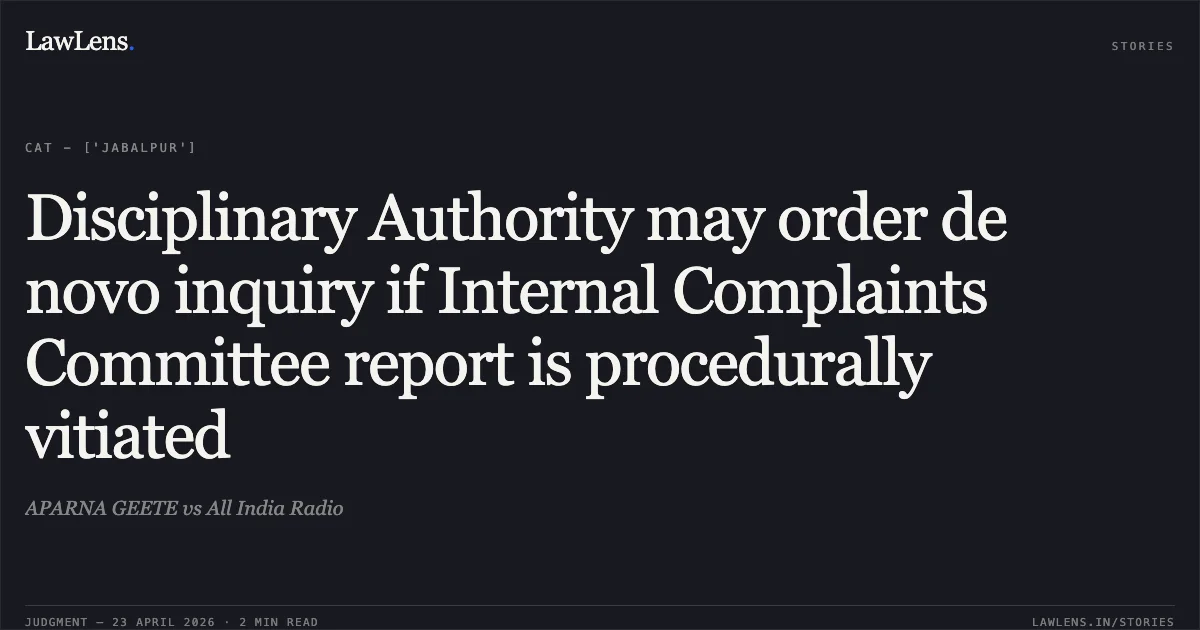
Source reference: p. 13-14The DA ordered a de novo (fresh) inquiry and constituted subsequent ICCs (Second and Third ICC).
Source reference: p. 6-7The applicant challenged the legality of the de novo inquiry and sought implementation of the First ICC's recommendations.
Source reference: p. 2-3Issues
1. Whether the Disciplinary Authority has the legal power to reject an ICC report and order a de novo inquiry under the Sexual Harassment of Women at Workplace Act, 2013, and CCS (CCA) Rules, 1965.
Source reference: p. 192. Whether the constitution of the subsequent ICCs was legally valid.
Source reference: p. 20Law Applied
Section 13(3) of the Sexual Harassment of Women at Workplace (Prevention, Prohibition and Redressal) Act, 2013, which mandates that proved misconduct be dealt with according to applicable service rules.
Source reference: p. 21Rule 14(2) of the CCS (CCA) Rules, 1965, and the DOPT OM dated 21.07.2009, which deem the ICC to be the Inquiring Authority for disciplinary proceedings.
Source reference: p. 22Section 4(5)(d) of the 2013 Act, which empowers the employer to remove and replace ICC members/presiding officers for abuse of position.
Source reference: p. 23Reasoning
The Tribunal reasoned that since Section 13(3) of the 2013 Act refers disciplinary action to the existing service rules, the provisions of the CCS (CCA) Rules, 1965, are applicable.
Source reference: p. 22Under Rule 15(1) of the CCS (CCA) Rules, a Disciplinary Authority possesses the inherent prerogative to remit a case for further inquiry or a fresh inquiry if the initial proceedings are found to be vitiated by fundamental legal or procedural errors.
Source reference: p. 15, 23The court noted that the First ICC report suffered from fatal flaws, including the absence of a mandatory external member (violating Section 7(c) of the Act) and the denial of cross-examination (violating principles of natural justice).
Source reference: p. 13The Tribunal further found that the power to reconstitute a committee is inherent under Section 4 of the Act, and once the composition of the ICC is legally changed due to the removal/replacement of a chairperson, a fresh inquiry is a logical and legal necessity.
Source reference: p. 23-24Holding
The Tribunal dismissed the Original Application, holding that the Disciplinary Authority is legally vested with the power to order a de novo inquiry when the initial ICC report is procedurally vitiated.
The court vacated the interim stay on the inquiry proceedings and directed the respondents to conclude the fresh inquiry within the statutory timeframe and the applicant’s prayer for implementation of the First ICC's recommendations (including the job appointment) was denied.
Source reference: p. 24Acts & Sections Cited
7 provisions across 1 statute referred to in this judgment. Each provision opens on LawLens.
Sexual Harassment of Women at Workplace (Prevention, Prohibition and Redressal) Act, 20137
Original Court PDF
APARNA GEETEvsAll India Radio
Click to open original judgment
Original judgment, available to read, download and summarize on LawLens.in