Facts
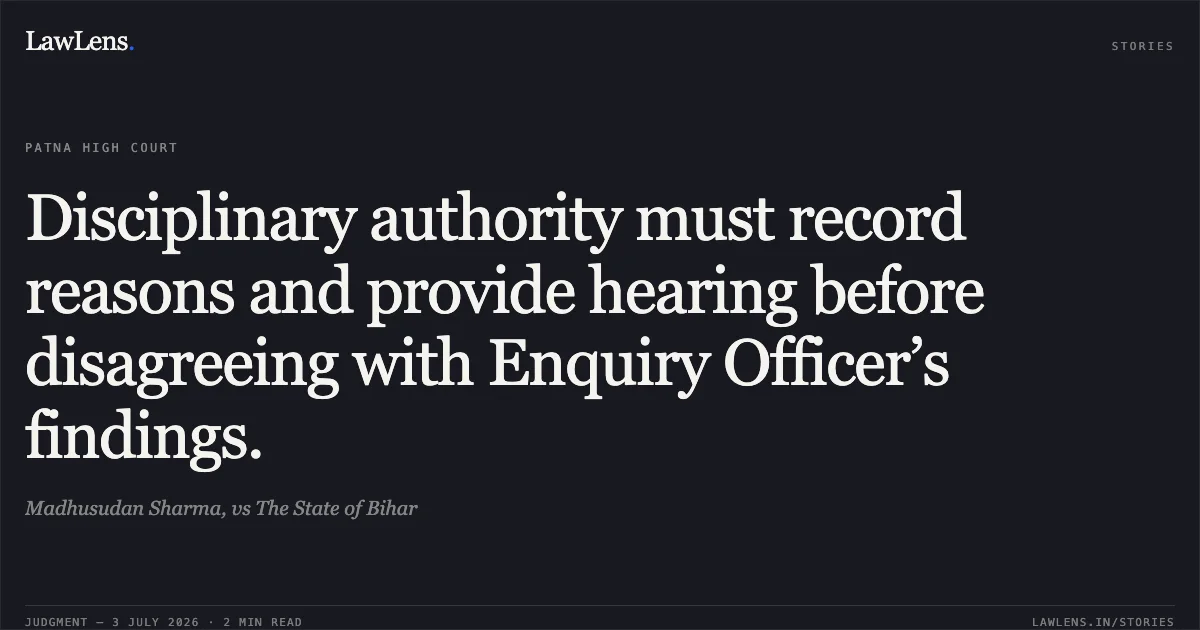
The petitioner, a Havildar in BMP-12, was charged with indiscipline and disobeying orders during a deputation at a tea estate in 2018.
Source reference: para. 3A departmental enquiry was conducted where the Enquiry Officer, based on witness testimony indicating another individual (Md. Salauddin) was the primary actor, found no evidence to prove the charges against the petitioner and submitted an exonerating report on 30.09.2019.
Source reference: para. 3-4However, the Disciplinary Authority (Commandant, B.M.P.-12), disagreeing with the findings, bypassed the report and inflicted a punishment of withholding increments for two years (equivalent to three black marks) on 18.10.2019.
Source reference: para. 4The petitioner’s subsequent appeal to the D.I.G. of Police was rejected on 26.04.2020.
Source reference: para. 4Issues
1. Whether the Disciplinary Authority can reverse an Enquiry Officer’s finding of innocence and impose a penalty without first issuing a disagreement note and affording the delinquent employee an opportunity to represent against such disagreement?
Source reference: para. 5, 8Law Applied
Rule 18(2) of the Bihar Government Servants (Classification, Control and Appeal) Rules, 2005, which mandates that if a disciplinary authority disagrees with the enquiry report, it must record reasons for such disagreement and record its own findings.
Source reference: para. 7Supreme Court precedent in Punjab National Bank Ors. v. Kunj Behari Misra [(1998) 7 SCC 84], which established that principles of natural justice require the disciplinary authority to provide a tentative note of disagreement and a fresh opportunity for hearing to the delinquent officer before reversing an exoneration.
Source reference: para. 5, 8Reasoning
The Court observed that the Enquiry Officer had clearly exonerated the petitioner after finding a lack of material evidence.
Source reference: para. 3Under Rule 18(2) of the CCA Rules, 2005, the Disciplinary Authority is statutorily obligated to record reasons for disagreement.
Source reference: para. 8In this case, the Commandant failed to serve any notice or communicate the reasons for differing from the Enquiry Officer's findings before passing the punishment order.
Source reference: para. 9The Court noted that even though a counter-affidavit was filed, the State could not confirm if a show cause notice regarding the disagreement was ever issued to the petitioner.
Source reference: para. 6Applying the Kunj Behari Misra doctrine, the Court reasoned that it is "unfair and iniquitous" to deprive a charged officer of the right to represent their case when the Disciplinary Authority intends to overturn a favorable enquiry report.
Source reference: para. 8Holding
The Court answered the issue in the negative, holding that the failure to provide a disagreement notice violated the principles of natural justice and statutory rules.
The High Court set aside the punishment order dated 18.10.2019 and the appellate order dated 26.04.2020.
Source reference: para. 9The writ petition was allowed, and the Court directed the respondents to provide all consequential benefits to the petitioner within three months.
Source reference: para. 9-10Original Court PDF
Madhusudan Sharma,vsThe State of Bihar
Click to open original judgment
Original judgment, available to read, download and summarize on LawLens.in