Facts
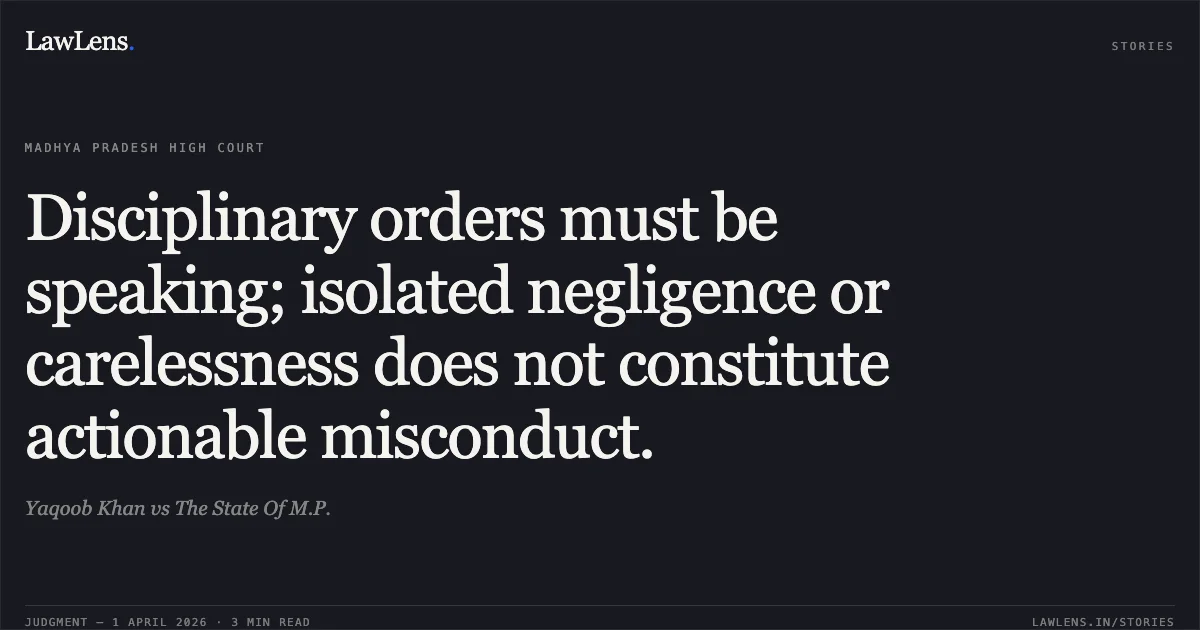
The petitioner, appointed as a Patwari in 1978, was served a charge-sheet alleging negligence and dereliction of duty regarding the illegal mutation of inalienable government lease land (Pattas)
Source reference: p. 2, para. 2; p. 4, para. 5Following an inquiry report dated 23.05.2009, the petitioner submitted a detailed reply on 29.05.2009
Source reference: p. 2, para. 2The Disciplinary Authority, via order dated 01.06.2009, dismissed the petitioner from service
Source reference: p. 2, para. 2The petitioner's departmental appeal was rejected on 26.02.2010, and a second appeal was dismissed on 27.09.2010 on maintainability grounds
Source reference: p. 2, para. 2The petitioner challenged these orders on the grounds that the dismissal order was unreasoned, "copy-pasted" findings from the inquiry report, and that the alleged negligence did not constitute "misconduct"
Source reference: p. 2-3, para. 2Issues
1. Whether the Disciplinary Authority’s order was a non-speaking and unreasoned order passed without application of mind
Source reference: p. 5, para. 72. Whether the absence of reasons in a punishment order can be cured by the disclosure of reasons in an appellate order
Source reference: p. 2, para. 2; p. 11, para. 123. Whether allegations of mere negligence or carelessness in the discharge of duties amount to "misconduct" warranting dismissal
Source reference: p. 12, para. 13Law Applied
The court applied the principle that quasi-judicial and administrative authorities must pass speaking orders supported by valid and justifiable reasons to ensure transparency and prevent arbitrariness
Source reference: p. 6, para. 8State of Punjab v. Bandip Singh (2016), which mandates that administrative decisions must be composite and self-sustaining
Source reference: p. 6-7, para. 9-10Kranti Associates Pvt. Ltd. v. Masood Ahmed Khan (2010), establishing that reasons are the "lifeblood" of judicial decision-making
Source reference: p. 7-9, para. 11Regarding the definition of misconduct, the court relied on Union of India v. J. Ahmed (1979) and S.D. Bind v. Union of India (2015), which held that isolated acts of negligence, lack of efficiency, or failure to attain the highest administrative standards do not constitute misconduct
Source reference: p. 13, para. 13Oryx Fisheries Pvt. Ltd. v. Union of India (2010) was applied to establish that the lack of reasons in an original order cannot be compensated by an appellate order
Source reference: p. 11, para. 12Reasoning
The Court observed that the Disciplinary Authority’s order dated 01.06.2009 was a verbatim "copy-paste" of the inquiry report's conclusions, indicating a total lack of independent application of mind
Source reference: p. 5-6, para. 7The Authority failed to consider the specific grounds raised in the petitioner’s reply dated 29.05.2009, rendering the order non-speaking and arbitrary
Source reference: p. 6, para. 7The Court held that when an authority exercises quasi-judicial powers, the affected party has a right to know how their defense was considered
Source reference: p. 6, para. 8The Court analyzed the nature of the charges—essentially procedural lapses in mutation entries—and concluded that they fell under "carelessness" rather than "misconduct"
Source reference: p. 13, para. 14Since there was no evidence of mens rea or grave misconduct as defined by the precedents in J. Ahmed and S.D. Bind, the punishment of dismissal was found to be legally unsustainable
Source reference: p. 13, para. 13-14Holding
The Court allowed the writ petition and quashed the punishment order dated 01.06.2009, the appellate order dated 26.02.2010, and the second appeal order dated 27.09.2010
The respondents were directed to grant the petitioner all consequential benefits, including monetary benefits, pension, and arrears, within three months, with a 6% per annum interest rate applicable in case of delay
Source reference: p. 14, para. 15(ii)Given that the petitioner was 74 years old and had already superannuated, the Court declined to grant the State liberty to initiate fresh action
Source reference: p. 14, para. 15(iii)Original Court PDF
Yaqoob KhanvsThe State Of M.P.
Click to open original judgment
Original judgment, available to read, download and summarize on LawLens.in


