Facts
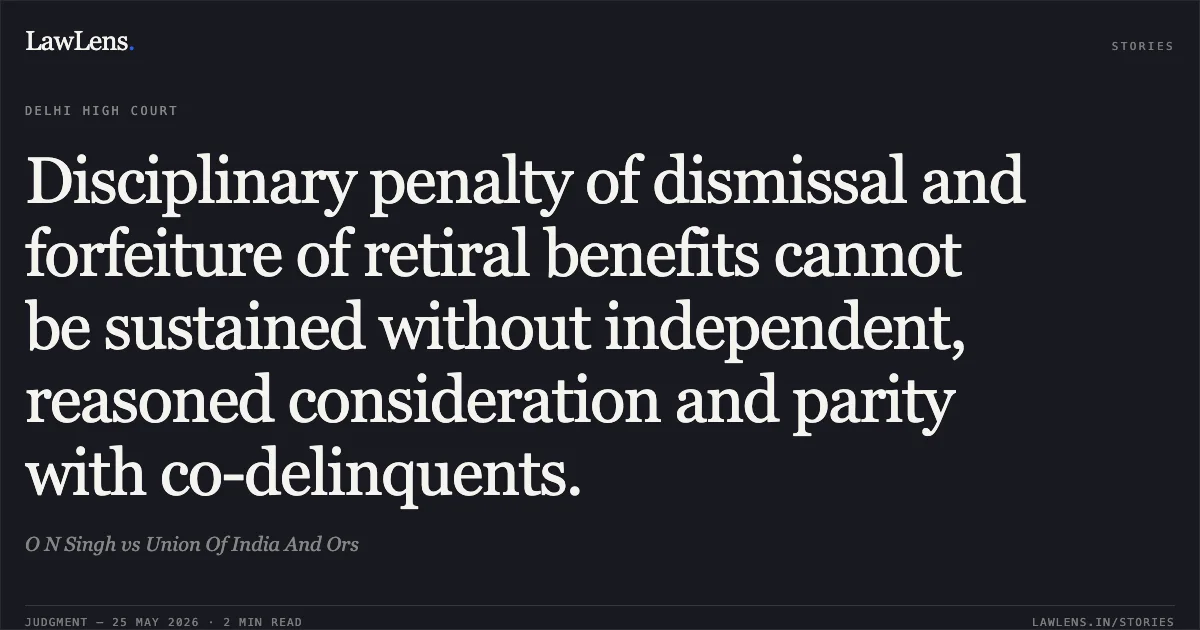
The Petitioner, former Director (Finance) of Satluj Jal Vidyut Nigam Ltd. (SJVN), challenged a 2004 chargesheet and a 2009 order of dismissal from service with forfeiture of retiral benefits
Source reference: p.1-2The disciplinary proceedings arose from three payments (aggregating approx. INR 42.46 crore) released to M/s Jaiprakash Hyundai Consortium (JHC) between 1996 and 1998, which the Respondent alleged were unauthorized ad-hoc advances
Source reference: p.3-5The Petitioner’s tenure ended on March 16, 2004, one day after the chargesheet was issued
Source reference: p.8Although the Inquiry Officer (IO) found the charges proved, the report was finalized without the Petitioner’s written brief due to a refused extension
Source reference: p.10Co-delinquents involved in the same transactions were either exonerated or given minor penalties
Source reference: p.12-13Issues
1. Whether the disciplinary proceedings could lawfully continue and result in forfeiture of retiral benefits after the Petitioner’s tenure had ceased
Source reference: p.21/para.24(iv)2. Whether the inquiry was vitiated by a violation of natural justice due to the non-consideration of the Petitioner’s written brief
Source reference: p.21/para.24(v)3. Whether the findings of misconduct were sustainable given the contemporaneous records, board approvals, and treatment of co-delinquents
Source reference: p.22/para.24(vi-viii)Law Applied
The court applied the principles of judicial review in disciplinary matters, emphasizing that while courts do not act as appellate authorities, they must intervene if findings are based on "no evidence," ignore material documents, or are perversely disproportionate (B.C. Chaturvedi v. Union of India; Union of India v. P. Gunasekaran)
Source reference: p.23It relied on the doctrine of parity, which mandates that co-delinquents in the same transaction shouldn't be singled out for harsher treatment without rational distinction (Rajendra Yadav v. State of M.P.; M. Raghavelu v. Govt. of A.P.)
Source reference: p.43-44Regarding post-retirement jurisdiction, it referenced State Bank of India v. A.N. Gupta and UCO Bank v. Rajinder Lal Capoor, holding that the power to impose penalties after service must be founded upon specific statutory/regulatory provisions
Source reference: p.27-29Reasoning
The Court observed that the disciplinary authority failed to identify the specific legal source of power to impose dismissal and forfeiture of benefits five years after the Petitioner’s tenure ended
Source reference: p.29It found a procedural breach as the IO ignored the Petitioner's written brief despite a statement made to the High Court that it would be considered
Source reference: p.31-32Substantively, the Court noted that the Petitioner’s concurrence on the first two payments included specific recovery stipulations which were ignored by the IO, and the third payment was a Board-level decision for which the Petitioner had recorded objections
Source reference: p.34-35Furthermore, the Respondent failed to quantify any actual financial loss, especially since subsequent arbitration/settlement validated many of the contractor’s claims
Source reference: p.41-42The Court found the penalty "shockingly disproportionate" compared to the exoneration of technical officers and the CMD who approved the same payments
Source reference: p.43-45Holding
The Court allowed the writ petition and quashed the order dated July 30, 2009. It held that the penalty was non-est for the purpose of retiral benefits
The Respondents were directed to release all retiral dues (gratuity, leave encashment, medical benefits) with 6% simple interest per annum within twelve weeks, failing which the interest rate would rise to 9%
Source reference: p.48-49Acts & Sections Cited
1 provisions across 1 statute referred to in this judgment. Linked provisions open on LawLens.
General Conditions of Contract1
Original Court PDF
O N SinghvsUnion Of India And Ors
Click to open original judgment
Original judgment, available to read, download and summarize on LawLens.in