Facts
The applicant, a Mechanic/Assistant Foreman with the Delhi Transport Corporation (DTC), was issued two charge sheets on 14.07.2014 and 28.07.2014 alleging fraud, bogus attendance, and faking documents for HMV license renewal
Source reference: para 6While a civil suit challenging these charge sheets was pending, the applicant superannuated on 30.09.2014
Source reference: para 2.5, 10Post-retirement, the DTC sought to continue the disciplinary proceedings via letter dated 22.01.2015 and withheld his retiral benefits, including gratuity, pension, and leave encashment
Source reference: para 2.6, 10The applicant challenged the continuation of these proceedings and the withholding of dues, arguing that the proceedings abated upon retirement in the absence of specific statutory rules
Source reference: para 4Issues
1. Whether the respondents possess valid statutory power to continue disciplinary proceedings against the applicant after his retirement
Source reference: para 11(i)2. Whether the charge sheets dated 14.07.2014 and 28.07.2014 lapsed or abated upon the applicant’s retirement on 30.09.2014
Source reference: para 11(ii)3. Whether the withholding of gratuity, leave encashment, and pensionary benefits is legally sustainable during the pendency of such proceedings
Source reference: para 11(iv)Law Applied
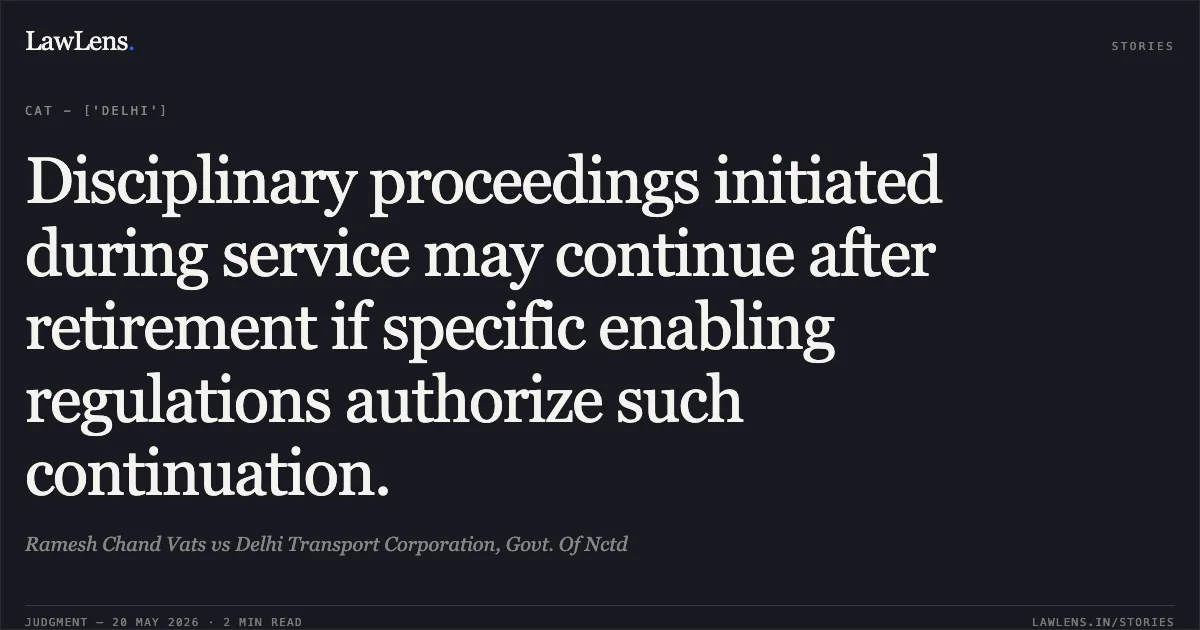
The Tribunal applied the Delhi Road Transport Authority (Condition of Appointment and Services) Regulations, 1952, specifically the amended Clause 15.2(d) and 15(3), which allow disciplinary proceedings initiated during service to continue post-superannuation as if the employee were still in service
Source reference: para 7, 13The Tribunal relied on the Supreme Court precedent in Ramesh Chandra Sharma v. Punjab National Bank, which held that proceedings do not abate if service regulations specifically enable their continuation
Source reference: para 7.1, 14.1The Tribunal also cited Union of India v. Kunisetty Satyanarayana regarding the limited scope of judicial interference at the charge-sheet stage
Source reference: para 19Reasoning
The Tribunal found that the DTC Board, via Resolution No. 23/2012, had validly amended the 1952 Regulations to insert provisions (Cl. 15.2(d)) specifically authorizing the continuation of inquiries and the withholding of benefits (except CPF contribution) until final orders are passed
Source reference: para 7, 13It rejected the applicant’s claim of "no statutory rule," noting that the amendment was in force prior to his retirement
Source reference: para 13, 14The Tribunal distinguished the applicant's reliance on Brajendra Singh Yambem v. Union of India, noting that in the present case, there was a specific enabling regulation, unlike in the cited precedent
Source reference: para 15The Tribunal noted that the allegations involved integrity (fraud and fabrication), and since the proceedings were initiated before superannuation, the jurisdiction of the DTC remained intact despite the absence of a "caveat" in the retirement order
Source reference: para 16, 18Holding
The Tribunal held that the disciplinary proceedings did not lapse and the DTC has the jurisdiction to conclude them
The O.A. was disposed of with directions to the respondents to complete the inquiries within six weeks and pass a final decision within two weeks thereafter. It ordered that if the applicant is found entitled to dues, they should be released promptly, and any withheld CPF must be released with interest as applicable to GPF from the date of retirement
Source reference: para 21(i), 21(ii)Acts & Sections Cited
2 provisions across 2 statutes referred to in this judgment. Each provision opens on LawLens.
Administrative Tribunals Act, 19851
Road Transport Corporations Act, 19501
Original Court PDF
Ramesh Chand VatsvsDelhi Transport Corporation, Govt. Of Nctd
Click to open original judgment
Original judgment, available to read, download and summarize on LawLens.in