Facts
The Plaintiff/Appellant was an employee of NTPC. After being exonerated in a disciplinary inquiry in 1997, he sought promotions and benefits.
Source reference: para. 4During the pendency of a writ petition for said benefits, the Defendant (then Executive Director, NTPC) issued a Show Cause Notice (SCN) dated 03.11.1998 as a Reviewing Authority.
Source reference: para. 6This SCN was eventually quashed by the High Court in 2011, a decision upheld by the Division Bench in 2015 and the Supreme Court in 2017.
Source reference: paras. 8-10Following the Supreme Court's final order on 12.01.2017, the Plaintiff filed a suit for damages (Rs. 25,00,000/-) on 10.01.2018 against the Defendant in his individual capacity for alleged "malafide" issuance of the SCN.
Source reference: paras. 11, 20The Trial Court dismissed the suit as barred by limitation and for lacking a cause of action.
Source reference: para. 1Issues
1. Whether the suit disclosed a valid cause of action against the Defendant in his personal capacity
Source reference: para. 25, Issue 3; para. 452. Whether the suit claim was within the prescribed period of limitation
Source reference: para. 25, Issue 4; para. 553. Whether the suit was maintainable against the Defendant for acts performed in his official capacity as an employee of NTPC
Source reference: para. 25, Issue 5; para. 30Law Applied
The court applied Order VII Rule 11 of the CPC regarding the disclosure of a cause of action.
Source reference: para. 45Article 74 of the Limitation Act, 1963 (compensation for malicious prosecution - 1 year from termination of prosecution).
Source reference: para. 59Article 79 of the Limitation Act, 1963 (compensation for illegal/irregular distress - 1 year from the date of distress).
Source reference: para. 60The court referenced Section 11 (Res Judicata) and Order II Rule 2 of the CPC regarding splitting of claims.
Source reference: paras. 14, 18The court relied on the precedent D. N. Bandopadhyay vs. Union of India to hold that departmental proceedings do not constitute "prosecution" under the Limitation Act.
Source reference: para. 32Reasoning
The Court observed that the plaint failed to detail any specific acts of personal vendetta or individual motivation by the Defendant; all actions were performed as a "Reviewing Authority" under Rule 33 of the NTPC (CDA) Rules.
Source reference: paras. 46-47Mere issuance of a notice permitted by service rules does not prima facie establish malafides.
Source reference: para. 48The Court held that since departmental inquiries aren't "prosecutions," Article 74 did not apply. Under Article 79, the one-year limitation period began from the "distress" (issuance of SCN in 1998) or at the latest, when the SCN was first quashed in 2011.
Source reference: paras. 55-57The Court rejected the Appellant’s argument that the cause of action arose only upon the Supreme Court judgment in 2017. Filing the suit in 2018, nearly 20 years after the SCN, was deemed "hopelessly barred".
Source reference: paras. 56, 61Holding
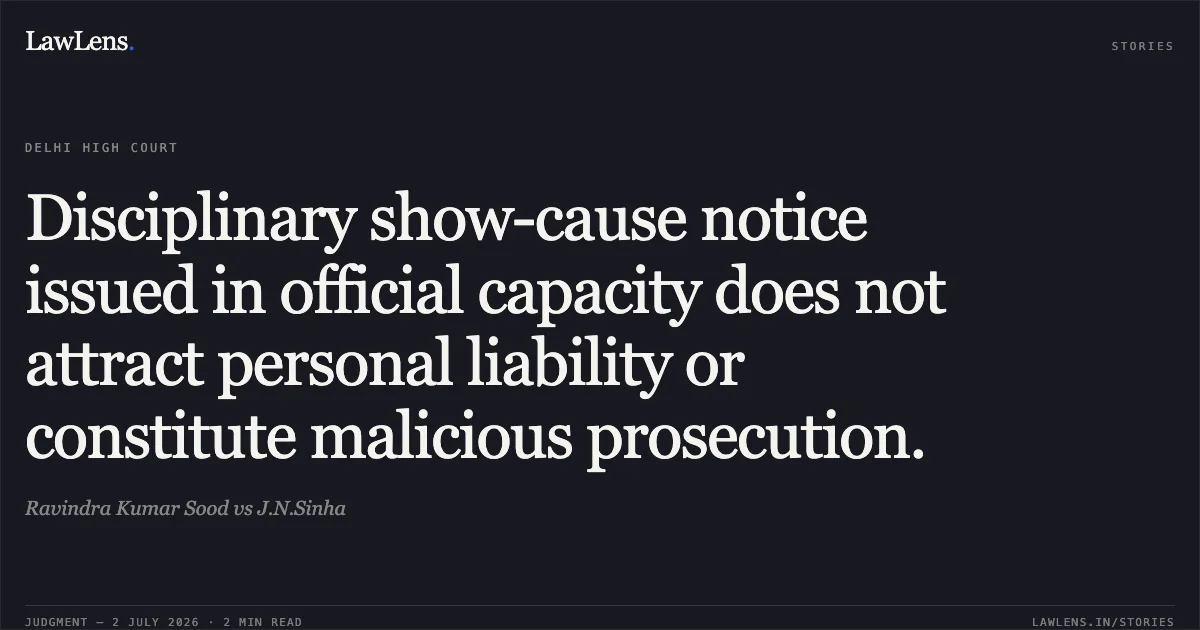
The suit disclosed no cause of action as the Defendant acted in his official capacity and no personal malafides were substantiated.
The suit was patently barred by limitation under Article 79 of the Limitation Act, as the period began in 1998 or 2011, and was not refreshed by the 2017 Supreme Court order regarding promotions.
Source reference: paras. 60-62The Court dismissed the appeal, affirming the Trial Court's judgment.
Source reference: para. 64Acts & Sections Cited
4 provisions across 1 statute referred to in this judgment. Each provision opens on LawLens.
Code of Civil Procedure, 19084
Original Court PDF
Ravindra Kumar SoodvsJ.N.Sinha
Click to open original judgment
Original judgment, available to read, download and summarize on LawLens.in