Facts
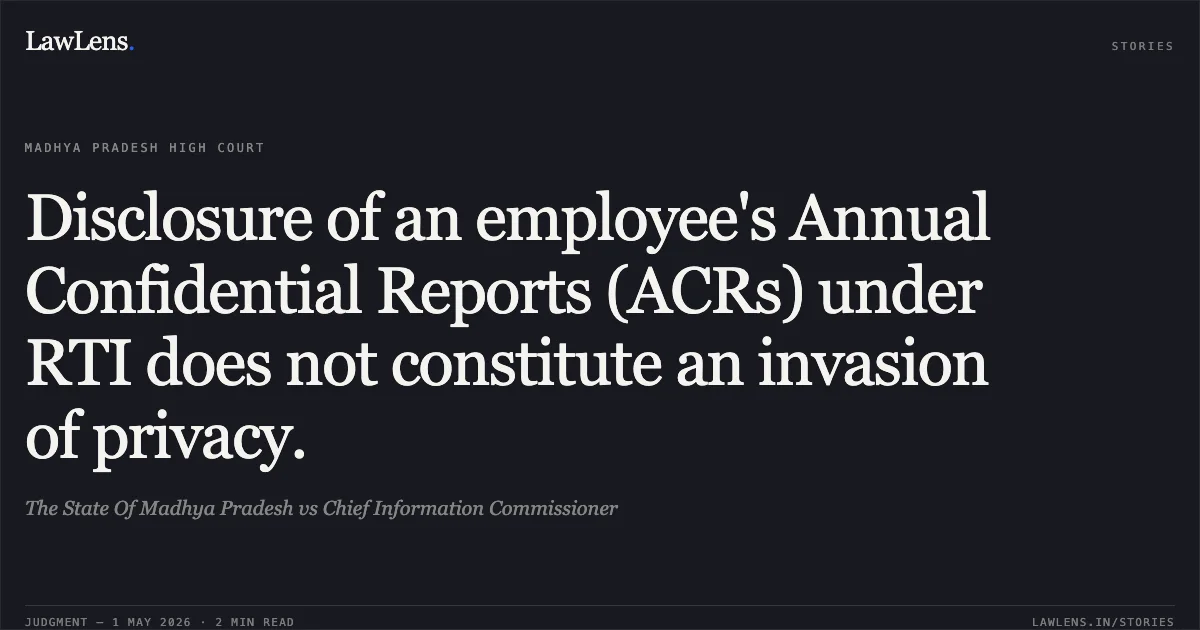
The Petitioner (State of Madhya Pradesh) challenged an order dated 01.12.2009 passed by the Chief Information Commissioner in Second Appeal No. 400/S.1.C./15/Bhopal/2006.
Source reference: para. 1The State Information Commission had directed the State to supply information regarding the Annual Confidential Report (ACR) of the applicant/respondent.
Source reference: para. 2, 3The Public Information Officer and the first appellate authority had previously rejected the application, citing Section 8(1)(j) of the RTI Act on the grounds that it was "personal information" and its disclosure lacked recorded "objective satisfaction" regarding larger public interest.
Source reference: para. 2Issues
1. Whether the disclosure of an employee's own ACR constitutes an unwarranted invasion of privacy under Section 8(1)(j) of the RTI Act.
Source reference: para. 2, 52. Whether the State Information Commission is required to record objective satisfaction regarding public interest when the information sought is the applicant’s own ACR.
Source reference: para. 2, 5Law Applied
Section 8(1)(j) of the Right to Information Act, which exempts personal information unless disclosure serves a larger public interest.
Source reference: para. 2Dev Dutt v. Union of India (2008) 8 SCC 725, which established that fairness and transparency under Article 14 require the communication of ACR entries to public servants to allow for representation.
Source reference: para. 3Bihar Public Service Commission v. Saiyed Hussain Abbas Rizwi (2012) 13 SCC 61, which mandates that authorities must balance the right to privacy against the right to information based on objective satisfaction.
Source reference: para. 2, 4Reasoning
The Court reasoned that while Saiyed Hussain Abbas Rizwi requires an objective satisfaction to outweigh privacy concerns in certain confidential matters like appointments, those principles do not bar an individual from accessing their own ACR.
Source reference: para. 5Following the ratio in Dev Dutt, the Court observed that ACRs are required to be communicated to employees to ensure non-arbitrariness in state action.
Source reference: para. 3, 5The Court found that an applicant seeking their own ACR cannot be said to be invading their own privacy, nor is such a request contrary to public interest.
Source reference: para. 5Consequently, the lack of a specific "objective satisfaction" recording by the Commission regarding "public interest" did not invalidate the order, as the right to access one's own ACR is now an established legal entitlement.
Source reference: para. 5Holding
The Court held that ACRs must be communicated to employees and cannot be withheld under the guise of Section 8(1)(j) of the RTI Act.
The Court upheld the State Information Commission's order and dismissed the writ petition. The impugned order dated 01.12.2009 was affirmed, and no order as to costs was made.
Source reference: para. 6Acts & Sections Cited
1 provisions across 1 statute referred to in this judgment. Each provision opens on LawLens.
Right to Information Act, 20051
Original Court PDF
The State Of Madhya PradeshvsChief Information Commissioner
Click to open original judgment
Original judgment, available to read, download and summarize on LawLens.in