Facts
The appellant was arrested on November 17, 2021, on the basis of a custodial disclosure statement made by a co-accused, Hafiz Abdullah Malik, who was apprehended in an injured condition with arms and ammunition.
Source reference: para. 3, 8The prosecution alleged the appellant was an "Over Ground Worker" (OGW) for Lashkar-e-Taiba.
Source reference: para. 3Charges were filed under Sections 307 IPC, 7/25 Arms Act, and Sections 13, 18-B, 20, 23, 33, and 39 of the UAPA.
Source reference: para. 1The appellant moved for bail after being in custody for nearly four and a half years, noting that only 13 out of 30 witnesses had been examined and none had incriminated him.
Source reference: para. 2, 4The Special Judge (UAPA), Anantnag, rejected the bail application on February 20, 2025.
Source reference: para. 1Issues
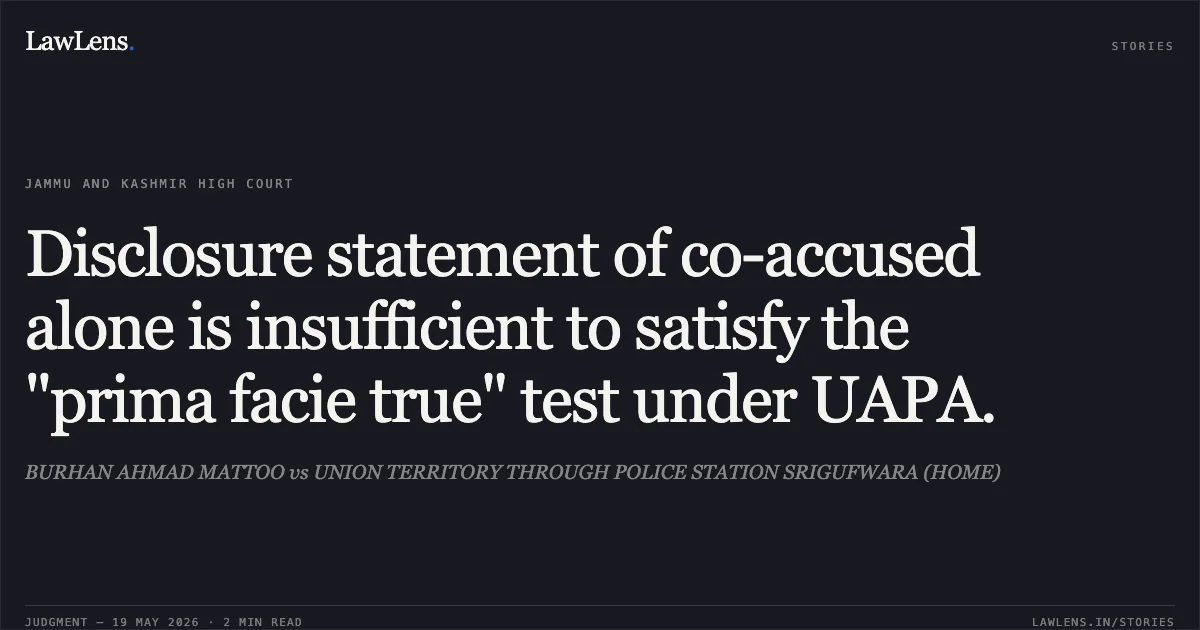
1. Whether the bar on granting bail under Section 43-D(5) of the UAPA applies when the only evidence against the accused is a co-accused's disclosure statement.
Source reference: para. 5, 92. Whether prolonged incarceration and the slow progress of the trial constitute valid grounds for granting bail despite the gravity of the charges.
Source reference: para. 10, 11Law Applied
The Court applied Section 43-D(5) of the Unlawful Activities (Prevention) Act, 1967, which prohibits bail if the court finds reasonable grounds to believe the accusations are prima facie true.
Source reference: para. 5, 11It relied on the principle from NIA v. Zahoor Ahmad Shah Watali (2019), requiring an assessment of the "totality of material" to determine the prima facie truth of the charges.
Source reference: para. 9it invoked the doctrine from Union of India v. K. A. Najeeb (2021), which establishes that constitutional courts can grant bail despite statutory restrictions if there is a violation of the right to a speedy trial due to prolonged incarceration.
Source reference: para. 10Reasoning
The Court observed that the appellant had been in continuous custody since late 2021 based solely on the disclosure statement of a co-accused, with no recovery of incriminating material from his person.
Source reference: para. 7, 8Applying the Watali standard, the Court found that the prosecution failed to bring any other evidence to the notice of the Court that would make the accusations prima facie true against the appellant specifically.
Source reference: para. 9The Court further noted that the trial was proceeding slowly, with only 13 of 30 witnesses examined over four years.
Source reference: para. 11Under the Najeeb precedent, the Court held that the appellant had successfully "crossed the hurdle" of Section 43-D(5) because the lack of corroborative evidence, combined with prolonged detention, outweighed the statutory restriction.
Source reference: para. 11Holding
The Court allowed the appeal and set aside the trial court's order dated February 20, 2025.
The Court held that the appellant was entitled to bail as there was no material suggesting his release would hamper the trial or that he would influence witnesses.
Source reference: para. 11The appellant was ordered to be released on bail subject to furnishing two solvent sureties of Rs. 1,00,000 each, remaining within the jurisdiction of Jammu and Kashmir, and appearing for all trial dates.
Source reference: para. 12Acts & Sections Cited
8 provisions across 3 statutes referred to in this judgment. Each provision opens on LawLens.
Indian Penal Code, 18601
Arms Act, 19592
Unlawful Activities (Prevention) Act, 19675
Original Court PDF
BURHAN AHMAD MATTOOvsUNION TERRITORY THROUGH POLICE STATION SRIGUFWARA (HOME)
Click to open original judgment
Original judgment, available to read, download and summarize on LawLens.in