Facts
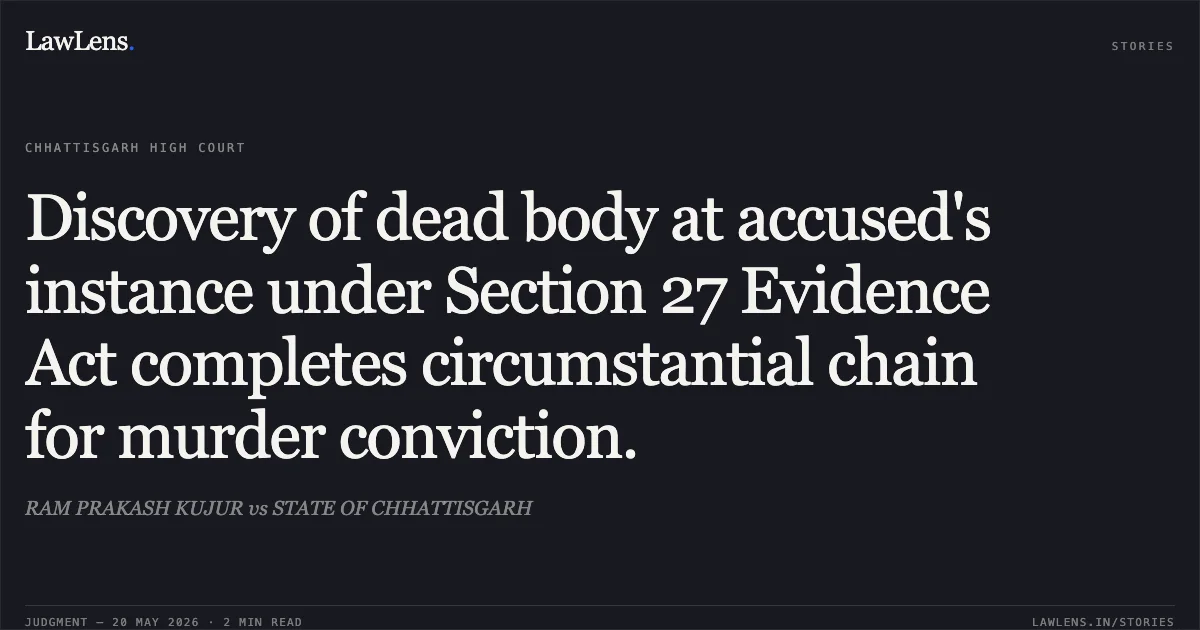
The Appellant, a police constable, was accused of the abduction and murder of Kumari Kavita Koreti, with whom he had a love affair.
Source reference: p.3Following a missing person report and CDR analysis, the Appellant was interrogated and provided a disclosure statement under Section 27 of the Evidence Act, leading to the excavation of the victim's remains from a depth of two feet at Tonahi Nala.
Source reference: p.4Medical examination revealed death by asphyxia due to strangulation.
Source reference: p.11The Trial Court convicted the Appellant under Sections 364, 302, 120(B), and 201 of the IPC.
Source reference: p.2The Appellant challenged the conviction, asserting that the chain of circumstantial evidence was incomplete and that the recovery was procedurally flawed.
Source reference: p.9-10Issues
1. Whether the prosecution successfully established a complete chain of circumstantial evidence to prove the guilt of the Appellant beyond reasonable doubt.
Source reference: p.12/para. 242. Whether the disclosure statement and subsequent recovery of the dead body and mobile phone are admissible and sufficient to link the Appellant to the crime.
Source reference: p.18/para. 343. Whether the death of the deceased was homicidal in nature.
Source reference: p.11/para. 20Law Applied
The Court applied Section 302 (Murder), Section 364 (Abduction), Section 120(B) (Conspiracy), and Section 201 (Disappearance of evidence) of the IPC.
Source reference: p.2-3Regarding evidence, it applied Section 27 of the Indian Evidence Act, 1872, emphasizing the "doctrine of confirmation by subsequent events".
Source reference: p.25It heavily relied on the "Panchsheel" principles of circumstantial evidence established in Sharad Birdhichand Sarda v. State of Maharashtra.
Source reference: p.14Definition of "fact discovered" from Pulukuri Kotayya v. King Emperor.
Source reference: p.24It further noted that "custody" under Section 27 includes any restriction or surveillance, as per Perumal Raja alias Perumal v. State.
Source reference: p.25Reasoning
The High Court found that the prosecution's case rested on a robust chain of circumstances: the homicidal nature of death was proved by the tracheal bone fracture and the medical board's report.
Source reference: p.11The "fact discovered" under Section 27 was not just the body, but the Appellant's exclusive knowledge of its hidden location.
Source reference: p.24The recovery of the victim's mobile phone from the Appellant's place of posting further incriminated him.
Source reference: p.21The Court dismissed procedural irregularities in the timing of the written memorandum, noting that the physical recovery of the body based on the Appellant's lead was the primary guarantee of truth.
Source reference: p.21, 26The DNA and FSL reports provided scientific corroboration connecting the biological remains to the victim's family, thereby completing the chain.
Source reference: p.26Holding
The High Court answered all issues in the affirmative, holding that the "chain link theory" was fully satisfied.
It ruled that suspicion had graduated into legal proof through the recovery of the body and incriminating articles at the Appellant's instance.
Source reference: p.27The Court upheld the conviction and life imprisonment awarded by the Trial Court and dismissed the appeal.
Source reference: p.28All pending applications were disposed of, and the Appellant was ordered to serve the remainder of his sentence.
Source reference: p.28-29Acts & Sections Cited
8 provisions across 3 statutes referred to in this judgment. Each provision opens on LawLens.
Bharatiya Nagarik Suraksha Sanhita, 20232
Indian Penal Code, 18604
Code of Criminal Procedure, 19732
Original Court PDF
RAM PRAKASH KUJURvsSTATE OF CHHATTISGARH
Click to open original judgment
Original judgment, available to read, download and summarize on LawLens.in


