Facts
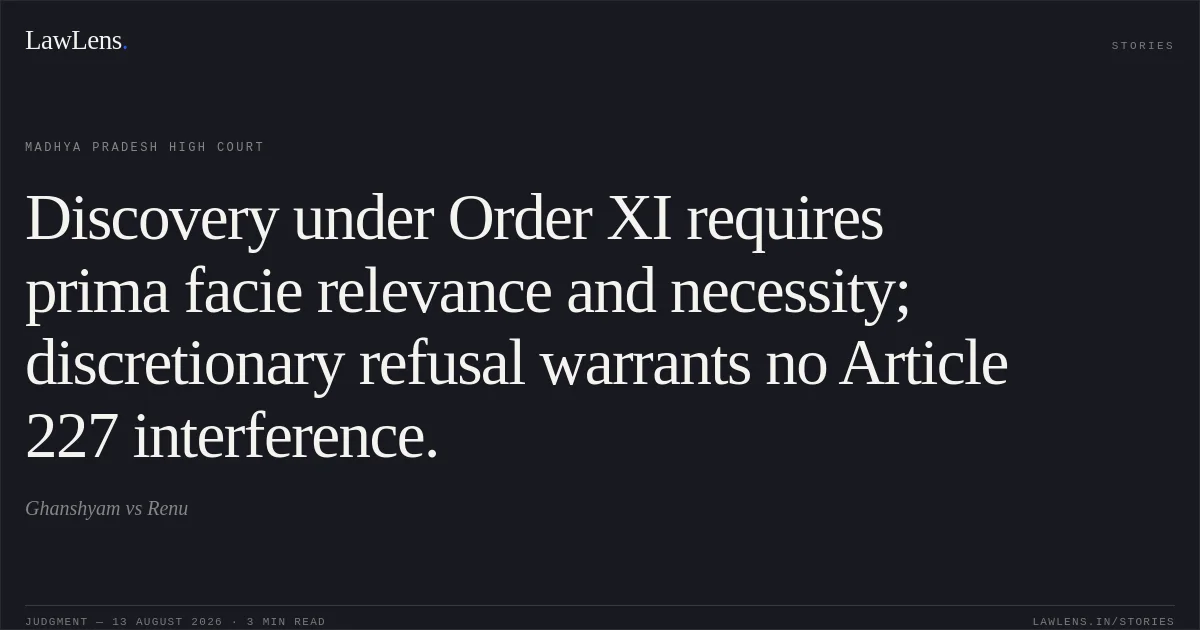
The petitioner–defendant challenged the order dated 3 August 2026 passed by the 5th Civil Judge, Senior Division, Ratlam, in Civil Suit No. 201-A/2023. The suit concerned eviction from tenanted premises.
Source reference: p. 1The petitioner had applied under Order XI Rules 12 and 14 read with Section 151 of the Code of Civil Procedure, seeking discovery and production of title and ownership documents relating to House No. 586, Kasturba Nagar, Ratlam, and House No. 30, Vidyavihar Colony, Ratlam, or their summoning from the Sub-Registrar’s office.
Source reference: p. 1He contended that the documents were relevant in view of the cross-examination of plaintiff-witness Renu Shrivastava and that rejection of the application had prejudiced his defence on Issue No. 7.
Source reference: p. 2The trial court rejected the application, holding that the petitioner had not stated any specific reason demonstrating the necessity or relevance of the documents to the suit.
Source reference: p. 2The petitioner therefore invoked the High Court’s supervisory jurisdiction under Article 227 of the Constitution.
Source reference: pp. 1–4Issues
1. Whether the trial court erred in rejecting the petitioner’s application under Order XI Rules 12 and 14 read with Section 151 CPC seeking discovery and production of documents concerning ownership of the two houses.
Source reference: pp. 1–32. Whether the trial court’s order disclosed any jurisdictional error, perversity, or infirmity warranting interference under Article 227 of the Constitution.
Source reference: pp. 2–4Law Applied
The Court applied Order XI Rule 12 CPC, under which discovery on oath may be directed only in respect of documents relating to a matter in question and where discovery is necessary for fairly disposing of the suit or saving costs.
Source reference: p. 3Order XI Rule 14 CPC permits the Court to order production of documents in a party’s possession or power where they are relevant to the matters in issue.
Source reference: pp. 1–3; no separate statutory text reproducedThe Court held that an application for discovery must establish the prima facie relevance and necessity of the documents to the real controversy.
Source reference: no citationInterference under Article 227 is supervisory and is justified only where the subordinate court has acted without jurisdiction, committed a patent error, or passed a perverse or legally infirm order.
Source reference: p. 4The Court also considered the authorities cited by the petitioner—Surya Dev Rai v. Ram Chander Rai, (2003) 6 SCC 675; Shalini Shyam Shetty v. Rajendra Shankar Patil, (2010) 8 SCC 329; and Radhey Shyam v. Chhabi Nath, (2015) 5 SCC 423—as recognising the availability of constitutional supervisory jurisdiction in appropriate cases, but not as requiring interference in the absence of jurisdictional error.
Source reference: p. 2Reasoning
The High Court found that the trial court had considered the petitioner’s request and correctly concluded that the application did not specify why the ownership documents of the two houses were required for adjudicating the tenancy dispute.
Source reference: p. 2The petitioner had not identified any particular document or explained how the requested material would assist in resolving the issues in the suit.
Source reference: p. 2Since discovery under Order XI Rules 12 and 14 CPC depends upon the relevance and necessity of the documents to the matters in controversy, the trial court was entitled to reject a general request unsupported by specific reasons.
Source reference: pp. 2–3The High Court further held that the trial court had exercised its discretion in accordance with the statutory framework and the material on record.
Source reference: p. 4The alleged impact on the petitioner’s defence and the reference to the witness’s cross-examination did not demonstrate perversity, failure to exercise jurisdiction, or a grave procedural illegality warranting Article 227 intervention.
Source reference: p. 4Holding
The Court answered the issues against the petitioner.
It held that the trial court had not committed any jurisdictional error or legal infirmity in rejecting the application for discovery and production of documents under Order XI Rules 12 and 14 read with Section 151 CPC.
Source reference: pp. 2–4Finding the petition meritless and declining to exercise supervisory jurisdiction under Article 227, the High Court dismissed Misc. Petition No. 4989 of 2026.
Source reference: p. 4Acts & Sections Cited
1 provisions across 1 statute referred to in this judgment. Each provision opens on LawLens.
Code of Civil Procedure, 19081
Original Court PDF
GhanshyamvsRenu
Click to open original judgment
Original judgment, available to read, download and summarize on LawLens.in