Facts
The State sought leave to appeal against a trial court judgment dated 30.07.2013, which acquitted the Respondent of charges under Sections 452, 294, 307, and 326 of the Indian Penal Code (IPC).
Source reference: p. 1-2The prosecution alleged that on 30.09.2010, the accused entered the "Garang Ashram" and assaulted Jyoti Ranjan Panda (P.W.6) with a "Tangia" (axe), causing seven bleeding injuries.
Source reference: p. 1-2During trial, the informant (P.W.5) and the mother and brother of the accused (P.Ws.1 and 2) turned hostile.
Source reference: p. 2The trial court acquitted the accused due to material contradictions between ocular and medical evidence, and the fact that the accused was a regular disciple with lawful access to the premises.
Source reference: p. 14-17Issues
1. Whether the findings of the trial court regarding the acquittal were perverse or based on a misreading of material evidence so as to warrant interference by the High Court under Section 378 of the CrPC.
Source reference: p. 17-182. Whether the entry of the accused into the Ashram constituted criminal trespass under Section 452 IPC.
Source reference: p. 193. Whether the contradiction between the alleged weapon (sharp Tangia) and the medical report (blunt injuries) was sufficient to create reasonable doubt.
Source reference: p. 23-24Law Applied
The Court primarily followed the principles governing appeals against acquittal as laid down in Chandrappa v. State of Karnataka (2007) and Sadhu Saran Singh vs. State of U.P. (2016), which hold that an appellate court should only interfere if the trial court's judgment is perverse or legally unsustainable.
Source reference: p. 17-18Regarding the appreciation of injured witness testimony, the court applied the criteria from Balu Sudam Khalde v. State of Maharashtra (2023), which emphasizes that while such evidence has high value, it must still be consistent and free from material contradictions.
Source reference: p. 21-22Statutory provisions included Sections 452 (trespass), 294 (obscenity), and 307/326 (assault/attempted murder) of the IPC.
Source reference: p. 14-16Reasoning
The Court found no perversity in the trial court's reasoning. Regarding Section 452, the testimony of P.W.4 established that the accused had been a disciple for 13 years, meaning his entry was not unauthorized.
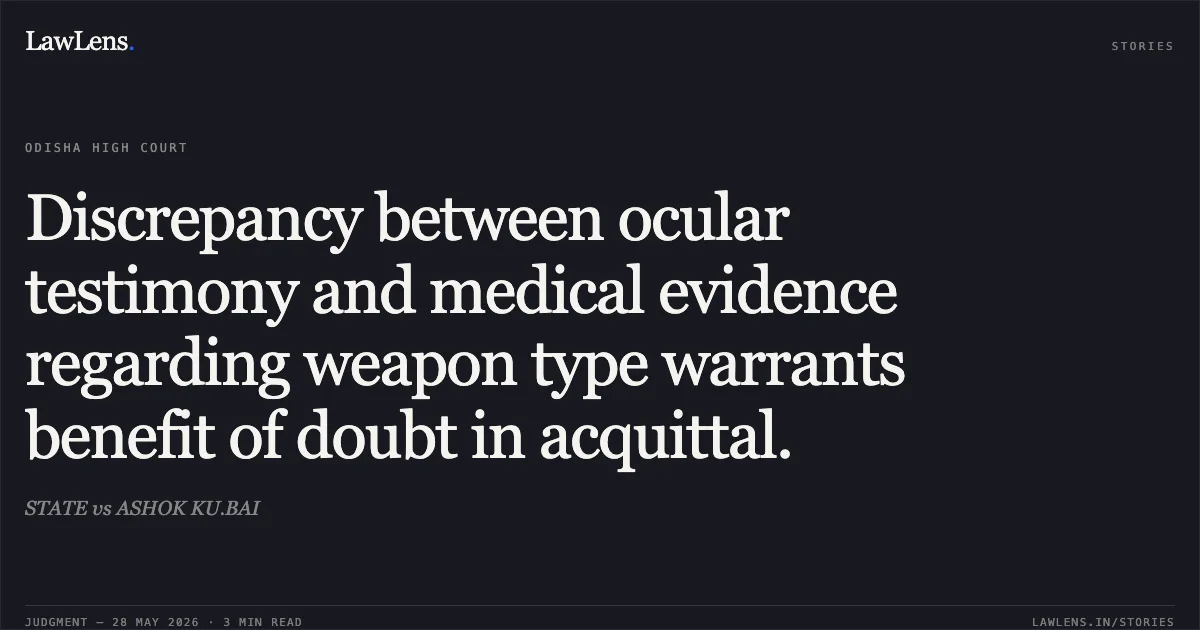
Source reference: p. 19On the assault charges, the Court noted a critical disconnect between the ocular testimony and medical evidence: while witnesses claimed a Tangia (sharp weapon) was used, the medical discharge certificate (Ext.1) recorded injuries caused by a "hard and blunt object".
Source reference: p. 23-24The Court observed that the prosecution failed to elicit an expert opinion on whether the blunt side of the axe could have caused such wounds.
Source reference: p. 24Furthermore, the investigation was found to be deficient: the Investigating Officer (P.W.7) never visited the hospitals, failed to seize original medical records (relying only on a photocopy), and did not examine the actual treating doctors.
Source reference: p. 24-25P.W.4’s status as an eyewitness was also doubted because he admitted during cross-examination to being inside a room while the assault occurred outside.
Source reference: p. 20Holding
The Court dismissed the Criminal Leave Petition and refused leave to appeal, affirming the judgment of acquittal.
It held that the cumulative effect of the hostile witnesses, the material contradictions between the weapon and injury type, and the lack of reliable medical testimony created substantial reasonable doubt.
Source reference: p. 25-26The Court concluded that in an appeal against acquittal, if two views are possible, the view favorable to the accused must be upheld unless the trial court's view is "wholly unsustainable".
Source reference: p. 17-18, 26Acts & Sections Cited
7 provisions across 2 statutes referred to in this judgment. Each provision opens on LawLens.
Indian Penal Code, 18604
Code of Criminal Procedure, 19733
Original Court PDF
STATEvsASHOK KU.BAI
Click to open original judgment
Original judgment, available to read, download and summarize on LawLens.in