Facts
The respondent instituted Regular Civil Suit No. 14 of 2026 before the Principal Civil Judge, Satlasana, involving a dispute concerning the parties’ land boundaries and construction allegedly made by the petitioner.
Source reference: paras. 2, 6; pp. 1–2, 4On the respondent’s application below Exhibit 6, the trial court invoked Order XXVI Rule 9 of the Code of Civil Procedure, 1908 (“CPC”), and appointed a Court Commissioner to ascertain the actual position of the land and the construction thereon.
Source reference: paras. 2, 6; pp. 1–2, 4The petitioner challenged that order under Article 227 of the Constitution, contending that the commission was intended to collect evidence rather than assist the court in elucidating the dispute.
Source reference: para. 3; p. 2During the proceedings, the trial court rejected the petitioner’s injunction application, noting discrepancies between the boundaries described in the plaint and those in the sale deed.
Source reference: para. 3.1; p. 2The petitioner relied on Cryogas Equipment Private Limited v. Inox India Private Limited and Amarshibhai Hirabhai Rathod v. State of Gujarat.
Source reference: para. 3.2; p. 2Issues
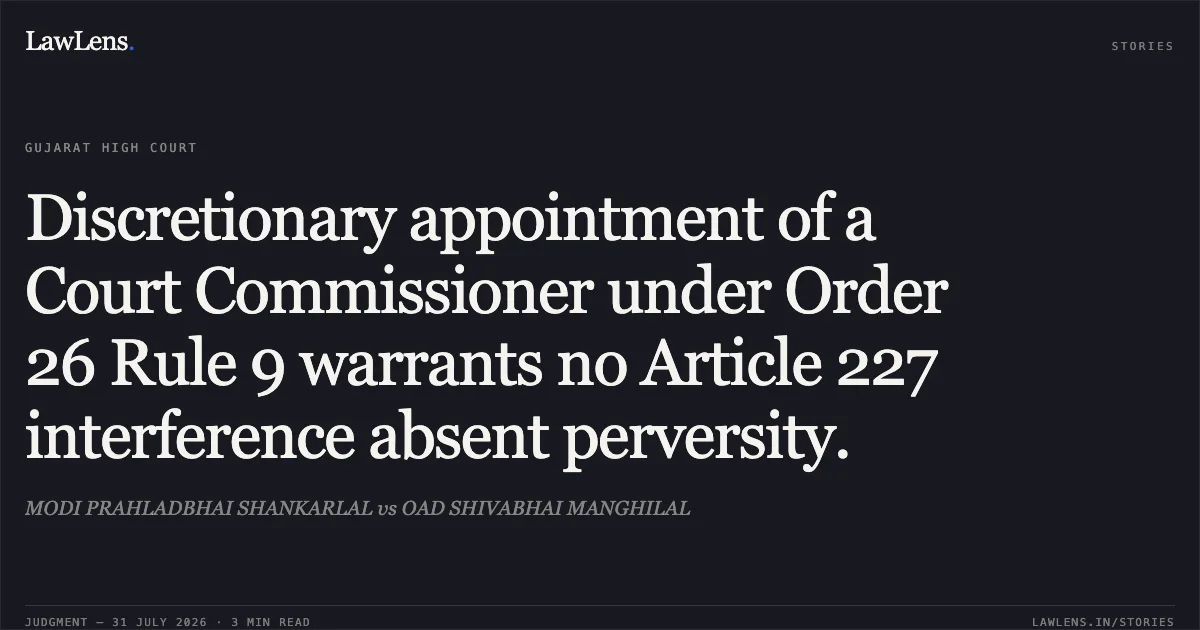
Whether the trial court was justified in appointing a Court Commissioner under Order XXVI Rule 9 CPC to ascertain the factual position of the disputed land, boundaries, and construction.
Source reference: paras. 3–4.1, 6; pp. 2–4Whether the impugned discretionary order disclosed perversity, gross error, or jurisdictional illegality warranting interference under Article 227 of the Constitution.
Source reference: paras. 4, 7–8; pp. 3–5Whether the precedents relied upon by the petitioner required setting aside the appointment of the Court Commissioner.
Source reference: para. 9; p. 5Law Applied
The court applied Order XXVI Rule 9 CPC, which permits appointment of a commission for local investigation where the court considers it necessary or proper to elucidate a matter in dispute, including the ascertainment of physical features and boundaries.
Source reference: paras. 6–8; pp. 4–5It further applied the supervisory jurisdiction under Article 227 of the Constitution, under which a discretionary interlocutory order of a trial court is not ordinarily interfered with unless it is perverse, grossly erroneous, or affected by jurisdictional illegality.
Source reference: para. 7; p. 4The court recognised the distinction between a commission appointed to clarify existing factual conditions and one appointed merely to enable a party to collect evidence.
Source reference: paras. 8–9; pp. 4–5The decisions in Cryogas Equipment Private Limited v. Inox India Private Limited, 2026 (0) GUJHC 25045, and Amarshibhai Hirabhai Rathod v. State of Gujarat, SCA No. 10071 of 2025, were distinguished on their facts.
Source reference: para. 9; p. 5Reasoning
The trial court had recorded a specific satisfaction that local investigation was necessary to determine the actual position of the disputed land and the construction allegedly made by the petitioner.
Source reference: para. 6; p. 4Since the underlying dispute concerned boundaries and the physical situation of the properties, the appointment of a Court Commissioner was held to fall within the permissible scope of Order XXVI Rule 9 CPC.
Source reference: paras. 6–8; pp. 4–5The High Court found that the order was neither perverse nor grossly erroneous and therefore declined to substitute its view for the trial court’s discretionary determination under Article 227.
Source reference: paras. 7–8; pp. 4–5The petitioner’s reliance on Cryogas was rejected because that case concerned protection of trade secrets in a copyright dispute, while Amarshibhai involved an impermissible attempt to collect evidence through a commission; neither situation existed in the present boundary-related dispute.
Source reference: para. 9; p. 5Holding
The High Court answered the issues against the petitioner.
It held that the trial court was justified in appointing the Court Commissioner under Order XXVI Rule 9 CPC for elucidating the disputed factual position and that no ground for interference under Article 227 was established.
Source reference: paras. 7–10; pp. 4–5The petition challenging the order dated 21 May 2026 passed below Exhibit 6 in Regular Civil Suit No. 14 of 2026 was dismissed, with no order as to costs.
Source reference: para. 10; p. 5Original Court PDF
MODI PRAHLADBHAI SHANKARLALvsOAD SHIVABHAI MANGHILAL
Click to open original judgment
Original judgment, available to read, download and summarize on LawLens.in