Facts
The Petitioner (Developer) issued an allotment letter to the Respondents (Complainants) for a flat in 2015.
Source reference: para. 11After the Respondents paid Rs. 45,15,844/-, the Petitioner terminated the allotment on 28 January 2016 and forfeited the amount due to alleged non-payment of balance consideration.
Source reference: para. 3.1 & 11The Respondents filed a complaint before the State Commission on 13 August 2018, which was returned on 16 April 2019 for lack of pecuniary jurisdiction, with a direction to file before the District Commission within one month.
Source reference: para. 3.2 & 11However, the Respondents filed a fresh complaint before the District Commission only on 22 July 2022.
Source reference: para. 11The District Commission and later the State Commission (in revision) condoned the delay, prompting the Petitioner to file this Writ Petition.
Source reference: para. 2 & 3.7Issues
1. Whether the delay in filing the complaint before the District Commission after its return by the State Commission was supported by "sufficient cause" warranting condonation.
Source reference: para. 182. Whether the Respondents were entitled to the benefit of Section 14 of the Limitation Act for the period spent litigating before the wrong forum.
Source reference: para. 12Law Applied
Section 14 of the Limitation Act, 1963, regarding the exclusion of time for bona fide proceedings in a court without jurisdiction.
Source reference: para. 12-13Consolidated Engg. Enterprises v. Principal Secy. Irrigation Department, which outlines the five conditions for Section 14 to apply.
Source reference: para. 13N. Balakrishnan v. M. Krishnamurthy, emphasizing that "sufficient cause" should receive a liberal construction to advance substantive justice and that superior courts should be loath to interfere with a lower court's positive exercise of discretion.
Source reference: para. 21State of Nagaland v. Lipok AO, noting that technicalities should not overshadow substantial justice.
Source reference: para. 22Basawaraj v. Special Land Acquisition Officer regarding the necessity of a rational explanation for delay.
Source reference: para. 23Reasoning
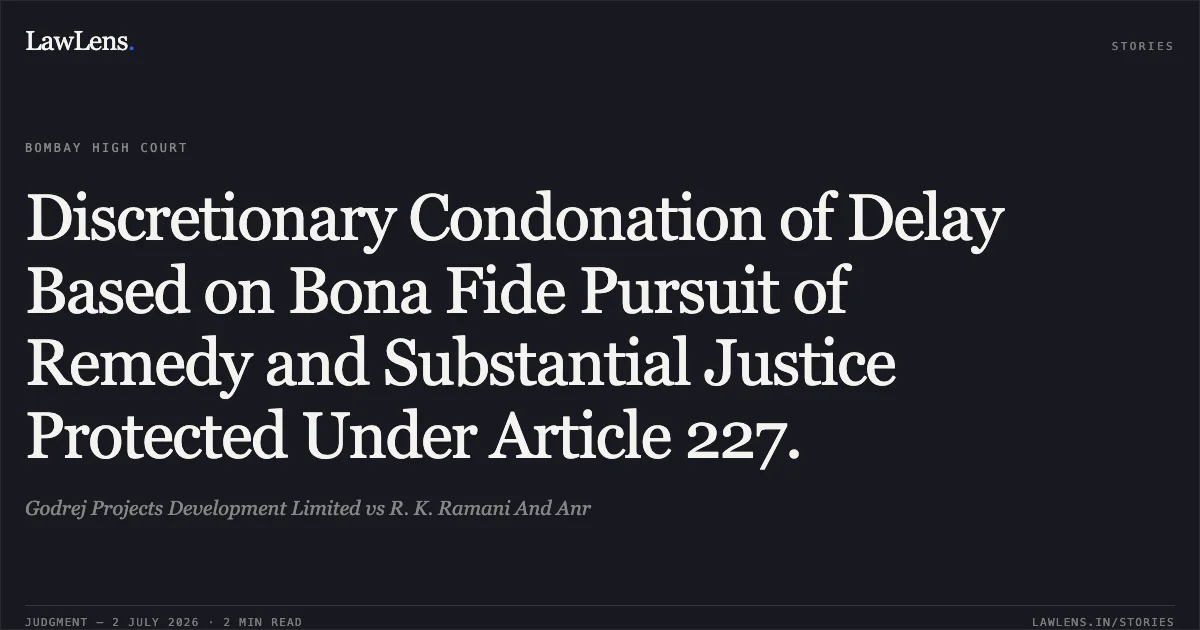
The court found that the Respondents satisfied the criteria for Section 14 of the Limitation Act, as they had diligently pursued the case in a forum they believed had jurisdiction.
Source reference: para. 13-14Regarding the specific delay between 2019 and 2022, the court accepted the Respondents' explanation that the delay was not deliberate but was caused by difficulties in retrieving the original case file and court fee refund from the State Commission—a claim supported by RTI documents dated 2022.
Source reference: para. 24The court also took judicial notice of the COVID-19 pandemic and the Supreme Court’s suo motu orders suspending limitation from 15 March 2020 to 28 February 2022.
Source reference: para. 25Given that Complainant No. 1 was a senior citizen who subsequently passed away after being infected with COVID-19, the court held that the District Commission's exercise of discretion to condone the delay was rational and not perverse.
Source reference: para. 26-27Holding
The court held that where a court of first instance exercises positive discretion to condone delay, revisional courts should not interfere unless the order is arbitrary or lacks reasons.
The High Court dismissed the Writ Petition and upheld the orders of the District and State Commissions condoning the delay; Rule discharged with costs.
Source reference: para. 27-28Acts & Sections Cited
1 provisions across 1 statute referred to in this judgment. Each provision opens on LawLens.
Consumer Protection Act, 20191
Original Court PDF
Godrej Projects Development LimitedvsR. K. Ramani And Anr
Click to open original judgment
Original judgment, available to read, download and summarize on LawLens.in