Facts
The Petitioner, a senior partner at an audit firm, challenged an order dated 26.04.2023 issued by the Respondent (ICAI) initiating disciplinary proceedings for professional misconduct under Sections 21, 21A, 21B, and 22 of the Chartered Accountants Act, 1949.
Source reference: p. 2The proceedings stemmed from an investigation by the Serious Fraud Investigation Office (SFIO) concerning fiscal years 2010-11 and 2011-12.
Source reference: p. 2The Petitioner contended that the proceedings were time-barred under Rule 12 of the 2007 Rules and that he was handicapped in defending himself due to the decade-long time lag and non-supply of complete records.
Source reference: p. 2-3Issues
1. Whether the disciplinary proceedings initiated against the Petitioner were liable to be quashed under Rule 12 of the 2007 Rules due to the lapse of more than seven years since the alleged misconduct.
Source reference: p. 3-4 / para. 92. Whether the Respondent's refusal to close the complaint was based on proper application of mind and recorded reasons.
Source reference: p. 5 / para. 13Law Applied
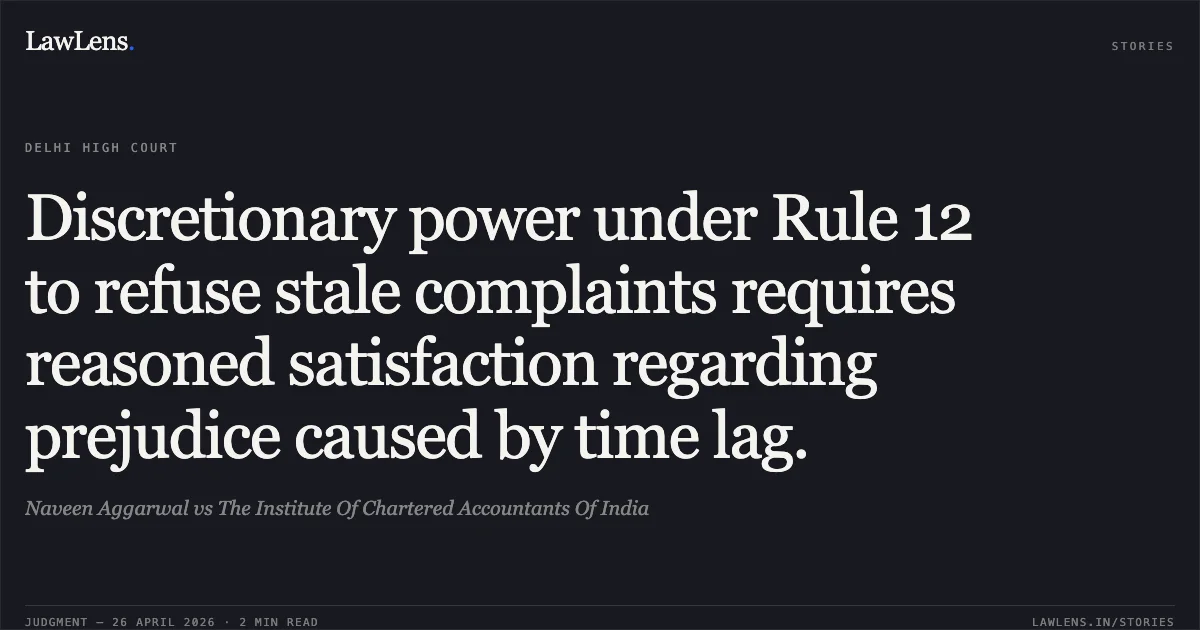
Rule 12 of the Chartered Accountants (Procedure of Investigations of Professional and Other Misconduct and Conduct of Cases) Rules, 2007, which grants the Director (Discipline) discretion to refuse to entertain a complaint made more than seven years after the alleged misconduct if there is difficulty in securing evidence or if the member finds it difficult to lead a defense due to the time lag.
Source reference: p. 4 / para. 8The precedent in Ashish Agarwal vs. ICAI established that the authority must record cogent reasons and consider whether the petitioner is "severely handicapped" before rejecting an objection under Rule 12.
Source reference: p. 5-6 / para. 15Reasoning
The Court observed that Rule 12 is a discretionary provision contingent upon the satisfaction of the Director.
Source reference: p. 5In this instance, the Court found that the Board had applied its mind, noting that the SFIO investigation was initiated via a 2018 Ministry of Corporate Affairs order and that a significant portion of evidence—including the Petitioner’s own statement and working papers—was already available with the ICAI.
Source reference: p. 4-5 / para. 10-12Unlike the precedent in Ashish Agarwal, where the objection was summarily rejected without discussion, the Respondent here provided sufficient reasoning as to why the inquiry was not procedurally inconvenient despite the time lag. The Court determined that since prima facie evidence existed, the Petitioner must justify his conduct during the inquiry rather than seeking an outright closure at the Rule 12 stage.
Source reference: p. 5-6Holding
The Court dismissed the plea to quash the proceedings, holding that the Respondent's decision not to invoke Rule 12 was justified and reasoned.
The Court directed the Respondent to provide the Petitioner with the entire material forming the basis of the allegations within 30 days and granted liberty to the Petitioner to file a revised reply and re-agitate the Rule 12 objection at the final stage of the inquiry.
Source reference: p. 6 / para. 18-19; p. 7 / para. 20-22Acts & Sections Cited
3 provisions across 2 statutes referred to in this judgment. Each provision opens on LawLens.
Chartered Accountants Act, 19492
Companies Act, 20131
Original Court PDF
Naveen AggarwalvsThe Institute Of Chartered Accountants Of India
Click to open original judgment
Original judgment, available to read, download and summarize on LawLens.in