Facts
The petitioners sought a review of an order dated 15.07.2026, which had allowed the withdrawal of a writ petition (W.P. No. 21807 of 2026) with liberty to file a representation.
Source reference: para. 1The initial dispute arose from the death of the first petitioner's wife, which military and local police concluded was due to natural medical causes.
Source reference: para. 2-3However, the respondent (the deceased's father) filed multiple complaints and a statutory application for an FIR, which was dismissed by a Magistrate and was pending revision at the time the writ was filed.
Source reference: para. 4The review petitioners alleged that the respondent obtained the previous order by suppressing these prior judicial proceedings and parallel litigations in other High Courts.
Source reference: para. 6Issues
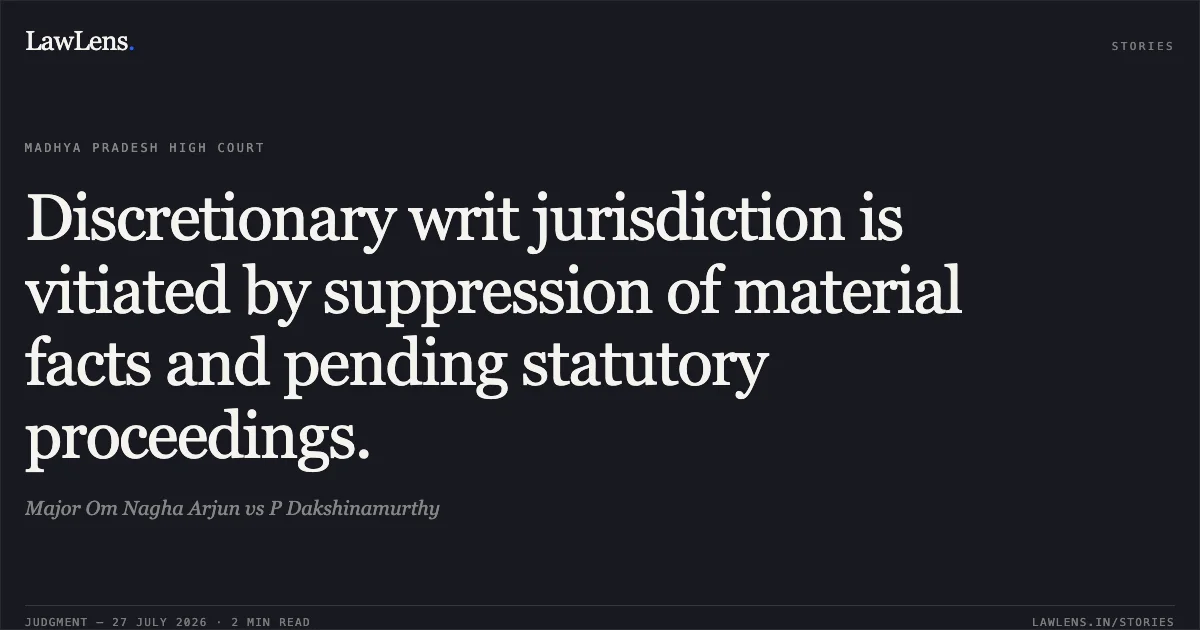
1. Whether the suppression of material facts and previous judicial proceedings by a litigant vitiates an order passed in exercise of discretionary jurisdiction under Article 226 of the Constitution.
Source reference: para. 102. Whether the court possesses the inherent authority to recall an order obtained through lack of full and candid disclosure.
Source reference: para. 15Law Applied
The court applied the equitable principles governing writ jurisdiction under Article 226 of the Constitution of India, which requires a petitioner to approach the court with "clean hands" and make full disclosure of all material facts.
Source reference: para. 12It relied on the precedent set in State of Punjab v. Davinder Pal Singh Bhullar (2011), establishing that suppression of material facts constitutes an abuse of the process of the court and renders any resulting order liable to be recalled.
Source reference: para. 16Reasoning
The court reasoned that writ jurisdiction is extraordinary and discretionary, resting entirely on the faith that the litigant is transparent.
Source reference: para. 12In this instance, the respondent failed to explicitly inform the court that his request for an FIR had already been rejected by a reasoned judicial order and was currently under revision, or that similar issues were being litigated in the Madras High Court.
Source reference: para. 11, 13The court rejected the argument that merely uploading documents or mentioning facts in electronic filing columns satisfied the "onerous obligation" of disclosure.
Source reference: para. 12, 14It held that such facts were crucial to determining the maintainability of the writ and the propriety of issuing directions, and their omission undermined the foundation of the court's earlier exercise of discretion.
Source reference: para. 13Holding
It held that an order obtained without specific and candid disclosure of relevant legal proceedings must be set aside to prevent the abuse of the judicial process.
The court allowed the review petition and recalled the order dated 15.07.2026. Consequently, the original writ petition was restored to its status for a fresh hearing on its merits, with all legal and factual contentions left open for future adjudication.
Source reference: para. 17-18Acts & Sections Cited
2 provisions across 2 statutes referred to in this judgment. Each provision opens on LawLens.
Code of Criminal Procedure, 19731
Bharatiya Nagarik Suraksha Sanhita, 20231
Original Court PDF
Major Om Nagha ArjunvsP Dakshinamurthy
Click to open original judgment
Original judgment, available to read, download and summarize on LawLens.in