01Facts
The petitioners, Hindustan Scouts and Guides Association (petitioner no. 1) and its National Chairman (petitioner no. 2), filed the present petition seeking to quash a Rejection Order dated November 25, 2022, passed by the respondent, Railways.
They sought parity and recognition, along with consequential benefits, on similar lines as Bharat Scouts and Guides.
p. 1The petitioner no. 1, registered as a 'Society' in 1998, is affiliated with the World Federation of Independent Scouts (WFIS), recognized by the United Nations.
p. 4It has been recognized by the Ministry of Youth Affairs and Sports (MOYA) since September 26, 2013, after an initial withdrawal and subsequent restoration of recognition.
p. 5Currently, petitioner no. 1 operates in 23 states with 13,15,350 scouts and guides.
p. 5The MOYA, in a letter dated June 13, 2016, clarified that only petitioner no. 1 and Bharat Scouts and Guides are recognized organizations for scouting and guiding in India and receive financial assistance.
p. 6 · pp. 27-28The respondent, Ministry of Railways, provides recruitment benefits under a Cultural-Cum-Scouts and Guides quota exclusively to Bharat Scouts and Guides.
p. 5The petitioners had previously approached the respondent for similar recognition and facilities in 2016 and 2020, but received no response.
p. 6Subsequently, they filed W.P.(C) 14845/2022, which led to an order dated October 20, 2022, directing the respondent to decide their representation.
p. 2The respondent, pursuant to this order, issued a Speaking Order dated November 25, 2022, rejecting the petitioners' representation for parity in recruitment benefits, leading to the current petition.
p. 3 · pp. 6-7The petitioners' claim for fare concession was withdrawn, confining the relief sought to parity in recruitment.
pp. 3-402Issues
i.1. Whether the petitioner no. 1 association has a right to be treated at par with Bharat Scouts and Guides in relation to the benefit of special quota for scouts and guides for recruitment in the Railways.
p. 4ii.2. Whether the Rejection Order dated November 25, 2022, issued by the Ministry of Railways, denying parity to the petitioner no. 1 association, is arbitrary, discriminatory, and in violation of Article 14 of the Constitution of India.
p. 36 · p. 4703Law Applied
The court primarily applied Article 14 of the Constitution of India, which guarantees equality before law and equal protection of law, requiring that "amongst equals the law should be equal and should be equally administered," and prohibiting discrimination between persons who are "substantially in similar circumstances or conditions".
Amita Versus Union of India and Another, (2005) 13 SCC 721 · pp. 31-32It further relied on the principle that differential treatment between similarly situated persons is permissible only if founded on an "intelligible differentia" that distinguishes the grouped from others and has a "rational relation to the object sought to be achieved".
Prem Chand SomChand Shah and Another Versus Union of India and Another, (1991) 2 SCC 48 · pp. 32-33 · State of West Bengal Versus Anwar Ali Sarkar, (1952) 1 SCC 1 · pp. 33-34 · Confederation of Ex-Servicemen Associations and Others Versus Union of India and Others, (2006) 8 SCC 399 · p. 35The court also highlighted that government departments cannot take "diagonally opposite stands" and must have a unified policy.
Central Warehousing Corporation Versus Adani Ports and Special Economic Zone Limited (APSEZL) and Others, (2022) 15 SCC 110 · p. 39Additionally, it emphasized that public employment must be fair, transparent, and impartial.
Amrit Yadav Versus State of Jharkhand and Others, 2025 SCC OnLine SC 280 · pp. 41-42Financial constraints are not a valid ground for denying rights under Article 14.
Haryana State Minor Irrigation Tubewells Corporation and Others Versus G.S. Uppal and Others, (2008) 7 SCC 375 · pp. 46-4704Reasoning
The Court found that both the petitioner no. 1 association and Bharat Scouts and Guides are similarly placed given their identical aims and objectives in youth development, community service, and adventure, and their shared recognition and financial aid from the Ministry of Youth Affairs and Sports (MOYA).
p. 27 · pp. 30-31The MOYA itself explicitly stated that both organizations are the only two recognized for scouting and guiding in India due to the large population.
p. 28 · p. 30Consequently, the respondent Ministry of Railways' exclusion of petitioner no. 1 from the "cultural-cum-scouts and guides quota" for recruitment, while extending it to Bharat Scouts and Guides, constituted clear discrimination.
p. 36The respondent's arguments for differentiation lacked an "intelligible differentia" with a "rational nexus to the object sought to be achieved".
p. 35The Court rejected the respondent's contention that international affiliation with WOSM (World Organization of the Scout Movement) was a valid distinguishing factor, noting that MOYA does not mandate such an affiliation for recognition in India and that WOSM's constitution is not binding on Indian authorities.
pp. 37-38 · p. 40The respondent's plea of financial constraint was dismissed as an unacceptable reason to deny rights under Article 14.
pp. 46-47The Court emphasized that allowing petitioner no. 1 members to apply for the quota would not obligate an increase in seats but would promote merit-based selection by increasing competition, aligning with the objective of securing the most suitable persons for public service.
pp. 45-46The contradictory stance between the Ministry of Railways and MOYA on recognizing scouting organizations was held to be impermissible, as governments are expected to maintain a unified policy.
pp. 38-3905Holding
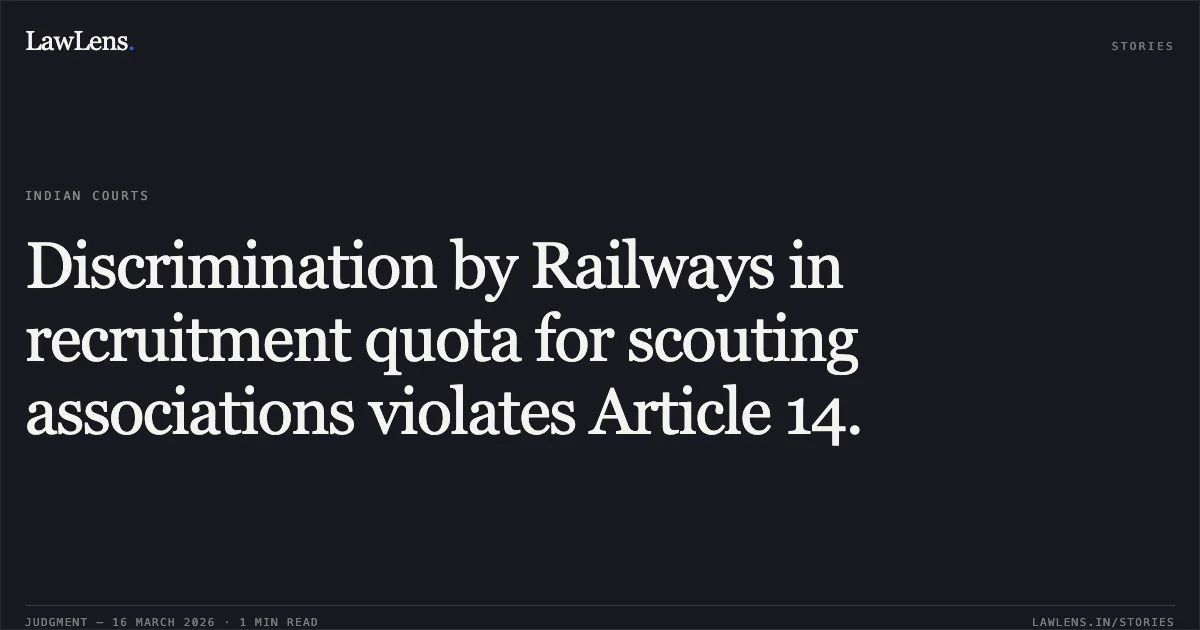
The Court concluded that the denial of the quota reservation to the petitioner no. 1 association was discriminatory and arbitrary, violating Article 14 of the Constitution of India.
pp. 47-48There was no intelligible differentia to justify treating the petitioner no. 1 association differently from Bharat Scouts and Guides.
p. 48Accordingly, the Court quashed the Speaking Order dated November 25, 2022.
¶ 58.I · p. 48The Court directed the respondent Ministry of Railways to extend the benefit of the quota reservation to the petitioner no. 1 association, equivalent to that provided to Bharat Scouts and Guides.
¶ 58.II · p. 48The petition was allowed.
¶ 59 · p. 48Original Court PDF
Hindustan Scouts And Guides Association Through Its National Secretary Champat SinghvsUnion Of India Through Ministry Of Railways
Click to open original judgment
Original judgment, available to read, download and summarize on LawLens.in