Facts
The Appellant, appointed as Sahayak Samiti Sevak in 1987, sought promotion to Society Manager
Source reference: para. 3Under the rules framed via Section 55(1) of the M.P. Cooperative Societies Act, 1960, the qualification for promotion was initially Higher Secondary, but new 2013 Rules mandated graduation
Source reference: para. 3.1, 3.6, 5.7Despite the Appellant’s 28 years of experience, the Registrar rejected the Society’s recommendation to relax the educational qualification for him under Rule 19-A
Source reference: para. 3.4, 5.3Conversely, two other employees with identical qualifications (Sushil Kumar Tripathi and Ram Swaroop Pandey) were granted relaxations and promoted
Source reference: para. 3.5, 7The Single Judge of the High Court allowed the Appellant’s writ petition on grounds of parity, but the Division Bench reversed this, holding that the Registrar had the discretion to refuse the relaxation as the Appellant lacked the prescribed qualification
Source reference: para. 2.3, 2.4, 8.1Issues
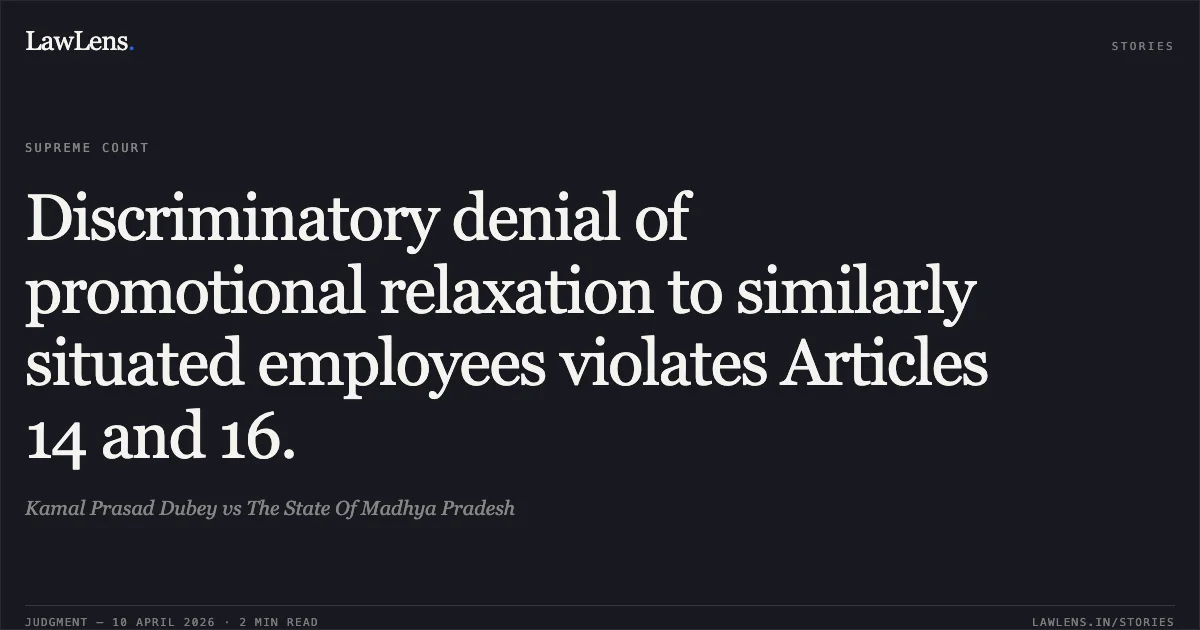
1. Whether the Registrar’s refusal to grant educational relaxation to the Appellant, while granting it to similarly situated employees, was arbitrary and discriminatory under Articles 14 and 16 of the Constitution
Source reference: para. 7.1, 9.12. Whether the Division Bench erred in upholding the Registrar’s order despite the Board of Directors having the primary discretion to recommend relaxation under the statutory rules
Source reference: para. 6.2, 8.2Law Applied
The court primarily applied the Service Rules (2013) framed under Section 55(1) of the Madhya Pradesh Cooperative Societies Act, 1960
Source reference: para. 3.1, 5.5Specifically, the Proviso to Rule 19-A empowers the Registrar to grant relaxation in educational qualifications for promotion based on an employee’s special experience, competence, or seniority
Source reference: para. 5.6The court further relied on the constitutional mandates of Articles 14 and 16, which prohibit arbitrary discrimination and ensure equal treatment in matters of public employment
Source reference: para. 9.1It emphasized that discretionary power must be exercised reasonably and that "discrimination is the other name of injustice"
Source reference: para. 2, 9Reasoning
The court reasoned that the Registrar’s decision was unsustainable due to patent discrimination and procedural irrationality.
Source reference: para. 5.1, 5.3, 6.2It observed that the Board of Directors—the competent authority—had passed a valid resolution for relaxation based on the Appellant's 28-year unblemished record, yet the Registrar rejected it through a cryptic, unreasoned order
Source reference: para. 5.1, 5.3, 6.2The court highlighted a violation of the principle of parity: two other employees with the same Higher Secondary qualification were approved for promotion, creating a homogeneous class from which the Appellant was arbitrarily excluded
Source reference: para. 7.1, 7.2The court found the Division Bench’s reasoning contradictory, as it acknowledged that discretion lay with the Board but simultaneously held the Registrar was right to ignore that discretion
Source reference: para. 8.2Furthermore, the court noted that the 2013 graduation requirement was subsequently lowered back to Higher Secondary in 2019, which the Appellant now satisfies
Source reference: para. 9.2, 9.3Holding
The Supreme Court allowed the appeals and set aside the Division Bench’s judgment and the order dismissing the Review Petition
The Court held that the Appellant was entitled to the relaxation of educational qualifications for promotion to Society Manager on the grounds of both merit (long service/seniority) and parity with similarly situated employees
Source reference: para. 8, 9.1The Registrar’s refusal was deemed a violation of Article 14 and 16, and the earlier order of the Single Judge directing the grant of promotion was effectively upheld
Source reference: para. 9.1, 10Acts & Sections Cited
1 provisions across 1 statute referred to in this judgment. Linked provisions open on LawLens.
M.P. Co-Operative Societies Act, 19601
Original Court PDF
Kamal Prasad DubeyvsThe State Of Madhya Pradesh
Click to open original judgment
Original judgment, available to read, download and summarize on LawLens.in