Facts
The petitioners purchased property from the informant for ₹1.75 crores, paying ₹29 lakhs as advance and issuing five postdated cheques for the balance (₹1.46 crores)
Source reference: p. 1Upon execution of the sale deed, the cheques were dishonored by the bank. The informant alleged that when he demanded payment, the petitioners abused and threatened him
Source reference: p. 1-2Consequently, Ramgarh P.S. Case No. 291/2024 was registered. After investigation, a chargesheet (No. 134/2025) was filed, and the Magistrate took cognizance under Sections 406, 420, 504, 506, and 34 of the IPC
Source reference: p. 1The petitioners moved the High Court under Section 528 of the BNSS, 2023, seeking to quash the proceedings, contending the matter was purely civil and lacked criminal ingredients
Source reference: p. 1-2Issues
1. Whether the dishonor of postdated cheques for the balance consideration of a registered sale deed constitutes offences under Sections 406 or 420 of the IPC.
Source reference: p. 3, para. 72. Whether the allegations of abusing and threatening the informant satisfy the essential ingredients of Sections 504 and 506 of the IPC.
Source reference: p. 3-4, para. 8-113. Whether the criminal proceedings constitute an abuse of the process of law by giving a "criminal cloak" to a purely civil dispute.
Source reference: p. 4, para. 12Law Applied
For Section 504 (Intentional Insult), the law requires intentional insult, provocation, and knowledge that such provocation would likely cause a breach of peace
Source reference: p. 3, para. 8For Section 506 (Criminal Intimidation), the law requires a threat of injury to person, reputation, or property with the intent to cause alarm
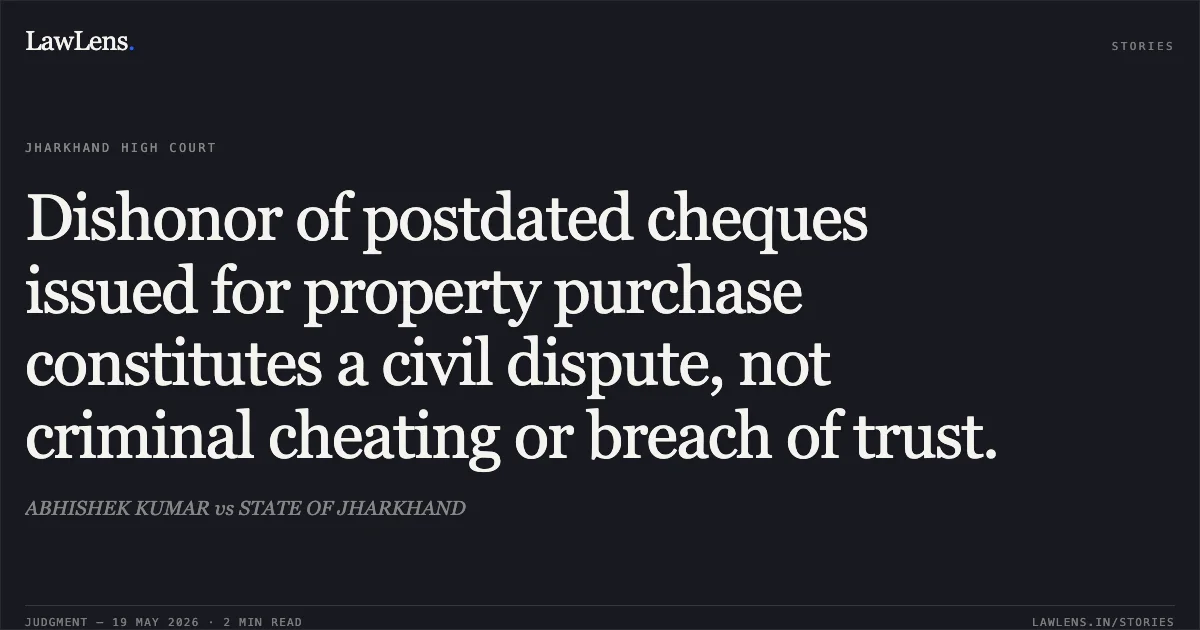
Source reference: p. 4, para. 10A mere breach of contract or dishonor of a cheque does not satisfy the requirements of Section 406 (Criminal Breach of Trust) or Section 420 (Cheating) unless dishonest intention exists at the inception
Source reference: p. 3, para. 7The Court invoked its inherent powers (Section 528 BNSS / Section 482 CrPC) to prevent the abuse of the process of law when a civil dispute is characterized as a criminal case
Source reference: p. 4, para. 12Reasoning
The Court observed that since the informant had already received a substantial advance (₹29 lakhs) and voluntarily executed the sale deed in exchange for postdated cheques, the subsequent dishonor of those cheques did not, by itself, attract the criminal provisions of Sections 406 or 420 of the IPC
Source reference: p. 3, para. 7Regarding Section 504, the Court found no evidence that the petitioners’ conduct was intended to provoke a breach of peace
Source reference: p. 3, para. 9For Section 506, the Court noted the absence of specific allegations of threats intended to cause "alarm" to the victim
Source reference: p. 4, para. 11The Court reasoned that the dispute was fundamentally civil—revolving around the recovery of the balance sale consideration—and that the informant was attempting to use the criminal machinery to settle a civil grievance for "wrecking vengeance"
Source reference: p. 4, para. 12Holding
The Court answered the issues in the negative, holding that the ingredients for the charged offences were not met even if the allegations were taken as true
The Court concluded that the continuation of the criminal proceeding would amount to an abuse of the process of law. Consequently, the High Court allowed the petition and quashed Chargesheet No. 134 of 2025, the order taking cognizance dated 09.06.2025, and the entire criminal proceeding in G.R. case no. 472 of 2025 against the petitioners
Source reference: p. 4, para. 12, 13-14Acts & Sections Cited
7 provisions across 3 statutes referred to in this judgment. Each provision opens on LawLens.
Bharatiya Nagarik Suraksha Sanhita, 20231
Indian Penal Code, 18605
Negotiable Instruments Act, 18811
Original Court PDF
ABHISHEK KUMARvsSTATE OF JHARKHAND
Click to open original judgment
Original judgment, available to read, download and summarize on LawLens.in


