Facts
The respondent/complainant alleged that he lent ₹5,00,000 to the petitioner in November 2011, of which ₹45,000 was repaid, leaving ₹4,55,000 outstanding. The petitioner allegedly issued HDFC Bank cheque no. 152182 dated 1 March 2012 for ₹4,55,000.
Source reference: pp. 2–4, paras. 2–4The cheque was presented on 28 May 2012 and dishonoured with the endorsement “account closed.” A statutory demand notice dated 12 June 2012 was served on the petitioner on 18 June 2012; he replied denying liability and alleging that his cheque leaves had been stolen. The complainant thereafter instituted proceedings under Section 138 of the Negotiable Instruments Act, 1881 (NI Act).
Source reference: pp. 2–4, paras. 2–4The Trial Court convicted the petitioner and sentenced him to three months’ simple imprisonment and a fine of ₹6,00,000. The Appellate Court affirmed the conviction on 30 August 2018.
Source reference: pp. 4–8, paras. 7–18In revision, the petitioner challenged the existence of the debt, relied on the alleged theft of his cheques and overwriting on the cheque, and contended that dishonour due to a closed account did not attract Section 138.
Source reference: pp. 9–10, paras. 20–23Issues
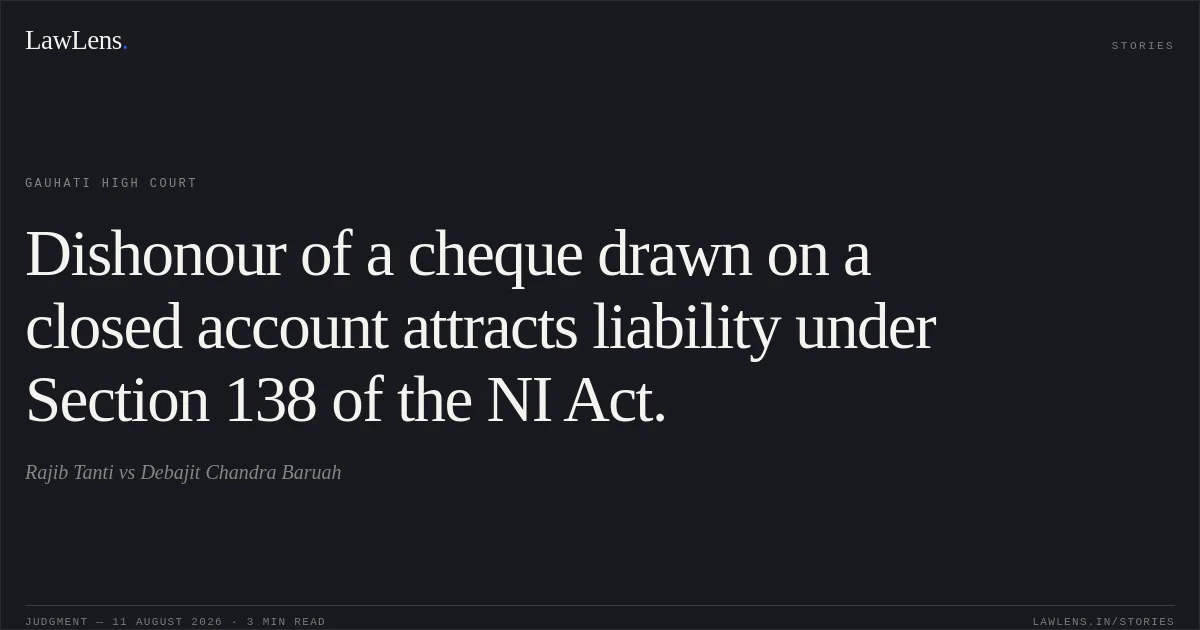
1. Whether dishonour of the cheque on the ground that the petitioner’s bank account was closed constituted an offence under Section 138 of the NI Act
Source reference: pp. 9–10, para. 21; p. 5, para. 132. Whether the cheque was issued by the petitioner in discharge of a legally enforceable debt or liability, thereby attracting the presumption under Section 139 of the NI Act
Source reference: pp. 4–6, paras. 6–123. Whether the petitioner successfully rebutted the statutory presumption by proving that the cheque leaves had been stolen or that the cheque had been materially manipulated
Source reference: pp. 4–8, paras. 8–184. Whether the concurrent findings of conviction warranted interference in revision under Sections 397/401 read with Section 482 of the CrPC
Source reference: p. 2, para. 1; p. 11, para. 28Law Applied
The Court applied Section 138 of the NI Act, which criminalises dishonour of a cheque issued towards discharge of a legally enforceable debt or liability, subject to fulfilment of the statutory notice and payment requirements.
Source reference: no citationUnder Section 139, a presumption arises that the holder received the cheque for discharge, wholly or partly, of a debt or liability; the accused may rebut it on a preponderance of probabilities.
Source reference: no citationThe Court relied on NEPC Micon Ltd. v. Magma Leasing Ltd., AIR 1999 SC 1952, for the principle that dishonour of a cheque because the drawer’s account was closed falls within the expression “the amount of money standing to the credit of that account is insufficient to honour the cheque” under Section 138.
Source reference: p. 5, para. 13Revisional jurisdiction under Sections 397/401 CrPC is limited and does not ordinarily permit reappreciation of concurrent factual findings unless there is perversity, illegality or material irregularity.
Source reference: p. 11, para. 28Reasoning
The Court held that the petitioner’s admission of his signature on the cheque attracted the presumption under Section 139.
Source reference: pp. 4–6, paras. 7–11The complainant’s capacity to lend the money was found plausible because he had been the petitioner’s manager and had known him for several years; the absence of a written loan document or independent witness was not considered sufficient to rebut the statutory presumption.
Source reference: pp. 7–8, para. 18The defence of theft was rejected because the petitioner failed to produce or prove the alleged GD entry, gave no satisfactory explanation for reporting the missing cheque book after more than a year, and did not establish that the complainant had stolen or misused the cheque.
Source reference: pp. 11–13, paras. 28–31The alleged overwriting in the numerical amount was immaterial because the amount was clearly written in words, and the petitioner’s conduct and admission of signature supported the complainant’s case.
Source reference: pp. 8, 11–13, paras. 18, 29–31Applying NEPC Micon, the Court further held that closure of the account did not take the cheque outside Section 138.
Source reference: p. 5, para. 13; p. 13, para. 31No legal or factual infirmity was found in the concurrent findings of the Trial Court and Appellate Court.
Source reference: p. 13, paras. 31–32Holding
The revision petition was dismissed, and the petitioner’s conviction under Section 138 of the NI Act was upheld.
However, considering the prolonged pendency of the matter, the Court modified the sentence by setting aside the three-month imprisonment and directing the petitioner to pay a fine of ₹5,50,000 within four months before the Trial Court.
Source reference: pp. 13–14, paras. 33–37In default, he was directed to undergo six months’ simple imprisonment.
Source reference: pp. 13–14, paras. 33–37Acts & Sections Cited
7 provisions across 2 statutes referred to in this judgment. Each provision opens on LawLens.
Code of Criminal Procedure, 19735
Negotiable Instruments Act, 18812
Original Court PDF
Rajib TantivsDebajit Chandra Baruah
Click to open original judgment
Original judgment, available to read, download and summarize on LawLens.in