Facts
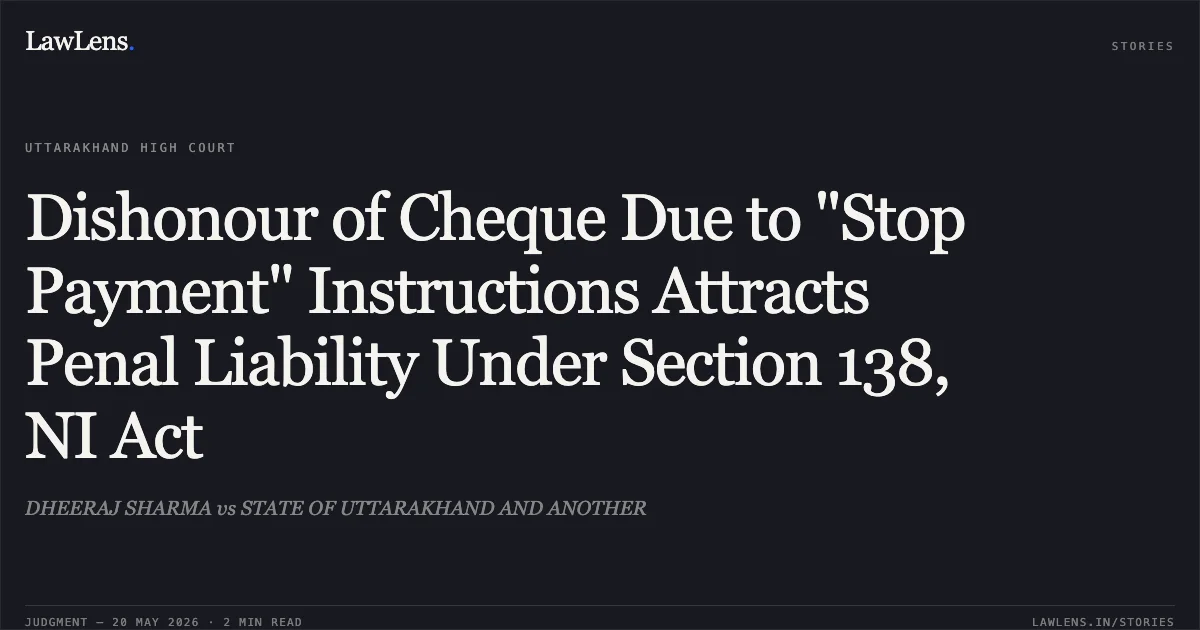
The Appellant (complainant) filed two complaint cases under Section 138 of the Negotiable Instruments (NI) Act against Respondent No. 2 (accused) asserting that cheques issued to discharge a legally enforceable debt were dishonored with the endorsement "Stop Payment"
Source reference: para. 1-3Despite statutory legal notices being served according to the presumptions under Section 27 of the General Clauses Act and Section 114 of the Evidence Act, the Respondent failed to liquidate the debt
Source reference: para. 4On July 18, 2016, the Judicial Magistrate IInd, Haridwar, acquitted Respondent No. 2
Source reference: para. 1The Appellant challenged this acquittal, arguing that the Trial Court ignored the mandatory statutory presumptions and erroneously placed the initial burden of proof entirely on the complainant despite the Respondent admitting to the signatures on the cheques
Source reference: para. 6-7Issues
1. Whether the Trial Court erred in law by failing to apply the statutory presumptions under Sections 118 and 139 of the NI Act once signatures on the cheques were admitted
Source reference: para. 17-182. Whether a dishonor with the endorsement "Stop Payment" attracts penal consequences under Section 138 of the NI Act
Source reference: para. 193. Whether the acquittal was based on a perverse appreciation of evidence requiring appellate interference
Source reference: para. 23-24Law Applied
The court primarily applied Section 138 of the Negotiable Instruments Act, which criminalizes the dishonor of cheques issued for the discharge of debt
Source reference: para. 1It relied on the "reverse onus" clauses under Section 118 (presumption of consideration) and Section 139 (presumption of debt) of the NI Act, which mandate that once execution is proved, the burden shifts to the accused to provide a probable defense
Source reference: para. 17it applied the precedent established in M/S Laxmi Dyechem v. State of Gujarat Ors. (2013), which holds that dishonor due to "stop payment" instructions constitutes an offense under Section 138 if foundational ingredients are met
Source reference: para. 19Reasoning
The High Court found that the Trial Court adopted a "wholly mechanical and perverse" approach by treating the burden of proof as resting solely on the complainant throughout the trial
Source reference: para. 6, 18The Court reasoned that since the cheques admittedly emanated from the Respondent's account and bore his signatures, a mandatory presumption of a legally enforceable debt arose
Source reference: para. 17The Respondent’s mere denial or vague explanations were insufficient to meet the threshold of a "probable defense" required to rebut these presumptions
Source reference: para. 20The High Court criticized the Trial Court for a "hyper-technical" scrutiny of the complainant’s case while ignoring that "stop payment" instructions do not extinguish criminal liability once the issuance of the cheque for a debt is established
Source reference: para. 19, 21The Court concluded that the findings were contrary to the legislative intent of the NI Act, which seeks to ensure commercial certainty
Source reference: para. 21Holding
The Court answered the issues in the affirmative, holding that the Trial Court’s acquittal suffered from manifest perversity and misapplication of settled legal principles
The High Court set aside the judgment dated July 18, 2016, and allowed the Criminal Appeal. The matter was remanded to the Trial Court for fresh adjudication in light of the statutory presumptions under Sections 118 and 139 of the NI Act, with a direction to conclude the proceedings within six months
Source reference: Order, p. 8-9Acts & Sections Cited
5 provisions across 3 statutes referred to in this judgment. Each provision opens on LawLens.
Code of Criminal Procedure, 19731
Negotiable Instruments Act, 18813
General Clauses Act, 18971
Original Court PDF
DHEERAJ SHARMAvsSTATE OF UTTARAKHAND AND ANOTHER
Click to open original judgment
Original judgment, available to read, download and summarize on LawLens.in


