Facts
The Petitioner, a Sweeper with the Jharkhand Armed Police (JAP-8), was dismissed from service following a departmental inquiry
Source reference: para. 2(i)The charge alleged that on December 10, 2011, the Petitioner entered the mess in an intoxicated state, verbally abused his superior, Company Commander Edward Minj, and assaulted him, causing the Commander to fall and suffer a leg fracture
Source reference: para. 4The Petitioner contended that the Commander was actually the one intoxicated and fell accidentally due to lose footing on wooden logs
Source reference: para. 2(v)The inquiry officer found the charges proved, leading to the Petitioner's dismissal on March 28, 2012
Source reference: para. 5which was subsequently upheld by the Appellate Authority on February 21, 2013
Source reference: para. 6Issues
Whether the disciplinary proceedings suffered from a violation of the principles of natural justice
Source reference: para. 24(i)Whether the findings of the inquiry officer and disciplinary authority were perverse or unsupported by evidence
Source reference: para. 24(ii)Whether the order of dismissal was justified and if the case warranted a remand to the authorities after a lapse of 14 years
Source reference: para. 24(iii-iv)Whether the Petitioner is entitled to back wages and consequential benefits
Source reference: para. 24(v)Law Applied
The court relied on the limits of judicial review under Article 226 as defined in Union of India v. P. Gunasekaran, which prohibits re-appreciation of evidence unless the finding is based on "no evidence" or is "perverse"
Source reference: para. 19-22It applied the principle of Natural Justice as an inbuilt statutory requirement established in Maneka Gandhi v. Union of India
Source reference: para. 27and State of U.P. v. Saroj Kumar Sinha
Source reference: para. 28Regarding perversity, it applied the definition from Arulvelu v. State, where a finding is perverse if it ignores relevant material or defies logic
Source reference: para. 35On the issue of back wages, the court applied the exceptions to the "No Work No Pay" rule from Union of India v. K.V. Jankiraman
Source reference: para. 53and Deepali Gundu Surwase v. Kranti Junior Adhyapak Mahavidyalaya, which hold that if an employee is illegally kept away from work, they are entitled to back wages
Source reference: para. 55Reasoning
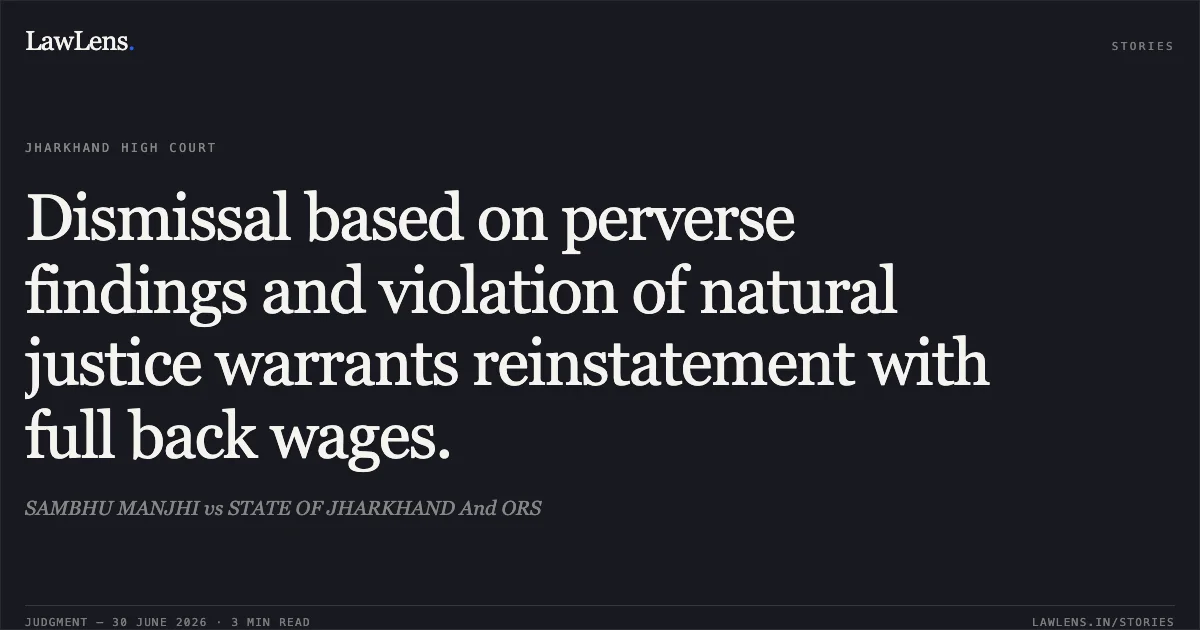
The Court found that the disciplinary authority failed to provide the Petitioner with the inquiry officer's findings or an opportunity to respond before imposing dismissal, constituting a gross violation of natural justice
Source reference: para. 26Upon reviewing the evidence, the Court noted that the medical report only mentioned an "alcoholic smell" and "semi-unconsciousness" without confirming intoxication
Source reference: para. 30and crucial eyewitnesses (Police 860 and Police 153) testified during cross-examination that the Commander fell because his leg got stuck in wood, not because of an assault by the Petitioner
Source reference: para. 31-32The Court held that the inquiry officer's conclusion was "perverse" as it ignored this exculpatory evidence
Source reference: para. 33, 36Furthermore, the Court declined to remand the matter because 14 years had elapsed since the incident, and remitting it would cause undue mental trauma
Source reference: para. 45-46Since the termination was found to be a "foisted false charge" and a result of the employer's wrongdoing, the Petitioner was deemed eligible for an exception to the "No Work No Pay" doctrine
Source reference: para. 66-70Holding
The Court allowed the writ petition and quashed the dismissal order dated March 28, 2012, and the appellate order dated February 21, 2013
The Court held that the Petitioner is entitled to reinstatement in service with continuity of service and full back wages from the date of dismissal
Source reference: para. 73, 75The Respondents were directed to treat the Petitioner as if he was never punished
Source reference: para. 1, 73Acts & Sections Cited
1 provisions across 1 statute referred to in this judgment. Linked provisions open on LawLens.
Industrial Disputes Act, 19471
Original Court PDF
SAMBHU MANJHIvsSTATE OF JHARKHAND And ORS
Click to open original judgment
Original judgment, available to read, download and summarize on LawLens.in