Facts
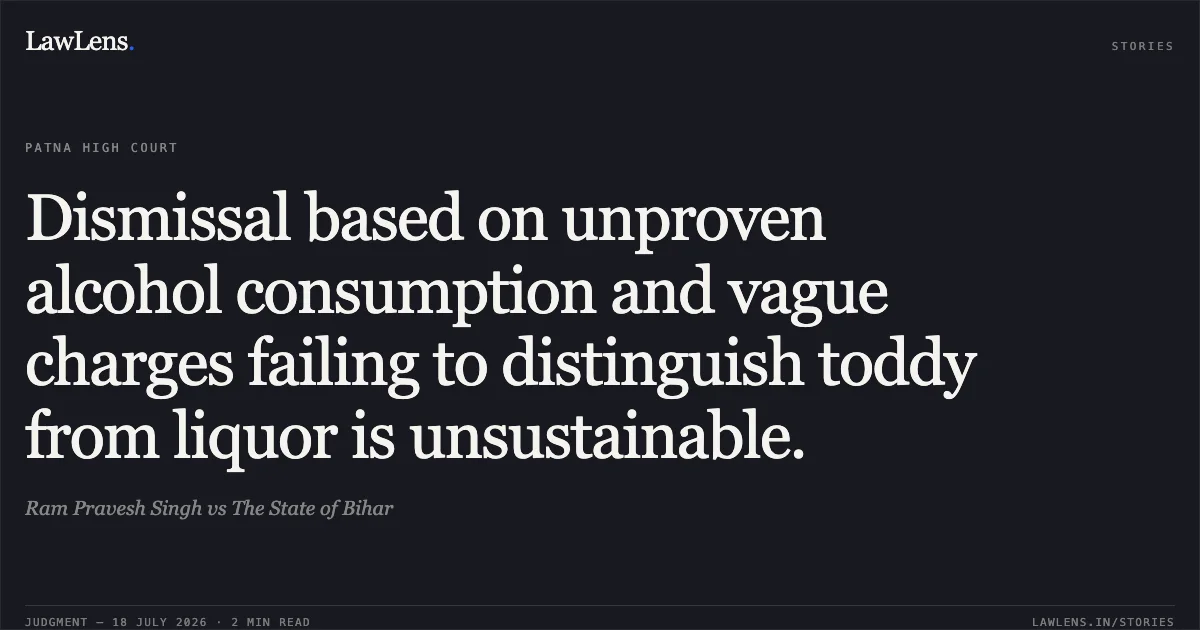
The petitioner, a Police Constable (PTC), was dismissed from service following a departmental inquiry initiated after the registration of Pakribarawan P.S. Case No. 377 of 2019 under Section 37(c) of the Bihar Prohibition and Excise Act, 2016.
Source reference: para. 2-3The prosecution alleged that the petitioner was found in an intoxicated state at the police station gate. A breath analyzer test allegedly showed alcohol consumption, and a Medical Officer noted the "smell of toddy".
Source reference: para. 3The petitioner contended he consumed toddy on medical advice and that toddy is not "liquor" under the prohibited category.
Source reference: para. 5Despite these defenses, the Disciplinary Authority dismissed him on 29.05.2020.
Source reference: para. 6His subsequent statutory appeal and memorial were rejected.
Source reference: para. 2, 7Issues
1. Whether the findings of the Inquiry Officer and the Disciplinary Authority were based on legally admissible evidence or were perverse in nature.
Source reference: para. 13-152. Whether the departmental proceedings were vitiated due to a vague charge memo and the non-production of the primary evidence (breath analyzer report).
Source reference: para. 21, 23, 30Law Applied
Principles of judicial review in disciplinary matters as established in Kuldeep Singh v. Commissioner of Police Others (1999), which permits interference if findings are perverse or based on "no evidence".
Source reference: para. 13Jurisdictional boundaries of Article 226 as per Union of India v. P. Gunasekaran (2015).
Source reference: para. 15The principle that a "smell of alcohol" is insufficient to prove intoxication without scientific blood/urine analysis as held in Bachubhai Hassanalli Karyani v. State of Maharashtra (1971).
Source reference: para. 22The doctrine that a document (like an FIR or report) does not prove itself unless its contents are proved by a witness as per Roop Singh Negi v. Punjab National Bank (2009).
Source reference: para. 26The Bihar Neera (Unfermented Juice of Palms) Rules, 2017, distinguishing regulated palm juice from prohibited liquor.
Source reference: para. 29Reasoning
The Court found the inquiry report to be based on "no evidence" because the department failed to exhibit the breath analyzer report or examine the technician who conducted the test.
Source reference: para. 21, 26The only medical evidence available—the Medical Officer's testimony—confirmed the smell of toddy, not alcohol.
Source reference: para. 20, 27The Court held that the disciplinary authority committed a jurisdictional error by dismissing the petitioner for "consuming alcohol" when the evidence only suggested "toddy," and no specific charge regarding toddy consumption had been framed.
Source reference: para. 28The Court observed that the authorities ignored the petitioner’s request to examine his defense witness (a medical practitioner) without valid reasons, violating principles of natural justice.
Source reference: para. 24Since the charges were vague and contradicted by the medical report, the findings were deemed perverse.
Source reference: para. 30Holding
The Court answered the issues in the affirmative, holding that the dismissal was legally unsustainable.
The High Court quashed the dismissal order dated 29.05.2020, the appellate order dated 29.04.2021, and the memorial rejection order dated 21.07.2023, and directed that all consequential benefits (including retiral benefits) be granted to the petitioner.
Source reference: para. 9, 31, 32-33Acts & Sections Cited
2 provisions across 1 statute referred to in this judgment. Each provision opens on LawLens.
BIHAR PROHIBITION AND EXCISE ACT, 20162
Original Court PDF
Ram Pravesh SinghvsThe State of Bihar
Click to open original judgment
Original judgment, available to read, download and summarize on LawLens.in